

Key Takeaways
Nutrient Density
Nutrient density refers to the amount of beneficial nutrients — vitamins, minerals, fiber, protein, and beneficial fats — a food provides relative to its calorie count. A nutrient-dense food delivers significant nutritional value without a disproportionately high calorie load. The concept helps shift focus from simply counting calories to evaluating the overall quality of what you eat.
Dietitians sometimes use formal scoring tools such as the Nutrient Rich Foods Index to quantify nutrient density across food categories, though everyday application requires no calculation.
Why Calorie Counting Alone Misses the Picture
For decades, popular diet culture focused almost exclusively on calorie totals — the idea that a calorie is a calorie, regardless of its source. While energy balance genuinely matters for body weight, this framework says nothing about whether a meal is actually nourishing you. Two foods can share an identical calorie count yet differ enormously in what they deliver to your body.
Consider 200 calories from plain white crackers versus 200 calories from canned salmon. The crackers supply refined starch and little else. The salmon brings high-quality protein, omega-3 fatty acids, vitamin D, and B12. Your body processes both, but only one is doing significant nutritional work. This gap is what nutrient density is designed to capture.
For a broader foundation on how different foods fit into a balanced diet, the beginner's guide to eating well covers core concepts in plain language.
What Makes a Food Nutrient Dense?
A food earns a high nutrient density profile when it supplies meaningful amounts of micronutrients — vitamins, minerals — and beneficial macronutrients like fiber, quality protein, or healthy fats, without delivering a disproportionate calorie load. No single nutrient defines density; it is the overall nutritional package relative to energy content that matters.
~10%
Of U.S. adults meet daily vegetable intake recommendations
According to CDC data, fewer than one in ten American adults consume the recommended amount of vegetables daily — foods that are among the most nutrient-dense available.
57%
Of American calories come from ultra-processed foods
Research published in BMJ Open estimated that ultra-processed foods account for more than half of daily calorie intake for many U.S. adults — foods that tend to score low on nutrient density measures.
4x
More micronutrients in whole grains vs. refined grains
Refining grains strips away the bran and germ, removing much of the fiber, B vitamins, and minerals — illustrating how processing can sharply reduce nutrient density.
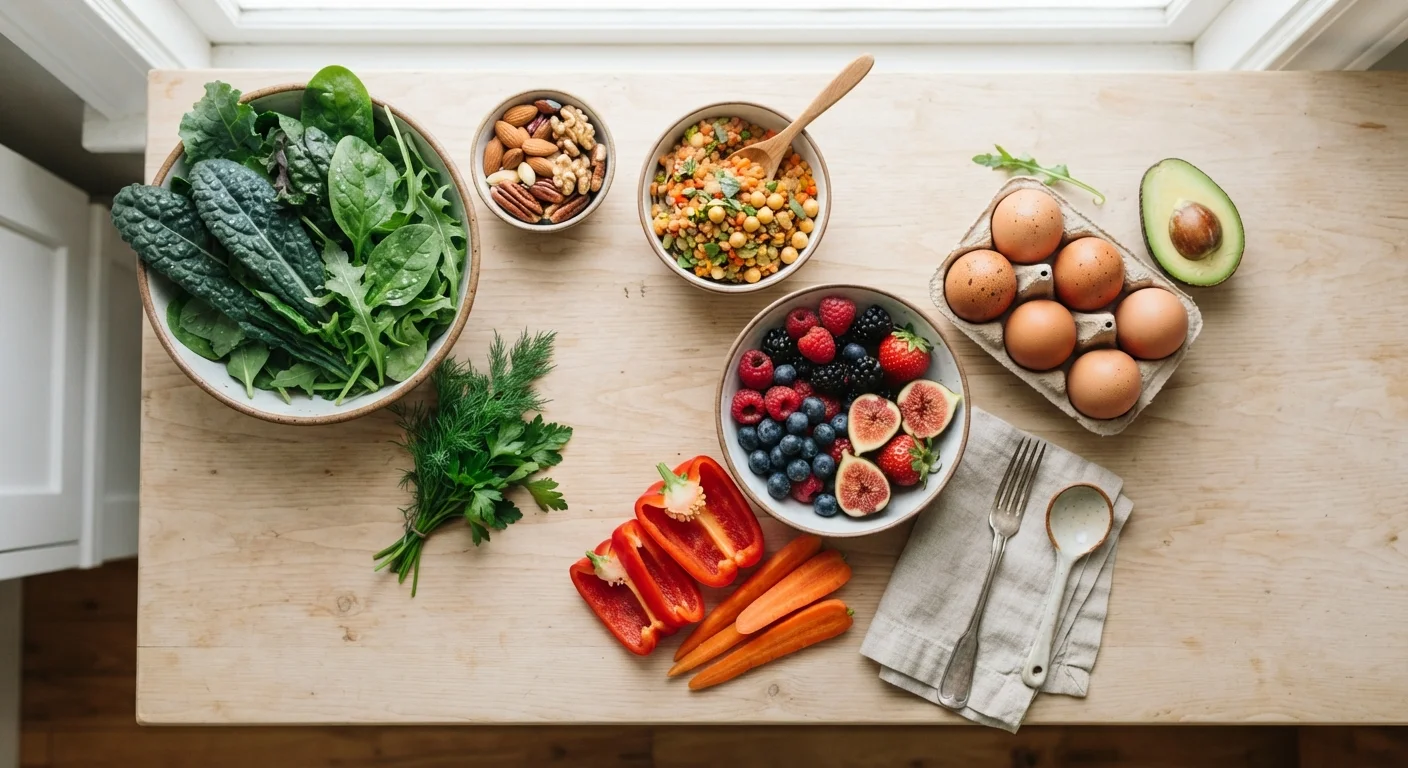
Foods that consistently rank well by this measure include:
- Dark leafy greens (kale, spinach, Swiss chard) — rich in folate, iron, vitamin K, and magnesium for minimal calories
- Legumes (lentils, black beans, chickpeas) — high in protein, fiber, iron, and complex carbohydrates
- Fatty fish (salmon, sardines, mackerel) — concentrated sources of omega-3s, vitamin D, and complete protein
- Eggs — supply choline, B vitamins, and protein in a compact package
- Berries — deliver antioxidants and fiber with a modest calorie count
- Nuts and seeds — calorie-dense but rich in healthy fats, vitamin E, and minerals
Understanding the roles of carbohydrates, proteins, and fats within these foods is equally useful — macronutrients decoded breaks down how each one functions in the body.
Putting Nutrient Density to Work at the Grocery Store
You do not need a scoring algorithm to apply nutrient density thinking in practice. A few consistent habits move you in the right direction.
A Simple Rule of Thumb at the Store
When comparing two similar products, check how many vitamins and minerals (shown as % Daily Value on the label) each provides relative to its calorie count. The one offering more micronutrient coverage per calorie is the denser choice. Even small differences add up across multiple daily food decisions.
Prioritize the perimeter, then shop strategically inside. Fresh produce, proteins, and dairy tend to cluster around grocery store perimeters. Packaged foods in the center aisles are not inherently bad — canned beans, frozen vegetables, and whole grains are nutrient-dense options — but ultra-processed snack foods and sweetened beverages deserve closer scrutiny.
Use the nutrition label as a quick density check. Look at the percent daily values for vitamins and minerals, then compare that to the calorie count per serving. A food offering 15–20% of several key nutrients for 150 calories is doing more nutritional work than one offering negligible daily values for the same calories. The guide to reading nutrition labels walks through exactly how to interpret those figures. You can also apply this approach comparatively — the label comparison approach is useful when choosing between similar packaged products.
Swap incrementally, not dramatically. Replacing white rice with a mix of brown rice and lentils, or swapping a sweetened yogurt for plain Greek yogurt with fresh fruit, shifts nutrient density upward without overhauling your entire diet at once.
Keeping Nutrient Density in Context
Nutrient density is a useful lens, not a rigid hierarchy. Enjoying foods with lower density — a slice of birthday cake, a handful of chips — has no meaningful impact on overall health when the broader dietary pattern is sound. Dietary quality is determined by habitual choices over weeks and months, not individual meals.
It is also worth noting that some people have specific micronutrient needs shaped by age, health status, or life stage — including pregnancy, older adulthood, or managing a chronic condition — that may require guidance beyond general principles. A registered dietitian can translate nutrient density concepts into a plan suited to individual circumstances.
“The goal of dietary guidance should not simply be to reduce calories, but to ensure that the calories people eat are doing real nutritional work — delivering the vitamins, minerals, and other compounds that support health over a lifetime.”
— Walter Willett, Professor of Epidemiology and Nutrition, Harvard T.H. Chan School of Public Health
Finally, nutrient density pairs well with adequate hydration. Water supports nutrient absorption and digestion in ways that affect how effectively your body uses the foods you eat — a dynamic explored in depth in the article on hydration and nutrition.
This article is for general informational and educational purposes only and is not a substitute for professional medical or dietary advice. Consult a qualified healthcare provider or registered dietitian before making significant changes to your diet, particularly if you have a medical condition or specific health concerns.