

Key Takeaways
Our Verdict
No single attic insulation type wins outright — the right choice depends on your attic's layout, existing insulation, air-sealing needs, and budget. Blown-in cellulose or fiberglass handles most typical attic floors well, while spray foam is the go-to where air sealing is critical. Batts suit straightforward DIY scenarios with standard framing.
| Best for | Recommended |
|---|---|
| Homeowners with irregular or cluttered attic floors | Blown-in (loose-fill) insulation |
| DIYers with standard joist spacing and a modest budget | Fiberglass batt insulation |
| Attics needing both air sealing and high R-value in tight spaces | Spray foam insulation |
| Sealing discrete areas like attic hatches or knee walls | Rigid foam board |
Why Attic Insulation Type Matters More Than You Might Expect
Attics are responsible for a significant share of a home's heat loss in winter and heat gain in summer. Simply adding more insulation isn't always enough — the type you choose affects how well gaps and air leaks get addressed, how durable the insulation remains over time, and whether a DIY installation is realistic for your situation.
The four main types — blown-in (loose-fill), batt, spray foam, and rigid board — each have distinct physical properties that make them better suited to certain attic conditions. Understanding these differences helps you match the material to your space rather than defaulting to whatever is most familiar or cheapest upfront.
R-38 to R-60
Recommended attic insulation range for most US climates
The U.S. Department of Energy publishes zone-specific R-value recommendations based on climate and heating fuel type.
~15%
Estimated share of home heat loss through the ceiling/attic
The DOE estimates that air sealing combined with adequate attic insulation can meaningfully reduce home heating and cooling loads.
Blown-In (Loose-Fill): The Flexible All-Rounder
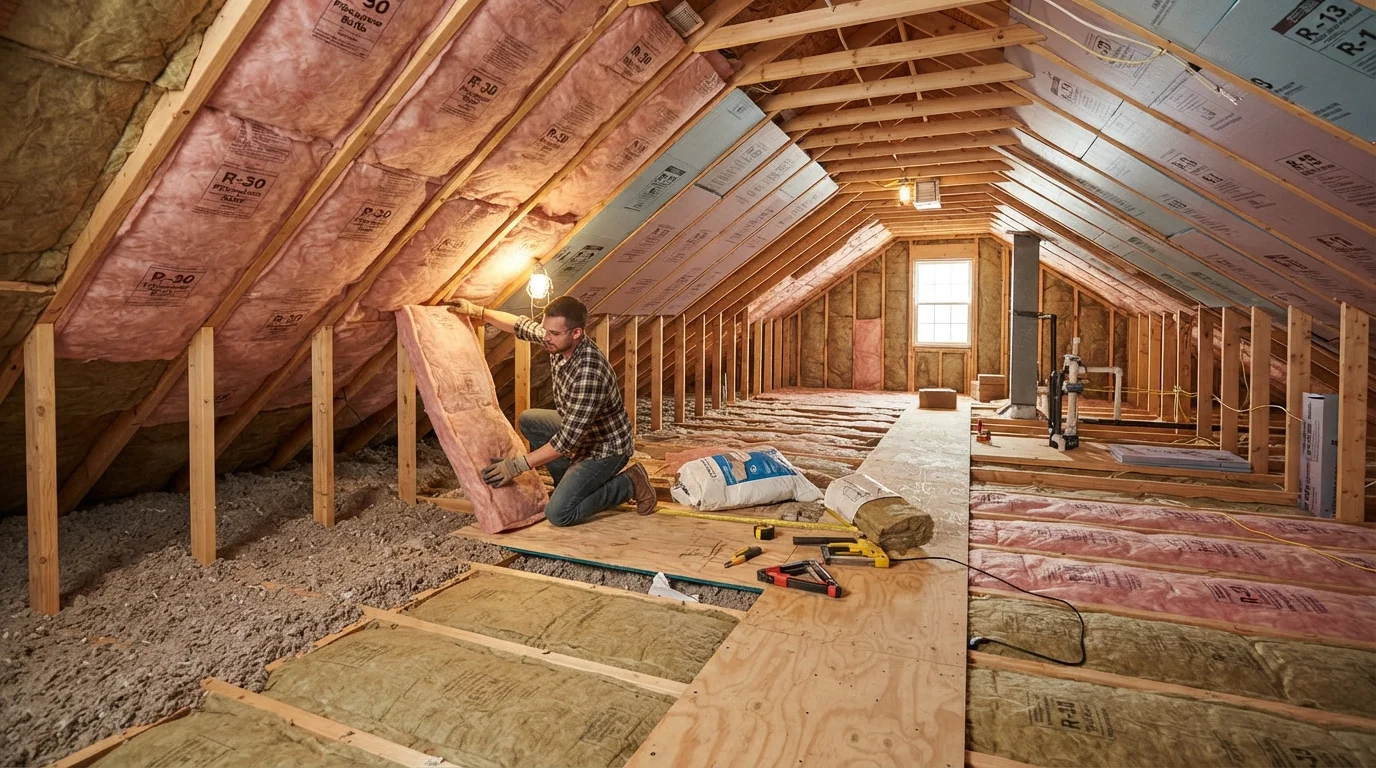
Blown-in insulation — available in fiberglass or cellulose — is installed using a blowing machine that fills cavities with small, loose particles. This makes it particularly effective at conforming around obstructions like wiring, pipes, and irregular framing.
Cellulose (made largely from recycled paper) offers an R-value of roughly R-3.2 to R-3.8 per inch and has good air-resistance properties. Fiberglass loose-fill reaches around R-2.5 per inch and is moisture-resistant, making it a practical choice in humid climates.
Blown-in is the most common choice for topping up existing attic insulation and is available as a DIY option at many home improvement retailers, which often loan blowing machines with material purchase. That said, achieving a consistent depth across the entire attic floor requires care and a depth gauge.
Seal Air Leaks Before Adding Insulation
Whether you choose blown-in or any other type, air sealing should come first. Common attic leak points include gaps around recessed lights, plumbing penetrations, and top plates of interior walls. Use canned spray foam or caulk to seal these areas before adding insulation — otherwise, even a high R-value material won't perform to its rated potential.
Batt Insulation: Straightforward but Sensitive to Fit
Fiberglass or mineral wool batts come in pre-cut widths designed to fit between standard 16-inch or 24-inch joist spacing. They're among the more accessible DIY options — no specialized equipment needed — and are widely available in R-values from R-11 up to R-38 per layer.
The critical limitation of batts is their dependence on a precise, gap-free fit. Any compression, gaps, or areas where the batt doesn't fully contact the framing can significantly reduce effective performance. Attics with non-standard joist spacing, obstructions, or lots of corners are poor candidates for batts.
Compression Reduces Batt Performance Significantly
Stuffing a thicker batt into a shallower cavity compresses the fibers and lowers the actual R-value delivered. Always use batts rated for the depth of your joist cavity — doubling up with two appropriately sized layers is far more effective than forcing an oversized batt into place.
Mineral wool batts offer slightly better fire resistance and moisture tolerance than fiberglass and are worth considering in attics with any moisture history.
Spray Foam: Highest Performance, Least DIY-Friendly
Spray polyurethane foam (SPF) comes in two forms: open-cell (around R-3.7 per inch) and closed-cell (around R-6 to R-7 per inch). Closed-cell spray foam also acts as a vapor barrier and provides structural rigidity — properties that make it uniquely suited for sealing cathedral ceilings, rafters, or any area where air infiltration is the core problem.
Because spray foam expands and cures rapidly, and because improper mixing or application can result in off-gassing and adhesion failures, professional installation is strongly recommended. DIY spray foam kits exist for small-area repairs but are not practical for whole-attic application. Costs are considerably higher than other types, but the combination of insulation and air-sealing in one step can offer long-term energy efficiency gains.
Rigid Foam Board: Targeted Applications
Rigid foam panels (available in EPS, XPS, and polyisocyanurate varieties) are not typically used to insulate an entire attic floor, but they excel in targeted applications: insulating attic hatches or pull-down stair covers, sealing knee walls in finished attics, and adding continuous insulation to rafters in cathedral or conditioned attic scenarios.
R-values range from R-3.8 per inch (EPS) to as high as R-6.5 per inch (polyisocyanurate). Panels can be cut with a utility knife and adhered or mechanically fastened, making targeted DIY work manageable. One important note: many rigid foam products require a fire-rated covering (such as drywall) when installed in living or occupied spaces — check local building codes before proceeding.
| Blown-In | Batt | Spray Foam | Rigid Board | |
|---|---|---|---|---|
| R-value per inch | R-2.5 to R-3.8 | R-3.1 to R-4.3 | R-3.7 to R-7 | R-3.8 to R-6.5 |
| DIY suitability | Moderate | High | Low | Moderate |
| Air sealing ability | Low | Very low | Excellent | Good (with tape) |
| Handles irregular spaces | Excellent | Poor | Excellent | Poor |
| Relative material cost | Low to moderate | Low | High | Moderate to high |
| Typical best application | Attic floors, top-up | New attics, standard framing | Rafters, tight spaces | Hatches, knee walls |
Just as comparing product types carefully before committing applies to insulation, it holds true in other home decisions too — much like the structured approach outlined in comparing mattress types without marketing noise.