

Key Takeaways
Why the Nutrition Facts Label Exists
The Nutrition Facts label is a federally standardized panel required by the U.S. Food and Drug Administration (FDA) on most packaged foods. It was designed to give consumers consistent, comparable information — and a significant update in 2016 (phased in through 2020) brought the format in line with current nutrition science, adding a dedicated line for added sugars and updating Daily Values for several nutrients.
Reading the label effectively is less about memorizing numbers and more about understanding the structure. If you're new to thinking about food and nutrition, our foundational nutrition guide provides helpful background on macronutrients and dietary patterns before you dive into label reading.
What you will need
Step-by-Step: Reading the Label
Work through these steps each time you pick up a packaged food, and the process will become second nature within a few grocery runs.
Start with serving size and servings per container
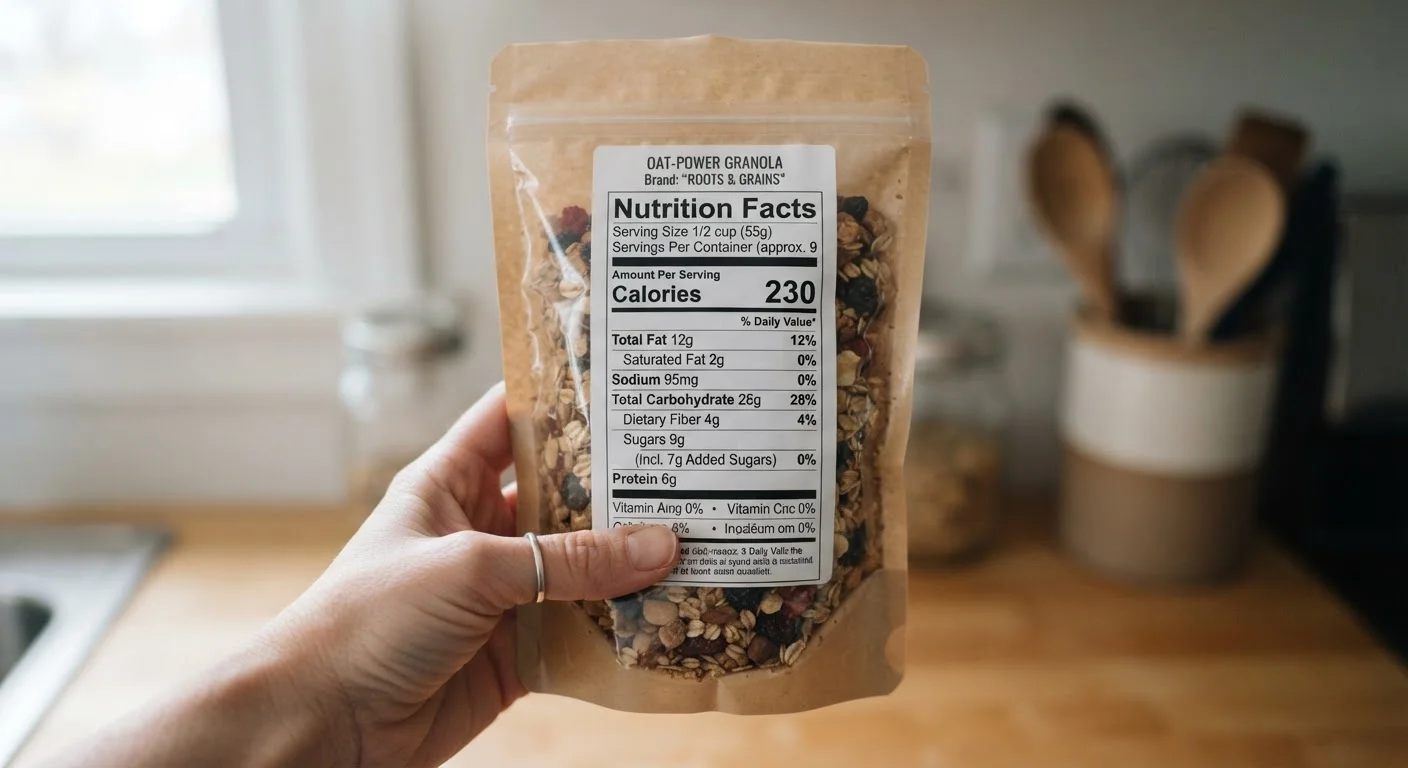
The very first section of any Nutrition Facts panel lists the serving size and the number of servings in the package. Every calorie count and nutrient value on the label is calculated for one serving — not the entire package.
Check whether the serving size matches how much you actually eat. A bag of chips may list a serving as 15 chips, but if you typically eat twice that, every number on the label effectively doubles for your consumption.
Read the calorie count in context
Calories tell you how much energy one serving provides. The FDA's general guidance uses 2,000 calories per day as a reference point for adults, but individual calorie needs vary considerably based on age, sex, body size, and activity level.
Rather than fixating on a single number, use the calorie count alongside the nutrient breakdown below it to assess whether a food is delivering meaningful nutrition for its calorie contribution — a concept known as nutrient density. See our guide to nutrient density for more on this approach.
Understand the % Daily Value column
The % Daily Value (%DV) column is one of the most useful — and most misunderstood — features of the label. It shows what percentage of a nutrient's recommended daily intake one serving provides, based on a 2,000-calorie reference diet.
- 5% DV or less is generally considered low for a nutrient.
- 20% DV or more is generally considered high.
Use this as a quick compass: aim for higher %DVs in nutrients you want more of (fiber, vitamins, minerals) and lower %DVs in those most people consume in excess (sodium, saturated fat, added sugars).
Identify nutrients to limit
Current dietary guidance consistently identifies a few nutrients that many Americans tend to consume above recommended levels:
- Saturated fat: Linked to cardiovascular risk when consumed in excess; found in fatty meats, full-fat dairy, and many processed foods.
- Sodium: High intake is associated with elevated blood pressure in many people.
- Added sugars: The label now distinguishes added sugars from naturally occurring ones. Our article on added sugars and where they hide explains why this distinction matters.
Look for nutrients to prioritize
The updated FDA label (rolled out from 2020 onward) highlights nutrients many Americans fall short on. These include:
- Dietary fiber: Supports digestive health and has been linked to cardiovascular and metabolic benefits. Most U.S. adults consume well below the recommended amount — our fiber guide covers practical food sources.
- Vitamin D, calcium, iron, and potassium: These four are required on all U.S. labels because population-wide shortfalls are well documented.
For a broader overview of vitamins and minerals, see our reference on essential micronutrients.
Scan the ingredient list
Ingredients are listed in descending order by weight. The first ingredient is present in the largest amount; the last, the smallest. A few quick reads:
- If a refined grain, sugar, or oil appears in the first two or three spots, those components dominate the food.
- Added sugars appear under many names — look for terms ending in -ose (glucose, fructose, dextrose), as well as syrups, concentrates, and honey.
- Shorter ingredient lists are not automatically healthier, but they can be easier to interpret quickly.
Use the Label as a Comparison Tool
When choosing between two similar products, align the labels to the same serving size before comparing numbers. Small differences in serving size can make one option look significantly better or worse than it actually is. Standardizing your comparison takes seconds and produces a much more accurate picture.
Putting the Label in Broader Context
A nutrition label describes one food in isolation. Dietary health, however, is shaped by overall eating patterns — what you eat across days and weeks, not a single purchase decision. Our guide to building a balanced plate offers a practical framework for thinking about meals as a whole rather than as collections of isolated numbers.
If you want to use labels to compare similar products side-by-side at the store, see our companion piece on reading labels as a comparison shopper. And for a periodic check on your broader dietary habits, our weekly nutrition self-check provides useful prompts.
Front-of-Package Claims Are Not Regulated the Same Way
Terms like "low-fat," "light," or "natural" printed on the front of a package have specific or sometimes loose regulatory definitions and can be misleading. Always cross-reference any front-of-package claim with the actual Nutrition Facts panel and ingredient list before drawing conclusions about a food's nutritional quality.
This article is for general informational and educational purposes only and is not a substitute for personalized medical or dietary advice. Consult a qualified healthcare professional or registered dietitian for guidance tailored to your individual health needs.