

Key Takeaways
Our Verdict
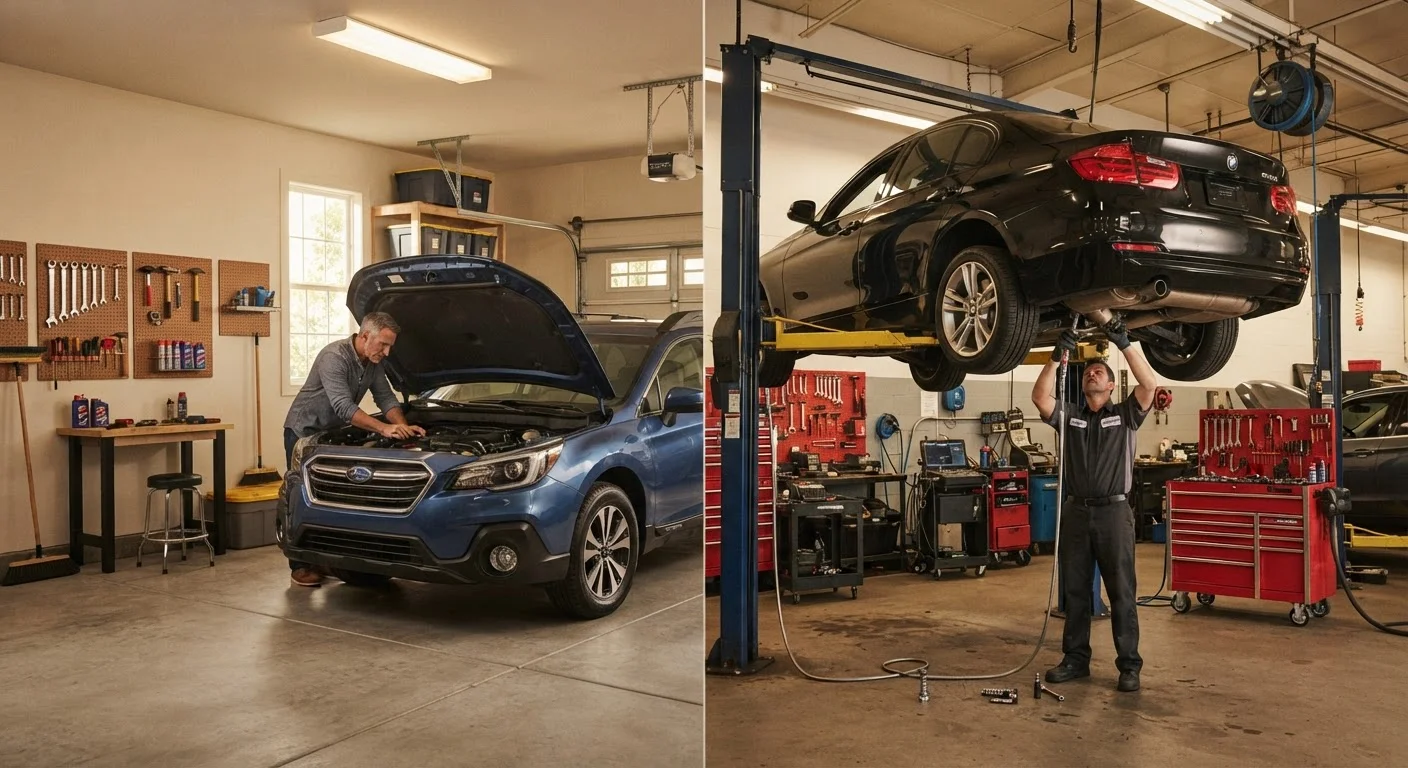
Most drivers can confidently handle basic fluid checks, filter swaps, wiper replacements, and battery changes at home. However, anything touching braking performance, steering geometry, fuel delivery, or advanced electronics carries enough risk — to your safety and your vehicle — that professional service is the smarter choice. The line between DIY and shop work is less about saving money and more about honest self-assessment.
| Best for | Recommended |
|---|---|
| Drivers comfortable with basic tools and routine upkeep | DIY in the garage |
| Safety-critical systems like brakes, suspension, and airbags | Qualified mechanic |
| Vehicles still under factory or extended warranty | Qualified mechanic |
| Diagnosing dashboard warning lights and complex fault codes | Qualified mechanic |
The Real Question Behind Every DIY Decision
Every driver eventually faces the same moment: something needs attention on the car, and the first instinct is to wonder whether this is a YouTube tutorial away from being solved or a situation that demands a professional. The honest answer is that both options have a legitimate place — the mistake is applying the wrong one.
The decision hinges on three factors: the complexity of the task, the consequences of getting it wrong, and the tools and space you realistically have available. Understanding those boundaries makes you a more capable car owner, not a less confident one. For a broader view of how maintenance milestones stack up, see Your Car's Maintenance Schedule, Explained.
Tasks Most Drivers Can Reasonably Handle at Home
A meaningful range of maintenance jobs require modest mechanical ability, common hand tools, and a flat driveway. Handled carefully, these are low-risk, high-value tasks for the home mechanic.
- Engine air filter replacement: Typically involves unclipping a housing, swapping the filter, and reseating the cover. Most vehicles make this accessible in minutes.
- Wiper blade replacement: Straightforward on nearly every vehicle, with clear packaging instructions and no tools required on most models.
- Battery replacement: Manageable for most drivers, though modern vehicles with memory-save functions benefit from a memory saver tool to avoid resetting electronics.
- Cabin air filter swap: Usually behind the glove box or under the dashboard — often easier than the engine filter.
- Checking and topping off fluids: Engine oil, coolant, brake fluid, power steering fluid, and washer fluid all have clearly marked reservoirs. Monitoring them regularly is one of the highest-value habits a driver can build.
- Tire pressure adjustment: A quality gauge and a compressor make this a two-minute task that meaningfully affects fuel economy and tire wear.
Parts quality matters even on simple jobs. OEM vs. Aftermarket Auto Parts can help you choose components that hold up without overpaying.
Start Simple and Build Confidence Gradually
If you're new to home maintenance, begin with tasks like air filter replacements and fluid top-offs before attempting anything that involves disassembling components. Each successful job builds the practical knowledge and situational awareness that makes the next task safer. Keep a basic record of what you've done — it helps at the shop, too.
Where the Shop Earns Its Labor Rate
Some jobs look approachable in a tutorial but carry consequences for error that go well beyond inconvenience. These are the tasks where professional training, specialized equipment, and liability accountability genuinely matter.
- Brake system work: Pad replacement appears straightforward, but improper caliper compression, uneven torque on caliper bolts, or contaminated rotors can compromise stopping distance. Brake lines and hydraulic components raise the stakes further.
- Wheel alignment: Requires precision laser equipment that no home garage has. Misalignment causes tire wear and affects vehicle handling in ways that compound over time.
- Suspension components: Struts, control arms, and ball joints require spring compression tools and specific torque sequences. Errors here affect both handling and structural integrity.
- Timing belt or chain service: On interference engines, a timing error can destroy the engine. This is a task where even mechanically capable enthusiasts often defer to a shop.
- Airbag and SRS system work: Any work near airbag components risks accidental deployment, which can cause serious injury. Always leave SRS work to trained technicians.
- Advanced electrical and module programming: Modern vehicles rely on networked control modules that require dealer-grade or professional scan tools to calibrate after replacement.
Never Compromise Safety-Critical Systems
Brakes, steering, and suspension directly determine your ability to control the vehicle in an emergency. If you are uncertain about any step during work on these systems, stop and consult a qualified mechanic before driving the vehicle. No tutorial or cost savings justifies putting yourself or others at risk on the road.
Deferred professional service often compounds costs significantly. Why Skipping Small Repairs Often Becomes an Expensive Habit illustrates how a modest repair ignored can multiply into a major expense.
How to Compare Your Options Clearly
| DIY at Home | Professional Shop | |
|---|---|---|
| Typical cost | Parts cost only | Parts plus labor |
| Tools required | Basic hand tools for most tasks | Specialized equipment for many jobs |
| Safety risk if done incorrectly | Low on simple tasks; higher on complex ones | Minimized by training and accountability |
| Warranty implications | Possible complications on covered vehicles | Generally preserves warranty coverage |
| Diagnostic capability | Limited to consumer OBD-II readers | Professional-grade scan and programming tools |
| Best suited for | Filters, fluids, wipers, battery | Brakes, suspension, timing, electrical modules |
One frequently overlooked consideration is warranty coverage. If your vehicle is under a factory or extended warranty, certain repairs performed outside an authorized facility — or with non-approved parts — can complicate future claims. Review your warranty documentation before doing DIY work beyond basic consumables.
New owners building their first maintenance routine will find practical guidance in Car Ownership for First-Timers: Building a Maintenance Routine.
Making an Honest Assessment of Your Skill Level
The gap between watching a repair video and successfully performing that repair is real. DIY automotive work rewards patience, methodical thinking, and the willingness to stop when something doesn't look right. It punishes overconfidence and shortcuts.
Before starting any task, ask: Do I have the correct tools — not approximate substitutes? Do I have a safe, stable work surface? Do I understand what a successful outcome looks like, and what a warning sign looks like mid-job? If the answer to any of those is uncertain, the shop is the right call — not a fallback, but the informed choice.
Car Maintenance Myths That Cost Drivers Money can also help you avoid acting on outdated advice that inflates your costs or creates unnecessary work.