

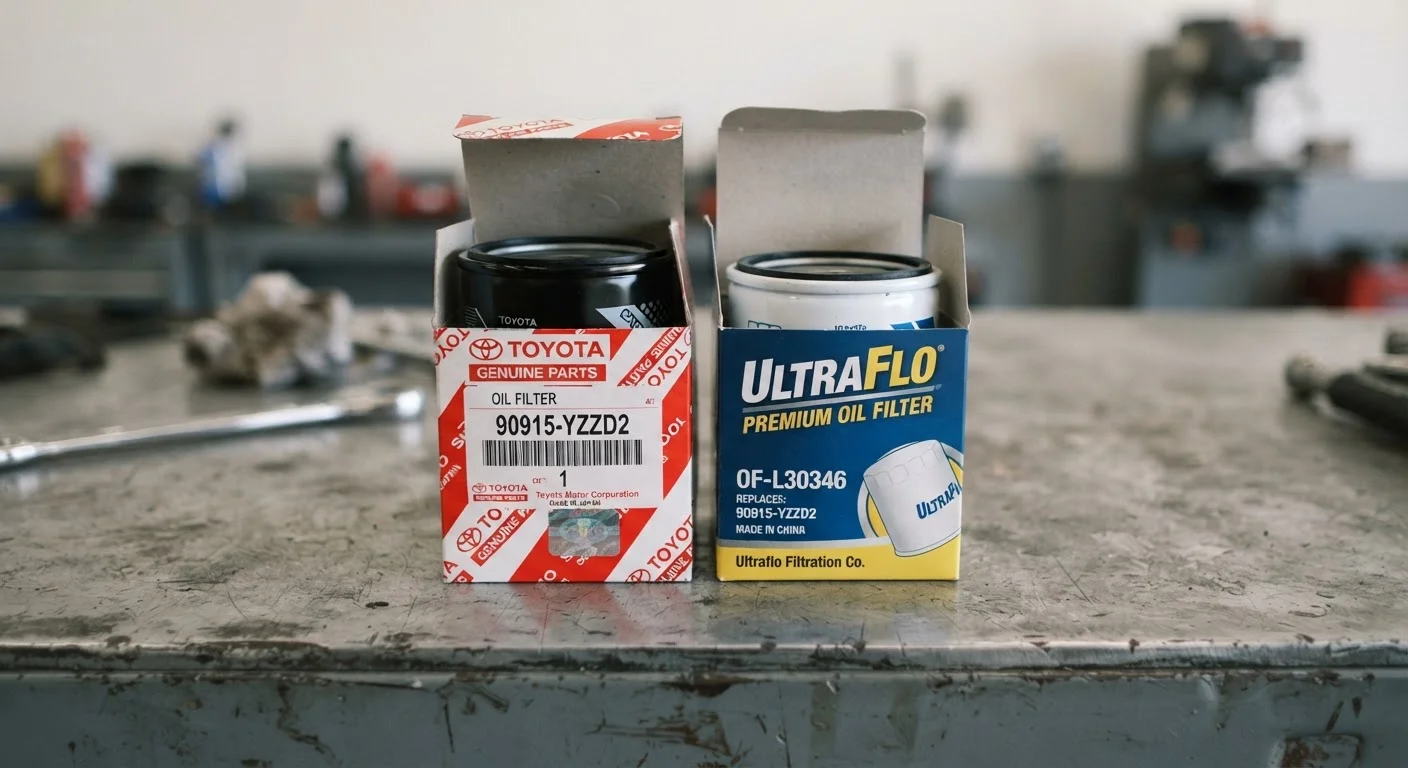
Key Takeaways
Option A
OEM Parts
The factory-matched, manufacturer-approved choice.
Best for: Repairs where exact fit, warranty compliance, or safety-critical precision are non-negotiable.
Option B
Aftermarket Parts
The flexible, often lower-cost alternative from third-party manufacturers.
Best for: Routine maintenance items and non-safety-critical components where functional equivalence is well established.
If your vehicle is under the manufacturer's warranty
OEM Parts
Using OEM parts keeps documented service records clean and avoids any ambiguity about warranty coverage, even though aftermarket use isn't automatically disqualifying.
If you're replacing routine wear items like filters, belts, or wipers
Aftermarket Parts
These components are standardized enough that reputable aftermarket versions perform comparably at a meaningfully lower cost.
If the repair involves safety-critical systems such as brakes, steering, or airbag components
OEM Parts
Precision fit and verified performance matter most here; the cost savings from aftermarket alternatives rarely justify the added uncertainty.
If you drive an older vehicle outside of warranty with high mileage
Aftermarket Parts
OEM parts for older models can be scarce or expensive; quality aftermarket alternatives are often a practical and cost-effective solution.
If you want performance upgrades beyond factory specifications
Aftermarket Parts
The aftermarket sector specifically produces performance-oriented components that exceed OEM specs for enthusiasts seeking upgrades.
What OEM and Aftermarket Actually Mean
OEM stands for Original Equipment Manufacturer. An OEM part is either made by your vehicle's manufacturer or by a supplier specifically contracted to produce components to the manufacturer's exact specifications. When you buy an OEM part, you're getting the same component — or a direct equivalent — that came installed when the vehicle was built.
Aftermarket parts are produced by independent third-party companies without a direct contract from the automaker. Quality ranges considerably: some aftermarket manufacturers hold rigorous certifications and produce parts that meet or exceed OEM standards, while others cut corners on materials or tolerances. Understanding this spectrum is essential before making any decision. For a deeper look at how these labels translate across product categories, see what OEM and certified labels really mean.
| Criterion | OEM Parts | Aftermarket Parts |
|---|---|---|
| Fit guarantee | Exact — engineered to spec | Varies by manufacturer quality |
| Typical cost | Higher | Often 20–50% lower |
| Availability for older vehicles | May be discontinued | Generally broader selection |
| Quality consistency | High and predictable | Wide range — brand-dependent |
| Warranty impact | Cleanest documentation | Protected by Magnuson-Moss Act |
| Best for safety-critical repairs | Yes — preferred choice | Only if certified equivalent |
| Best for routine maintenance | Works but often overkill | Frequently the practical choice |
Where Aftermarket Parts Genuinely Hold Up
Certain vehicle components are straightforward enough in design and function that the aftermarket produces reliable equivalents with little meaningful trade-off.
~40%
Average aftermarket cost savings on common wear parts
Industry analyses consistently estimate aftermarket parts cost 20–50% less than OEM equivalents for commodity components like filters and belts.
3 in 4
Repair shops use aftermarket parts regularly
According to the Auto Care Association, the majority of independent repair facilities use aftermarket parts for routine maintenance jobs.
- Air and cabin filters: These are commodity items. Fit and filtration ratings are standardized, and reputable aftermarket versions perform comparably.
- Wiper blades: Form and function are simple; aftermarket blades from established suppliers work well.
- Spark plugs: As long as heat range and thread specifications match, aftermarket plugs from recognized brands are proven in millions of vehicles.
- Batteries: Cold-cranking amp ratings and physical dimensions are what matter. Many aftermarket batteries meet or exceed OEM specs.
- Belts and hoses: Routine replacements on older vehicles are well-served by aftermarket options, provided specifications are matched.
Staying current on these routine items matters more than which brand supplies them. See why deferred maintenance compounds over time for context on the real cost of neglect.
Where OEM Is Worth the Extra Cost
Some repairs demand a higher confidence threshold, and that's where OEM parts — or their rigorously certified aftermarket equivalents — make a clear case for themselves.
- Brake system components: Rotors, calipers, and pads require precise fitment and consistent friction performance. Dimensional variation in low-quality aftermarket parts can affect stopping distance.
- Airbag and restraint system parts: These are engineered to exacting tolerances for crash performance. Substitutes carry serious safety implications.
- Transmission and engine internals: Tolerances here are tight. Poorly matched aftermarket components can accelerate wear or cause failure.
- Electronic control modules: Vehicle computers are deeply integrated with manufacturer software. Third-party modules often require reprogramming and may not interface correctly.
If you're uncertain whether a specific repair is within DIY scope, comparing garage versus shop repairs is a useful starting point. For safety- or complexity-related repairs, consult a qualified mechanic before proceeding.
Always Verify Part Specifications Before Installing
Even reputable aftermarket parts can ship with incorrect dimensions or ratings due to catalog errors. Before installation, cross-reference the part number, physical measurements, and any ratings (torque, heat range, friction coefficient) against your vehicle's service manual or a verified fitment database. When in doubt, have a qualified mechanic inspect the part before it goes on the vehicle.
Warranties, Legality, and What to Watch For
A common concern is whether using aftermarket parts voids a vehicle warranty. Under the Magnuson-Moss Warranty Act, a manufacturer generally cannot void a warranty simply because an aftermarket part was used — unless the manufacturer can demonstrate that the aftermarket part caused the specific failure being claimed. That said, keeping clear service records and using reputable aftermarket brands protects you if a dispute arises.
When evaluating aftermarket parts, look for certification marks relevant to the part type — such as SAE ratings for fluids or OES designations. Avoid parts with no documented specifications or from suppliers with no verifiable track record. The pattern of low upfront cost leading to higher total spending is well documented — the cheapest aftermarket option is not always the most economical one over time.
Finally, consider where your vehicle is in its life. On a high-mileage vehicle well outside warranty, the economics of aftermarket parts shift decisively in their favor — particularly when OEM availability is limited. Contrast that with a newer vehicle where resale value and warranty integrity may factor into your decision. For broader context on that trade-off, comparing new versus used vehicle considerations covers relevant ground.