

Key Takeaways
Option A
Urban Exploration
The layered, human-driven discovery experience.
Best for: Travelers who thrive on cultural density, culinary variety, and spontaneous street-level encounters.
Option B
Nature Immersion
The restorative, sensory-first wilderness experience.
Best for: Travelers seeking solitude, physical engagement, and a genuine break from screens and crowds.
If you recharge through social energy and cultural stimulation
Urban Exploration
Cities offer continuous novelty — new neighborhoods, galleries, markets, and conversations — keeping curious minds fully engaged.
If you're burned out and need genuine mental restoration
Nature Immersion
Research consistently links time in natural environments with lower cortisol levels and improved mood — hard to replicate in a city.
If you're traveling solo for the first time internationally
Urban Exploration
Urban infrastructure, transit options, and social scenes make it easier and safer to navigate independently as a first-timer.
If physical activity and unplugging are your primary goals
Nature Immersion
Trails, waterways, and wild landscapes create natural conditions for sustained movement and digital disconnection.
If your travel window is under five days
Urban Exploration
Cities are logistically efficient — you can access concentrated experiences without long transfer times or gear requirements.
What Each Mode of Travel Actually Delivers
Urban exploration and nature immersion aren't simply two types of vacation — they satisfy fundamentally different human needs. Understanding what each one actually delivers helps you choose with intention rather than habit.
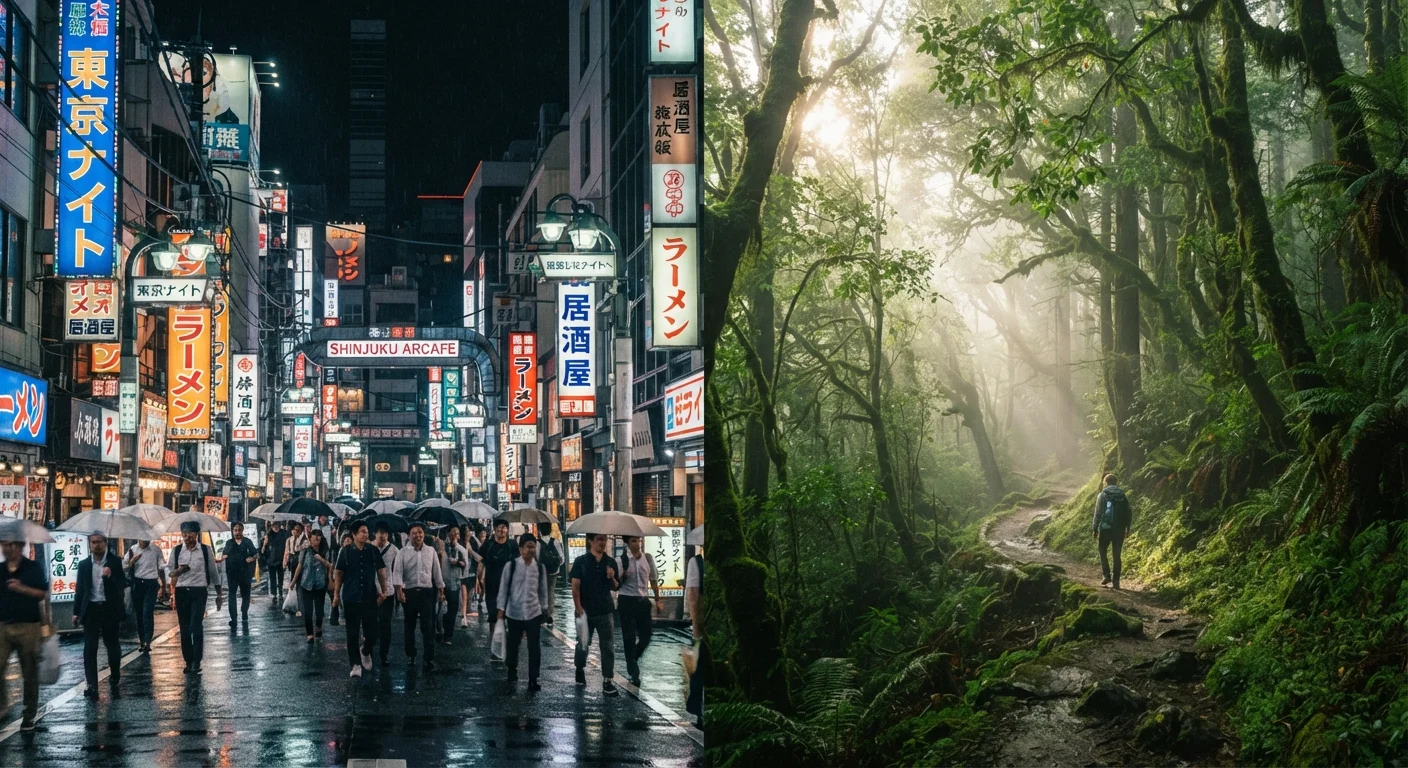
Urban exploration is about density. In a single afternoon, a traveler can move through a covered market, an independent bookshop, a neighborhood gallery, and a century-old café. Cities layer history, subculture, architecture, and cuisine into walkable proximity. The stimulation is near-constant, and the rewards are social and intellectual. For travelers who find meaning in watching how people live — what they eat for breakfast, how they organize public space, what they argue about — urban travel is almost impossibly rich.
Nature immersion works differently. The rewards are slower, quieter, and often more physical. A morning on a coastal trail or a night in a backcountry camp strips away the ambient noise of ordinary life. Attention narrows to what's immediate: the grade of the path, the shift in light, the sound of water. Multiple studies in environmental psychology suggest that time in natural settings reduces stress markers and improves directed attention — though individual experiences vary. What nature consistently delivers that cities rarely can is genuine quiet and an altered sense of time.
For a deeper look at how slowing your travel pace reshapes what you take from a destination, see our guide to slow travel.
| Criterion | Urban Exploration | Nature Immersion |
|---|---|---|
| Primary reward | Cultural density, novelty, human connection | Restoration, solitude, physical engagement |
| Planning complexity | Low to moderate — flexible on arrival | Moderate to high — permits and gear required |
| Physical demand | Low — mostly walking at own pace | Moderate to high — varies by terrain |
| Accessibility | Generally strong infrastructure | Variable; remote areas more limited |
| Best trip length | Works well in 3–5 days | More rewarding with 5+ days |
| Digital disconnection | Difficult — constant connectivity | Natural and often unavoidable |
| Spontaneity | High — easy to pivot plans | Lower — logistics constrain flexibility |
Logistics, Cost, and Accessibility
The practical gap between urban and nature travel is real and worth examining honestly before you book.
Urban trips are logistically forgiving. Accommodation runs the full spectrum from budget hostels to boutique hotels, transit is usually self-explanatory, and a missed reservation rarely derails the day. You can arrive with a rough outline and adjust in real time based on energy and weather. That flexibility is a genuine advantage, especially on shorter trips or first visits to a region.
Nature immersion asks more of you upfront. Depending on the destination, you may need to reserve permits weeks or months in advance (many U.S. national parks now require timed-entry passes during peak season). Gear matters — improper footwear or inadequate layers can turn a rewarding hike into an uncomfortable or unsafe one. Remote settings also mean fewer bail-out options if plans change. None of this is prohibitive, but it does require more preparation.
120 min
Weekly nature time linked to wellbeing benefits
A large-scale study published in Scientific Reports found that spending at least 120 minutes per week in natural environments was associated with better health and wellbeing outcomes.
85%
U.S. travelers citing cultural experiences as a key trip motivator
According to U.S. Travel Association research, the vast majority of American leisure travelers rank cultural and heritage experiences among their top reasons for choosing a destination.
Accessibility is a legitimate consideration too. Urban environments — while imperfect — typically offer more infrastructure for travelers with mobility limitations than backcountry wilderness does. That gap is narrowing as more parks develop accessible trails and facilities, but it remains significant in remote areas.
Cost is harder to generalize. City accommodation in major metros can be expensive, but budget options exist. Nature travel can appear cheaper on the surface, but gear, permits, fuel, and guided services add up quickly.
Depth of Experience: Which One Actually Connects You to a Place?
Both approaches can produce genuine connection — but they connect you to different things.
Urban exploration connects you to a place's present and past human story. Walking the Treme neighborhood in New Orleans, for example, puts you in direct contact with centuries of musical, cultural, and architectural history that no museum exhibit fully replicates. Exploring New Orleans beyond Bourbon Street is a perfect case study in how neighborhood-level urban discovery delivers what conventional tourism misses.
Nature immersion connects you to a place's physical and ecological character — the specific geology, plant communities, light quality, and silence that make one landscape distinct from another. Standing in a California redwood grove or kayaking a Maine estuary at low tide delivers a sense of place that no city walk can replicate.
The honest answer is that neither mode has a monopoly on meaningful travel. What matters is whether the experience matches your current needs. Finding locally meaningful experiences in any destination — urban or wild — comes down to intentionality over itinerary length.
You Don't Have to Choose Permanently
Urban and nature travel aren't competing identities — they're tools. Many seasoned travelers cycle between them deliberately, using city trips to fuel curiosity and nature trips to recover from overstimulation. If you're unsure where to start, consider what you've been missing most in everyday life: if it's quiet, go outside; if it's novelty and conversation, head to a city.
Many travelers find the most satisfying trips combine both styles: a few days in a city anchoring each end of a trip, with a nature-focused stretch in between. If that appeals to you, weighing city breaks against nature escapes by trip goal is worth reading before you plan.