

Key Takeaways
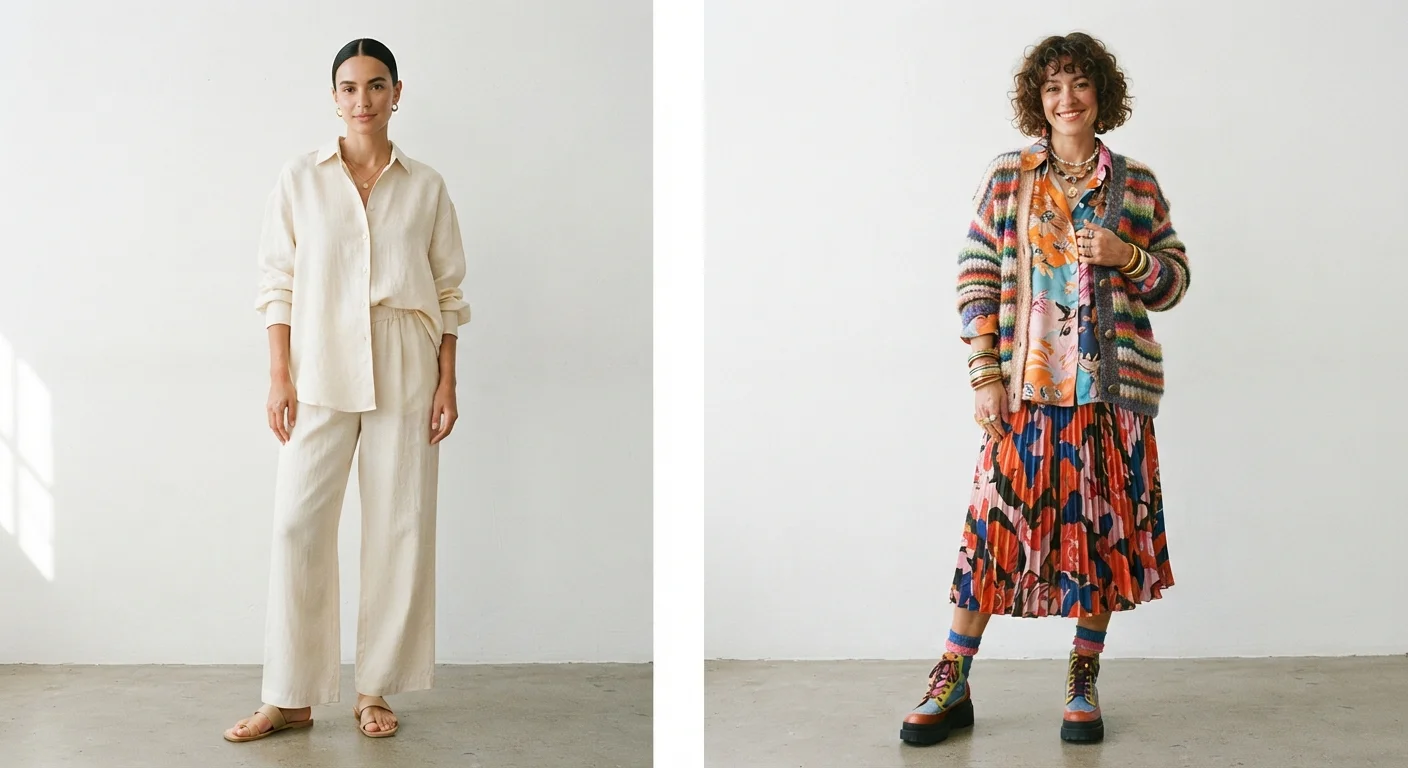
Option A
Quiet Luxury
The art of saying more with less.
Best for: Those who prefer a restrained, neutral palette and let fabric quality and cut do the talking.
Option B
Maximalism
The art of saying everything, all at once.
Best for: Those who view dressing as a form of self-expression and embrace layering, color, and pattern with confidence.
If you want a low-maintenance, versatile wardrobe that reads polished in any setting
Quiet Luxury
A neutral, well-edited wardrobe simplifies daily dressing and transitions easily between professional and casual environments without relying on trend cycles.
If dressing is a primary form of creative and personal expression for you
Maximalism
Maximalism rewards those who enjoy the process of assembling an outfit as much as the result, turning self-presentation into an ongoing creative practice.
If you are building a wardrobe from scratch with a limited budget
Quiet Luxury
Fewer, more considered pieces in neutral tones tend to offer greater mix-and-match versatility, though the quiet luxury look typically demands higher per-item investment in fabric quality.
If your personal style draws from multiple cultural references, subcultures, or art movements
Maximalism
Maximalism's layering logic naturally accommodates eclectic influences, making it easier to honor multiple aesthetic touchpoints within a single look.
Defining the Two Aesthetics
Quiet luxury — sometimes called "stealth wealth" in fashion commentary — centres on restraint. Think tailored trousers in oatmeal wool, a cashmere crewneck in camel, unbranded leather loafers. The visual language is intentionally muted: neutral palette, precise fit, natural fibres, and a conspicuous absence of logos. The goal is to communicate quality through texture and construction rather than through recognisable labels. For a deeper look at how quiet luxury relates to a similar but distinct trend, see our breakdown: Quiet Luxury vs. Old Money Aesthetic.
Maximalism operates from an entirely different premise. Where quiet luxury edits out, maximalism layers in. Bold color-blocking, clashing prints, stacked jewelry, embroidered statement pieces, and textural variety coexist within a single outfit. Far from being chaotic, considered maximalism follows an internal logic: every addition is chosen, and the cumulative effect is intentional visual abundance. The aesthetic draws from fashion history ranging from 1970s bohemia to the opulent dressing traditions of various global cultures, and it has found renewed prominence in contemporary style conversations.
| Criterion | Quiet Luxury | Maximalism |
|---|---|---|
| Color palette | Neutral, monochromatic, tonal | Bold, varied, often contrasting |
| Pattern use | Minimal or absent | Mixed patterns welcomed |
| Branding visibility | Deliberately avoided | Varies; logos can be part of the look |
| Layering approach | Restrained, precise silhouette | Abundant, textural layering |
| Accessory philosophy | Minimal, understated | Stacked, statement-driven |
| Wardrobe size | Fewer, higher-investment pieces | Often larger, more varied inventory |
| Trend sensitivity | Low — prioritizes timelessness | Variable — can be trend-forward or archival |
The Intentionality Behind Each Approach
A common misconception is that quiet luxury is "easy" because it relies on fewer pieces. In practice, building a wardrobe around restraint demands precise judgment: every silhouette must work, every fabric must justify its cost, and every piece must integrate seamlessly with the others. A neutral wardrobe has real trade-offs — versatility often comes at the expense of personality, and the investment per piece tends to run higher when quality is the primary differentiator.
Maximalism, meanwhile, requires a different discipline: knowing when to stop. The most effective maximalist dressers develop an intuition for composition — which patterns can coexist, how to balance scale, where to anchor a look so it reads as curated rather than cluttered. This is a learnable skill, not an innate talent, and it often benefits from understanding broader style archetypes as a foundation. Both aesthetics, then, require active decision-making — they simply ask different questions of the person getting dressed.
62%
Shoppers prioritizing personal expression over trends
A McKinsey & Company consumer survey found that a majority of fashion consumers globally report dressing to express identity rather than follow seasonal trends.
3–5x
Average cost difference per quiet luxury garment
Industry observers note that garments meeting quiet luxury standards — natural fibres, precise construction, no visible branding — typically carry a significant price premium over trend-driven alternatives.
How to Identify Which Philosophy Aligns With You
The most useful starting point is not trend data or editorial coverage — it is your own wardrobe history. Pull out the pieces you reach for most consistently. Do they tend toward neutral tones, clean lines, and tactile fabrics? Or do they skew toward color, pattern, and layering potential? Most people find their instincts cluster more naturally toward one end of the spectrum, even if they borrow from both.
Consider also the role dressing plays in your daily life. If an outfit's primary job is to support you through varied professional and social environments without demanding attention, quiet luxury's neutrality is genuinely functional. If getting dressed is itself a source of creative satisfaction — if you think about combinations, experiment with proportion, and enjoy the reaction an unexpected pairing generates — maximalism's expansiveness may suit you better. The capsule versus curated closet debate captures a similar tension between these two orientations toward dressing with intention.
Hybrid Dressing Is More Common Than You Think
The quiet luxury versus maximalism framing is a useful intellectual tool, but most wardrobes exist somewhere in between. A person might build their base in quiet luxury neutrals and introduce maximalist energy through a single statement coat or a layered jewelry moment. Style educators increasingly describe this as 'intentional mixing' — borrowing each aesthetic's strengths without being governed by either. If you find both philosophies appealing, that is not indecision; it may simply reflect a more nuanced personal aesthetic.