

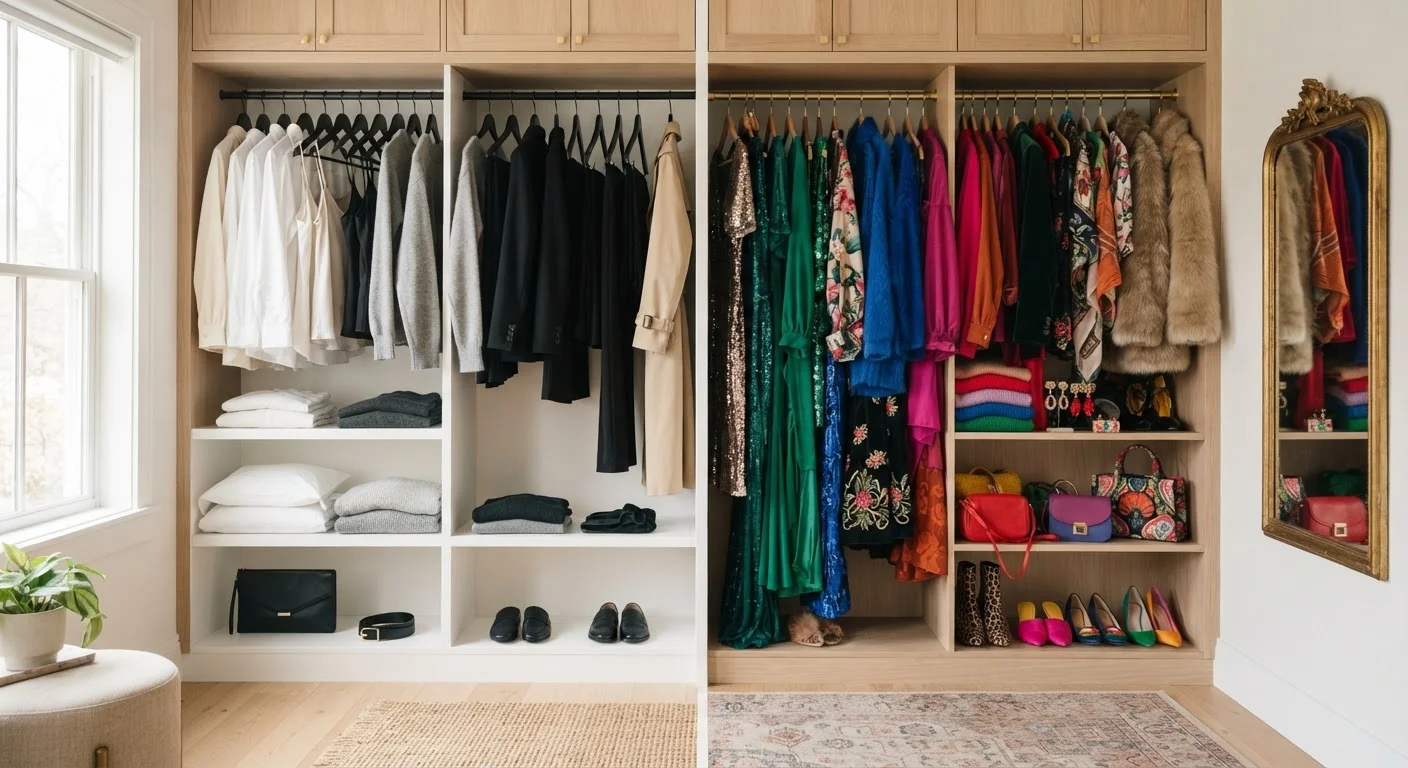
Key Takeaways
Option A
Capsule Wardrobe
The disciplined, minimalist framework for effortless dressing.
Best for: People who want to simplify decisions, reduce clutter, and build maximum outfit versatility from a small, cohesive set of pieces.
Option B
Curated Closet
The intentional but expansive approach to personal style expression.
Best for: People who find joy in variety, self-expression through clothing, and want a closet that reflects the full range of their personality and lifestyle.
If decision fatigue is your biggest wardrobe frustration
Capsule Wardrobe
A strict, limited set of interchangeable pieces eliminates the paralysis of too many options, making getting dressed faster and more consistent.
If clothing is central to your self-expression and creativity
Curated Closet
A curated approach gives you room to hold pieces that reflect distinct moods, aesthetics, and contexts — without demanding minimalist sacrifice.
If you have a uniform lifestyle with predictable dressing contexts
Capsule Wardrobe
When your days are consistent, a tightly edited wardrobe covers your real needs without excess.
If your lifestyle spans many different dressing contexts
Curated Closet
Varied occasions — from formal events to creative settings to casual weekends — benefit from a broader, thoughtfully chosen range of clothing.
If you're starting fresh and want a clear, structured framework
Capsule Wardrobe
The capsule model's defined rules offer a useful scaffold for anyone rebuilding their wardrobe from scratch or recovering from style drift.
What Each Philosophy Actually Means
The terms get used interchangeably online, but they describe meaningfully different approaches. Understanding the distinction is the first step to knowing which one belongs in your life.
A capsule wardrobe is a deliberately limited collection — typically ranging from 30 to 50 pieces — where every item is chosen for its ability to work with everything else. The philosophy, popularized by London boutique owner Susie Faux in the 1970s and later expanded by designer Donna Karan, prioritizes restraint. Versatility is the primary filter: if a piece doesn't mix well across multiple outfits, it doesn't earn its place. Learn more about the capsule wardrobe concept and where it came from before committing to the model.
A curated closet, by contrast, sets no numerical ceiling. The governing principle is intentionality: every item you own should be there on purpose, earning its space through genuine use, emotional connection, or specific function. A curated closet might contain 80 or 150 pieces — the number isn't the point. What matters is that nothing is accidental. This approach often accommodates broader personal style, including statement pieces, trend-forward items, and category-specific wardrobes (workwear, activewear, occasion dressing) that a strict capsule might struggle to serve.
| Criterion | Capsule Wardrobe | Curated Closet |
|---|---|---|
| Item count | Typically 30–50 pieces | No fixed limit; varies widely |
| Core principle | Maximum versatility, minimum volume | Intentional ownership, personal resonance |
| Decision structure | Strict: every piece must coordinate | Flexible: pieces chosen for varied reasons |
| Personality expression | Limited — neutrality prioritized | High — room for statement and variety |
| Maintenance discipline | Built-in via item limit | Requires active, ongoing auditing |
| Best lifestyle fit | Consistent, predictable contexts | Varied, multi-context daily life |
| Trend accommodation | Low — trends rarely pass versatility test | Moderate — selective trend pieces allowed |
The Real Trade-Offs: Control vs. Flexibility
Each philosophy carries genuine advantages — and genuine costs. The capsule wardrobe's discipline pays off in cognitive ease. When every item coordinates with every other, getting dressed becomes almost automatic. It also naturally discourages the trend-chasing habits that quietly drain a wardrobe, because impulse purchases rarely meet the strict interoperability standard.
The cost of that control is range. Life isn't always uniform. Creative professionals, people who travel frequently, or those whose social calendar spans black-tie events and weekend hiking trips often find a rigid 30-piece capsule leaves genuine gaps. Forcing every piece to be neutral and versatile can also flatten personality — a real sacrifice for people whose clothing is tied to identity and self-expression.
The curated closet's flexibility accommodates that complexity. It makes room for the cobalt blazer that only pairs with two things but earns its place because you love it. It can hold both a polished workwear section and a weekend-casual section without contradiction. The risk, however, is drift: without a hard constraint, a curated closet requires ongoing discipline. Without regular auditing, intentionality can quietly give way to accumulation. The wardrobe audit process is essential for keeping a curated closet honest.
~80%
Of owned clothes worn rarely or never
Research cited by sustainability organizations consistently finds the majority of wardrobe items go unworn — a problem both philosophies aim to address.
35+
Daily decisions average adults make about clothing
Behavioral researchers studying decision fatigue have found that clothing choices are among the recurring micro-decisions that collectively deplete mental energy throughout the day.
60%
Increase in garments produced since 2000
According to the Ellen MacArthur Foundation's analysis of the fashion industry, global garment production roughly doubled between 2000 and 2015, with wear rates declining.
How to Choose the Right Path for You
The most useful guide here isn't aesthetics — it's lifestyle. How you actually live should shape what your wardrobe looks like, not the other way around. If your days are largely predictable — office, gym, weekend errands — a capsule wardrobe can cover that terrain with minimal friction. If your context shifts constantly, a curated closet gives you the range to show up appropriately and authentically across all of it.
Personal relationship to clothing matters equally. Some people experience choice as freedom; others experience it as noise. If a full closet energizes you, the curated model aligns with how you're wired. If it exhausts you, the capsule's constraints are a gift, not a limitation.
It's also worth noting that these aren't binary options. Many people operate somewhere in between: a capsule core of everyday essentials, surrounded by a deliberately small collection of personality pieces and occasion-specific items. This hybrid model borrows the capsule's discipline for the foundational layer while allowing the curated approach's expressiveness at the edges. It pairs naturally with an understanding of how opposing aesthetic philosophies can both be practiced with equal intention.
Whatever path you choose, resist the urge to overhaul everything at once. A sudden style reset often leads to regret and incoherence — gradual, deliberate transitions hold up far better over time.
Neither Approach Is About Spending Less
A common misconception is that a capsule wardrobe is inherently budget-friendly and a curated closet is expensive. In practice, both can be executed at any price point. The capsule model may actually encourage spending more per piece, since each item carries more weight. The curated approach can be built thoughtfully over time without high costs. The shared goal is intentionality — not a particular budget outcome.