

Key Takeaways
Option A
Quiet Luxury
The contemporary minimalist's answer to understated dressing.
Best for: Anyone seeking a refined, logo-free wardrobe built around quality fabrics and neutral palettes.
Option B
Old Money Aesthetic
A heritage-inflected style language rooted in generational ease.
Best for: Those drawn to preppy, collegiate references and a sense of inherited, effortless elegance.
If you want a sleek, modern wardrobe with zero visual noise
Quiet Luxury
Quiet luxury's emphasis on tonal dressing and elevated basics creates a streamlined, timeless look that reads as sophisticated without relying on recognisable style codes.
If you're drawn to East Coast prep and collegiate references
Old Money Aesthetic
Old money's layered blazers, polo shirts, and heritage accessories fit naturally into a lifestyle wardrobe with clear cultural roots and a relaxed, assured confidence.
If you want a wardrobe that mixes well with trend-driven pieces
Quiet Luxury
Quiet luxury's neutral, minimal foundation integrates easily with seasonal additions without compromising the overall look.
If personal style history and aesthetic storytelling matter to you
Old Money Aesthetic
Old money draws from a rich visual vocabulary — equestrian, nautical, ivy league — that gives a wardrobe a sense of narrative depth beyond mere colour coordination.
Where These Two Aesthetics Overlap — and Where They Diverge
On a first glance, quiet luxury and old money style look nearly identical. Both favour muted palettes, reject visible logos, and centre on garments that suggest quality rather than announce it. It's no surprise the two are often conflated in trend coverage. But the differences in attitude, inspiration, and execution are meaningful enough to shape real wardrobe decisions.
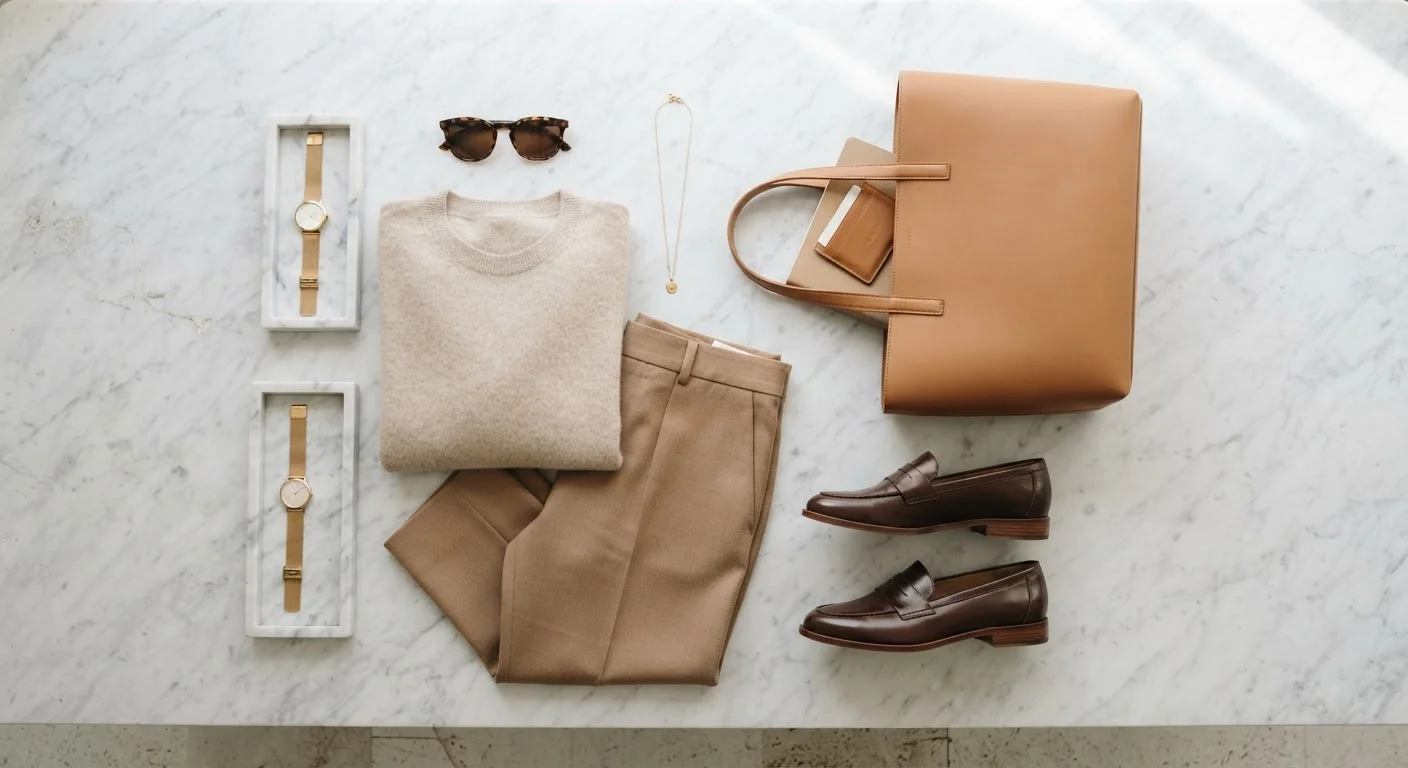
Quiet luxury is a contemporary phenomenon, propelled by a cultural shift away from ostentatious branding. It centres on fabric quality, clean silhouettes, and tonal restraint — think cashmere in oatmeal, wide-leg trousers in camel, and leather goods in understated cuts. The aesthetic is intentionally blank in terms of cultural signalling. It doesn't want to belong to a particular tradition; it wants to exist above categorisation.
Old money aesthetic, by contrast, is explicitly referential. It draws from a specific cultural archive: Ivy League campuses, New England coastlines, equestrian clubs, and European country estates. The look includes cable-knit sweaters, striped Oxford shirts, blazers with brass buttons, penny loafers, and plaid — items that carry generational associations. The suggestion isn't just wealth; it's inherited wealth, ease, and belonging to a world where style was never a performance.
| Criterion | Quiet Luxury | Old Money Aesthetic |
|---|---|---|
| Cultural reference | None — deliberately context-free | Ivy League, prep, European gentry |
| Colour palette | Strict neutrals, tonal dressing | Neutrals plus heritage patterns |
| Key silhouettes | Clean, minimal, architectural | Layered, relaxed, slightly traditional |
| Logo presence | None | None (occasionally subtle crests) |
| Trend sensitivity | Contemporary — emerged mid-2020s | Enduring — decades-old vocabulary |
| Attitude conveyed | Wealthy anonymity | Inherited ease and belonging |
| Typical fabrics | Cashmere, silk, fine wool, linen | Cotton, wool, tweed, seersucker |
For a deeper look at how aesthetics like these interact with broader fashion cycles, see our discussion of fast versus slow fashion.
Building Each Look in Practice
Translating either aesthetic into a functional wardrobe requires understanding their respective anchor pieces.
Quiet Luxury Wardrobe Anchors
- Monochromatic or tonal outfits in sand, ivory, grey, or navy
- Structured coats with clean lapels and no embellishment
- Minimalist footwear — pointed flats, simple loafers, unbranded sneakers
- Accessories defined by material (smooth leather, brushed gold hardware) rather than logo
Old Money Aesthetic Anchors
- Layering: polo shirts under crewneck sweaters, blazers over chambray
- Heritage patterns: houndstooth, tartan, seersucker, Breton stripes
- Footwear with history: loafers, boat shoes, brogues
- Accessories that read as functional rather than decorative — a signet ring, a canvas tote, a watch worn loosely
67%
Consumers preferring logo-free clothing
A Edelman survey on luxury consumer sentiment found a majority of affluent shoppers globally associate prestige with discretion rather than visible branding.
3–5x
Longevity of quality over fast fashion
Industry analyses consistently suggest well-constructed natural-fibre garments retain wearability significantly longer than synthetic fast-fashion equivalents.
Neither aesthetic requires luxury price tags to execute well. The governing principle in both cases is selectivity: fewer pieces, each chosen with care. This philosophy overlaps significantly with the approach outlined in our guide to what personal style actually means.
It's also worth noting that leaning heavily into either trend without grounding it in genuine preference can lead to wardrobe regret. Our coverage of trend-chasing pitfalls explores this in detail.
Which Aesthetic Actually Suits You?
The most useful question isn't which aesthetic is more sophisticated — both are, in their own register — but which one reflects how you actually want to move through the world.
If you're drawn to minimalism as a philosophy, prefer your clothes to communicate nothing beyond quality, and gravitate toward streamlined shapes without cultural baggage, quiet luxury is the more natural fit. It pairs well with modern interiors, contemporary art, and a lifestyle that values discretion over heritage.
If you feel a genuine pull toward tradition, layering, and a slightly worn-in ease — if you want your clothes to suggest a Saturday on the water or an afternoon in a library — old money aesthetic offers a richer visual language to work with. It tends to suit those who enjoy mixing pieces across contexts without looking like they tried too hard.
Both aesthetics also respond well to the kind of deliberate wardrobe-building described in style archetypes frameworks, which can help clarify which direction feels instinctively right rather than aspirationally borrowed.
These Aesthetics Are Starting Points, Not Rules
Both quiet luxury and old money are useful frameworks for building a more intentional wardrobe, but neither should function as a rigid uniform. Most well-dressed people pull from multiple aesthetic traditions instinctively. If a heritage tweed blazer works in an otherwise minimal quiet-luxury wardrobe, wear it. The goal is coherence, not category compliance.
For readers curious about how quiet luxury compares to a completely different stylistic philosophy, our piece on quiet luxury versus maximalism offers a useful counterpoint.