

Key Takeaways
Seasonal Colour Analysis
Seasonal colour analysis is a personal styling framework that sorts people into one of four categories — Spring, Summer, Autumn, or Winter — based on the natural colouring of their skin, hair, and eyes. Each season maps to a palette of colours thought to harmonise with those characteristics. The system is used as a practical guide for choosing clothing, accessories, and makeup that appear cohesive and flattering.
The framework draws loosely on colour theory principles such as undertone (warm vs. cool) and value (light vs. dark). More advanced systems subdivide the original four seasons into twelve or sixteen sub-types to account for finer distinctions in personal colouring.
Where the System Came From
The four-season colour framework was popularised in the early 1980s, most prominently through Carole Jackson's book Color Me Beautiful, published in 1980. The concept built on earlier colour theory work — particularly the Bauhaus teachings of Johannes Itten, who observed that his students tended to favour colours that harmonised with their own natural colouring. Jackson translated those ideas into an accessible consumer-facing system organised around the four seasons of the year.
The framework spread quickly through image consulting and personal shopping industries, eventually becoming a fixture of professional style advice. Today it persists in updated and expanded forms, with analysts, online quizzes, and app-based tools all offering their own interpretations.
“Colour is the keyboard, the eyes are the harmonies, the soul is the piano with many strings. The artist is the hand that plays, touching one key or another, to cause vibrations in the soul.”
— Wassily Kandinsky, Bauhaus artist and colour theorist whose foundational ideas on colour harmony influenced later personal styling frameworks
How the Four Seasons Break Down
Each season is defined by a combination of three colour qualities: undertone (warm or cool), value (light or deep), and chroma (bright/clear or muted/soft). Understanding how those qualities interact is the core of the system.
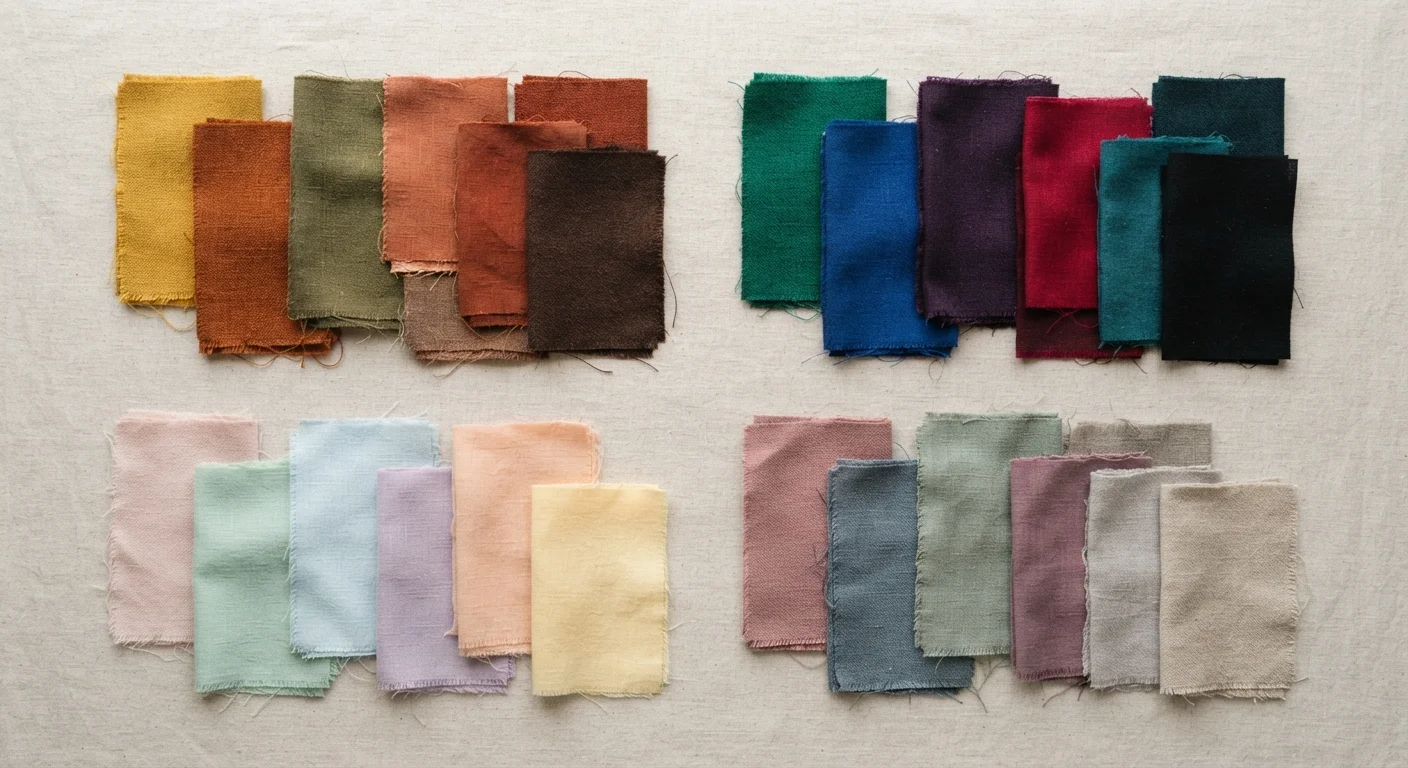
- Spring: Warm undertone, light to medium depth, clear and bright saturation. Associated colours include coral, peach, warm ivory, and golden yellow.
- Summer: Cool undertone, light to medium depth, soft and muted saturation. Associated colours include lavender, dusty rose, powder blue, and soft grey.
- Autumn: Warm undertone, medium to deep depth, muted and rich saturation. Associated colours include terracotta, olive, burnt orange, and warm brown.
- Winter: Cool undertone, medium to deep depth, high contrast and vivid saturation. Associated colours include icy pastels, true white, black, and jewel tones like sapphire and emerald.
For a deeper look at how undertones work as a standalone concept, understanding undertones and personal colouring is a useful companion read.
1980
Year the modern seasonal system was popularised
Carole Jackson's book Color Me Beautiful, published in 1980, brought the four-season framework to mainstream audiences and helped establish the image consulting industry.
16
Sub-types in the most expanded versions
Some contemporary colour analysts divide the original four seasons into as many as sixteen sub-types to account for variations in contrast, undertone intensity, and saturation level.
How People Actually Use It
In practice, most people encounter the seasonal system when building or editing a wardrobe. The palette framework offers a shortcut: rather than evaluating every colour individually, you have a working reference for what tends to look harmonious against your complexion.
Start With Undertone, Not Season
If the four-season framework feels overwhelming as a starting point, begin by identifying whether your skin has a warm, cool, or neutral undertone. Look at the veins on the inner wrist — blue or purple veins tend to indicate cool undertones, while green-tinted veins suggest warm. This single distinction narrows your seasonal options considerably and gives you a practical foundation before exploring the full system.
A common approach is to use your seasonal palette for clothes worn close to the face — tops, scarves, jacket lapels — while allowing more flexibility elsewhere in an outfit. This reflects where colour contrast with your skin and features is most visible and impactful.
The system also pairs naturally with seasonal wardrobe planning. If you're thinking about transitioning your wardrobe between seasons without starting over, a colour palette framework can help identify which pieces already work across multiple contexts and which feel limited to one climate or season.
It's worth noting that the seasonal system addresses colour, not silhouette, pattern preference, or personal aesthetic. Those dimensions are covered by other frameworks — for instance, the style archetypes framework approaches personal aesthetic from a different angle entirely.
Limitations Worth Knowing
The seasonal system has real utility as a heuristic, but it has limitations. The original four-category model is broad — two people categorised as the same season can have noticeably different colouring and may not share identical palettes in practice. Expanded twelve- or sixteen-type systems aim to address this, but add complexity that some find more confusing than clarifying.
The framework also reflects historical beauty standards in some of its colour associations and has been criticised for not translating equally well across the full range of human skin tones. Contemporary analysts increasingly acknowledge this and work to adapt the system for greater inclusivity.
Finally, colour preference and context matter. Someone may technically fall into one season's palette but find that a colour from another resonates with their personal style or works for a particular occasion. Maintaining style consistency across seasons is ultimately about building a wardrobe that feels coherent to you — and the seasonal colour system is one tool among several, not a definitive authority.
The System Is a Starting Point, Not a Rulebook
Colour analysts and stylists who use this framework consistently emphasise that it provides direction, not strict limitations. Personal style involves preferences, cultural context, occasion, and individual confidence that no palette system can fully capture. Use the seasonal framework as a filter for narrowing choices — not a barrier to wearing colours you genuinely love.