

Key Takeaways
Low upfront cost makes fashion broadly accessible
Fast fashion allows consumers across income levels to participate in current trends without significant financial outlay, which matters particularly for younger shoppers or those on variable incomes.
Rapid response to trend cycles
Turnaround from runway to retail can be as short as a few weeks, giving consumers access to current aesthetics at the moment they're culturally relevant.
Wide availability and size range in many markets
High-volume production often means broader size availability and wider retail distribution, reducing access barriers that can affect slower, smaller-run labels.
Practical for short-use or experimental purchases
For items worn a handful of times — a themed event, a seasonal trend test, a travel-specific piece — a lower-cost garment may be the more sensible allocation of clothing budget.
Significant environmental footprint across production
Textile dyeing and treatment are among the largest sources of industrial water pollution globally, and synthetic fiber production relies heavily on petrochemicals with limited end-of-life recyclability.
Labor conditions frequently raise serious concerns
Price compression in fast fashion supply chains creates strong pressure on wages and working conditions at manufacturing level, particularly in lower-wage production countries where oversight may be limited.
Shorter garment lifespan increases waste volume
Garments designed for a single season or a few wears contribute disproportionately to textile waste, much of which ends up in landfill or is exported to overwhelmed secondhand markets.
Lower material quality can mean poor cost-per-wear value
A garment that costs less upfront but degrades quickly after a few washes may deliver worse value over time than a more expensive, durable alternative — particularly for frequently worn categories.
Encourages overconsumption through constant newness
The fast fashion model is structurally dependent on consumers buying more, more often — a dynamic reinforced by low prices, rapid drops, and trend obsolescence cycles that can be difficult to step back from.
Our Verdict
Fast fashion and slow fashion represent genuinely different philosophies about how clothing is made, priced, and consumed — but neither is a simple villain or hero. Fast fashion makes style accessible but externalizes significant costs onto workers and the environment. Slow fashion offers a more considered alternative, though it carries its own barriers around price and access. Understanding both models clearly is the first step toward making wardrobe choices that align with your values and circumstances.
Readers who want to build a more intentional wardrobe without abandoning trend awareness or working within a realistic budget will find value in understanding where each model succeeds and falls short.
Defining the Two Models
The terms fast fashion and slow fashion are used frequently in style conversations, but they're often treated as simple moral binaries rather than structural descriptions of how the clothing industry operates. Getting the definitions right matters before evaluating either.
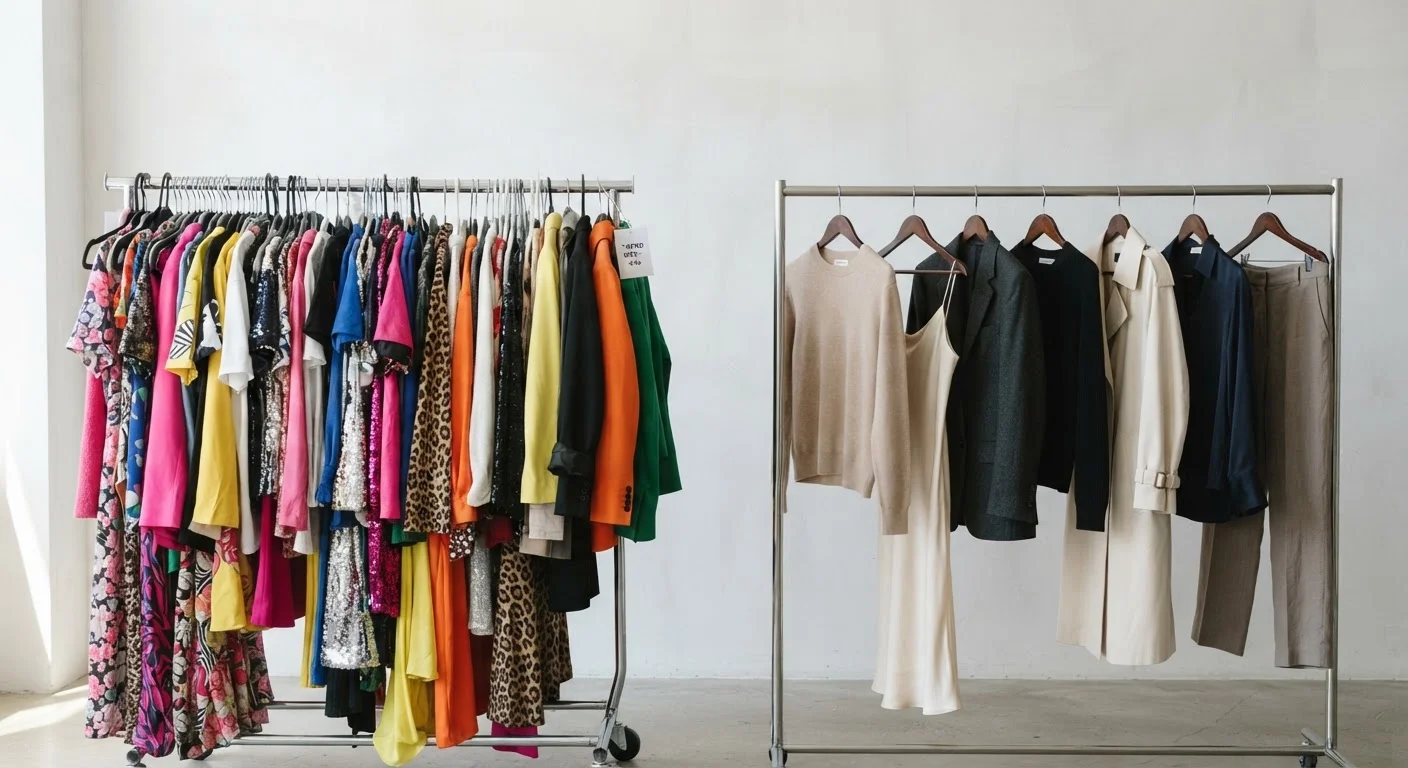
Fast fashion refers to a high-volume production model in which garments are designed, manufactured, and retailed at rapid speed — often tracking runway looks or viral trends within weeks. Prices are kept low through global supply chains, synthetic materials, and scaled manufacturing. The model is explicitly built on volume and turnover.
Slow fashion is a broader term for approaches that prioritize longevity, ethical labor practices, lower production volumes, and more durable materials. It draws partly on the slow food movement's critique of industrialized production. It includes some independent labels, heritage brands, and secondhand markets — but the term lacks a regulated definition, so it's used loosely. For more on how fashion terminology gets applied in practice, see The Vocabulary of Fashion Trends.
The Advantages of Fast Fashion
Fast fashion's persistence isn't accidental — it solves real problems for real consumers.
Low upfront cost makes fashion broadly accessible
Fast fashion allows consumers across income levels to participate in current trends without significant financial outlay, which matters particularly for younger shoppers or those on variable incomes.
Rapid response to trend cycles
Turnaround from runway to retail can be as short as a few weeks, giving consumers access to current aesthetics at the moment they're culturally relevant.
Wide availability and size range in many markets
High-volume production often means broader size availability and wider retail distribution, reducing access barriers that can affect slower, smaller-run labels.
Practical for short-use or experimental purchases
For items worn a handful of times — a themed event, a seasonal trend test, a travel-specific piece — a lower-cost garment may be the more sensible allocation of clothing budget.
52+
Micro-seasons some fast fashion retailers produce annually
Research from Good On You and industry analysts has documented some retailers cycling through more than 52 collections per year, compared to the traditional two-season calendar.
~10%
Share of global carbon emissions attributed to fashion industry
The United Nations Environment Programme has cited the fashion industry as responsible for approximately 8–10% of global carbon emissions, though methodologies vary across studies.
For budget-conscious shoppers, trend-driven events, or categories where longevity is genuinely less important (a specific costume, a seasonal beach cover-up), fast fashion can be a rational choice. The cost-per-wear framework helps clarify when a lower upfront price actually makes sense versus when it's a false economy.
The Drawbacks of Fast Fashion
Fast fashion's trade-offs are substantial and increasingly well-documented across environmental and labor research.
Significant environmental footprint across production
Textile dyeing and treatment are among the largest sources of industrial water pollution globally, and synthetic fiber production relies heavily on petrochemicals with limited end-of-life recyclability.
Labor conditions frequently raise serious concerns
Price compression in fast fashion supply chains creates strong pressure on wages and working conditions at manufacturing level, particularly in lower-wage production countries where oversight may be limited.
Shorter garment lifespan increases waste volume
Garments designed for a single season or a few wears contribute disproportionately to textile waste, much of which ends up in landfill or is exported to overwhelmed secondhand markets.
Lower material quality can mean poor cost-per-wear value
A garment that costs less upfront but degrades quickly after a few washes may deliver worse value over time than a more expensive, durable alternative — particularly for frequently worn categories.
Encourages overconsumption through constant newness
The fast fashion model is structurally dependent on consumers buying more, more often — a dynamic reinforced by low prices, rapid drops, and trend obsolescence cycles that can be difficult to step back from.
These aren't abstract concerns — they shape the true cost of garments that appear inexpensive at point of sale. The externalized costs (environmental remediation, labor exploitation, textile waste processing) are borne by communities and systems beyond the retail transaction.
Where Slow Fashion Falls Short
Slow fashion is often positioned as a straightforward ethical upgrade, but the picture is more complicated.
Slow Fashion Isn't a Regulated Label
Unlike organic food certification or Fair Trade labeling, the terms "slow fashion," "sustainable fashion," and "conscious collection" carry no standardized or legally enforced meaning in the United States. Brands can and do apply them without independent verification. Consumers looking for genuine accountability should look for third-party certifications — such as B Corp status, Fair Trade Certified, or GOTS (Global Organic Textile Standard) — and published supply chain transparency reports rather than relying on marketing language alone.
Price remains the most significant barrier. Garments made with fair wages, quality materials, and lower-volume production genuinely cost more to produce — and that's reflected at retail. For shoppers managing tight budgets, the slow fashion market is often inaccessible, which raises real questions about equity in sustainability discourse.
There's also a greenwashing problem. Because "slow fashion" and related terms like "sustainable" or "conscious" carry no regulated meaning, they're adopted freely by brands whose practices may not meaningfully differ from conventional production. Consumers have to look past marketing to supply chain transparency reports, certifications (such as Fair Trade or GOTS for textiles), and material disclosures.
Secondhand and vintage markets offer a partial bridge — they extend garment life without requiring new production — but availability, sizing, and condition vary widely. The personal style hub covers how to build a cohesive wardrobe across different sourcing approaches.
How Most People Actually Shop
In practice, the majority of American consumers blend both models — buying investment pieces in core categories while using fast fashion for trend-specific or short-use items. This isn't a contradiction; it's a pragmatic response to uneven budgets and uneven needs across a wardrobe.
The more useful question isn't "fast or slow?" but rather: which categories genuinely benefit from quality and longevity (outerwear, structured shoes, staple knitwear), and which categories are genuinely short-use (seasonal trend pieces, occasion-specific items)? Applying that distinction category by category produces a more honest and workable approach than either extreme. This kind of intentional thinking mirrors what the quiet luxury and old money aesthetic debate reveals about dressing with long-term coherence rather than trend velocity.
Understanding the structural differences between the two models — rather than treating them as identity markers — puts the consumer in a better position to make decisions that reflect their actual values, budgets, and circumstances.