

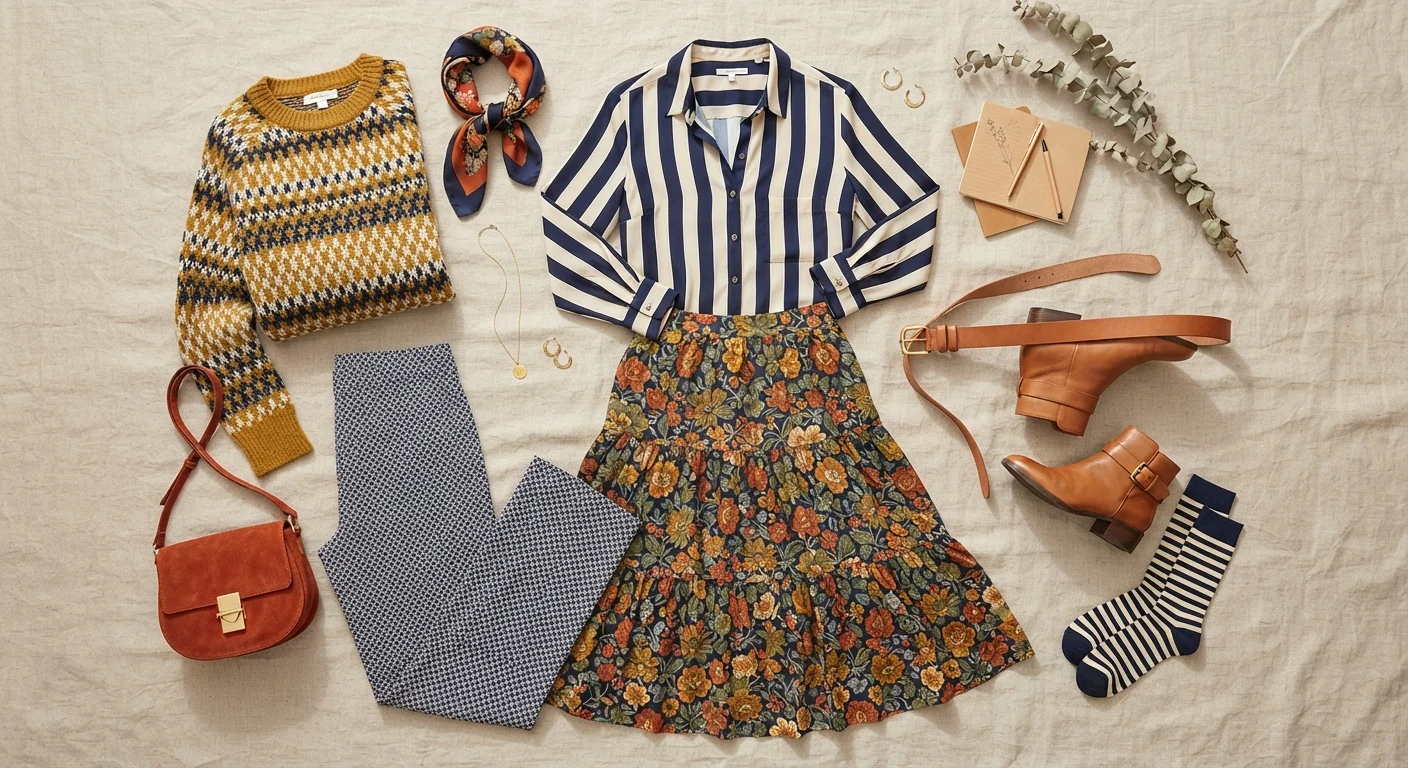
Key Takeaways
Why Pattern Mixing Feels Risky — and Why It Doesn't Have to Be
Most people who avoid mixing prints aren't afraid of pattern itself — they're afraid of looking like they got dressed in the dark. That fear is reasonable, but it often overstates the difficulty. Pattern mixing follows learnable visual logic, and once you understand it, combinations that once seemed chaotic start to read as intentional.
The foundational insight is that patterns are governed by the same principles as color and proportion. For a deeper look at how those fundamentals interact, see our guide on proportion and fit. When you apply that same trained eye to print combinations, the results become predictable in the best way.
The Core Principles in Practice
Understanding the rules intellectually is only part of it — applying them to real dressing situations is where the skill develops. Below are quick actions you can take today to start building that muscle.
As you experiment, pay attention to how color reinforces pattern choices. A floral and a stripe in clashing undertones will fight each other even if the scale contrast is perfect. Our guide to color confidence can help you identify which palettes to keep in the same outfit family.
Pattern Mixing as a Personal Style Tool
The point of pattern mixing isn't to follow a trend formula — it's to give your wardrobe more range without buying more pieces. A striped shirt you already own becomes three different outfits when you know how to pair it with a windowpane blazer, a floral scarf, or a graphic print bag without each combination looking accidental.
“Pattern is a language. Once you understand its grammar — scale, color, rhythm — you can say almost anything you want with it.”
— Tim Gunn, Fashion educator and author on personal style
For a broader look at how pattern, texture, and layering work together as a system, the texture and layering guide covers each element in depth. And if you're applying these principles to your home rather than your wardrobe, where most people go wrong with pattern mixing addresses the specific missteps that disrupt interior visual harmony.
Pattern mixing rewards curiosity and small experiments. Start with two prints that share a color, keep scale contrast clear, and add a solid anchor — then observe what works. That iterative process, more than any single rule, is what builds lasting personal style confidence.