

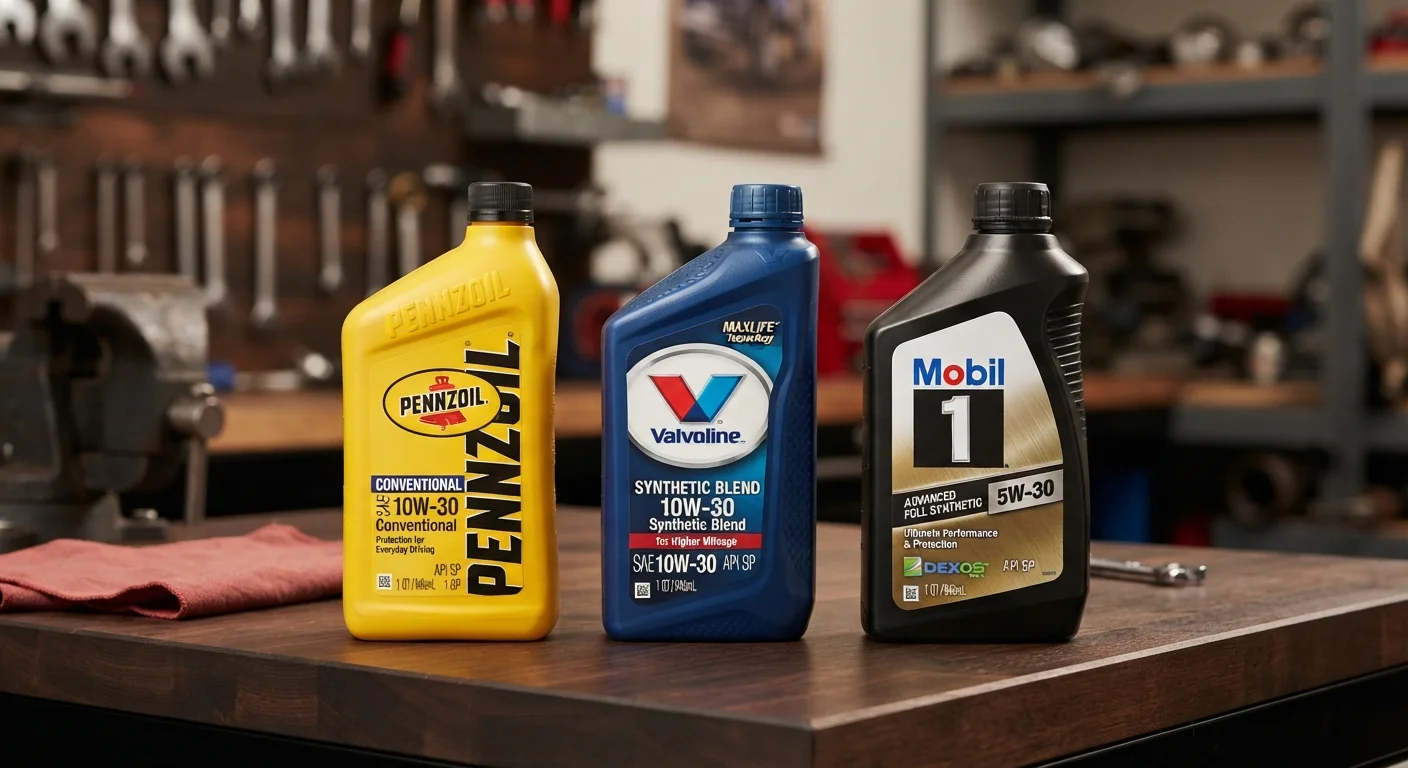
Key Takeaways
Option A
Conventional Motor Oil
The time-tested, widely available standard.
Best for: Older vehicles with simple engine designs and drivers who follow frequent oil change schedules.
Option B
Synthetic Motor Oil
The engineered, high-performance alternative.
Best for: Modern engines, high-mileage vehicles, extreme climates, and drivers seeking longer drain intervals.
If you drive an older vehicle with a high-mileage, simpler engine
Conventional Motor Oil
Older engines are often designed around conventional oil's viscosity profile, and the lower cost makes frequent changes financially practical.
If you drive a modern vehicle and want maximum engine protection
Synthetic Motor Oil
Most new engines are engineered to spec with full synthetic, and the extended drain intervals can offset the higher upfront cost.
If you want better protection than conventional without paying full-synthetic prices
Synthetic Blend Motor Oil
Blends offer meaningfully improved performance in temperature extremes and under load, at a price point closer to conventional oil.
If you live in a region with very cold winters or very hot summers
Synthetic Motor Oil
Synthetic oil flows more reliably at low temperatures and resists thermal breakdown better in sustained heat than conventional formulations.
What Makes These Oils Different at a Molecular Level
All motor oil starts with a base oil — the foundation that makes up roughly 70–90% of the final product — combined with an additive package that handles tasks like wear protection, corrosion resistance, and viscosity stability. The critical difference between conventional and synthetic oil lies in how that base oil is produced.
Conventional motor oil is refined directly from crude petroleum. The refining process removes many impurities, but the resulting molecules are still irregular in size and shape. Those inconsistencies mean more friction, faster oxidation at high temperatures, and a narrower effective temperature range.
Full synthetic motor oil is chemically engineered, typically from synthesized compounds. The manufacturing process creates a far more uniform molecular structure, which translates to better flow at cold temperatures, greater stability at high temperatures, and slower breakdown over time.
Synthetic blends (sometimes called semi-synthetic) mix conventional base oil with synthetic base oil. They occupy genuine middle ground — outperforming conventional in stress conditions while remaining more affordable than full synthetic. See our guide to common maintenance myths if you've heard conflicting claims about whether blends are worth the extra cost.
| Criterion | Conventional Oil | Synthetic Oil |
|---|---|---|
| Base stock origin | Refined crude petroleum | Chemically engineered compounds |
| Molecular uniformity | Irregular — more friction | Uniform — less friction |
| Cold-temperature flow | Slower at startup | Faster, more protective |
| Heat resistance | Breaks down sooner | Resists thermal breakdown longer |
| Typical drain interval | 3,000–5,000 miles | 7,500–15,000 miles (varies by vehicle) |
| Cost per quart | Lower | Higher |
| Best suited for | Older or simpler engines | Modern, high-performance engines |
Performance, Protection, and Real-World Trade-Offs
The performance gap between conventional and synthetic oil narrows under easy driving conditions — short, moderate-temperature commutes on relatively new engines. The gap widens considerably under stress: towing, extended highway driving, stop-and-go traffic in summer heat, or cold starts in sub-zero temperatures.
Synthetic oil's molecular consistency gives it a meaningful advantage in two key areas. First, it flows faster to critical engine components at startup, when the majority of engine wear actually occurs. Second, it resists oxidation and thermal breakdown longer, which is why many manufacturers specify extended drain intervals for engines running full synthetic.
~75%
Engine wear occurring at cold startup
Engineering studies on engine wear patterns consistently point to the startup phase — before oil fully circulates — as the highest-wear period.
2x–3x
Longer drain intervals with full synthetic
Many vehicle manufacturers specify full synthetic oil change intervals of 7,500 to 15,000 miles, compared to 3,000–5,000 miles typical for conventional oil.
That said, extended drain intervals aren't a blanket permission slip. Driving conditions — lots of short trips, dusty environments, towing heavy loads — can degrade even full synthetic oil faster than the mileage marker suggests. Our honest look at extended drain intervals covers this trade-off in depth.
For most drivers, the practical question isn't whether synthetic is technically superior — it generally is — but whether the performance benefits justify the cost difference given how and where they drive. If your vehicle's manufacturer specifies synthetic, that decision has already been made for you.
Choosing the Right Oil for Your Engine
The most reliable source for this decision is your vehicle's owner's manual. Manufacturers specify an oil type and viscosity grade — such as 5W-30 or 0W-20 — based on how the engine was designed and tested. Using a different grade or type than specified can affect fuel economy, engine protection, and in some cases warranty coverage.
Don't Ignore Your Owner's Manual
Marketing language on oil bottles can be misleading — terms like 'premium' or 'advanced' don't replace the specific grade your engine requires. Always cross-reference with the owner's manual or the oil filler cap, which often lists the recommended viscosity grade directly. Using the wrong viscosity, even with a high-quality synthetic, can reduce protection and fuel efficiency.
High-mileage vehicles (typically 75,000 miles or more) may benefit from high-mileage oil formulations — a specialized category of synthetic or blend oil that includes seal conditioners to help reduce oil consumption in older engines. If your vehicle is burning or leaking small amounts of oil, this is worth discussing with a qualified mechanic before your next change.
If you're doing the work yourself, our DIY oil change guide walks through the process safely. And if you want the full picture on all the fluids your car depends on, see Fluids Every Car Relies On for a broader overview. For context on how your powertrain type affects maintenance needs overall, our powertrain comparison is a useful reference — electric vehicles, for instance, don't use engine oil at all.