

Key Takeaways
Our Verdict
Independent travel and guided tours each deliver genuine, distinctive experiences — they're not competing products but different philosophies. Independent travel rewards those who thrive on spontaneity and self-directed discovery. Guided tours serve travelers who want depth, context, and smooth logistics without the planning overhead. The sharpest travelers often borrow from both.
| Best for | Recommended |
|---|---|
| Travelers who prioritize flexibility and spontaneous discovery | Independent Travel |
| First-time visitors to complex or unfamiliar destinations | Guided Tours |
| Those seeking deep cultural or historical context | Guided Tours |
| Experienced travelers comfortable navigating logistics solo | Independent Travel |
What Each Approach Actually Involves
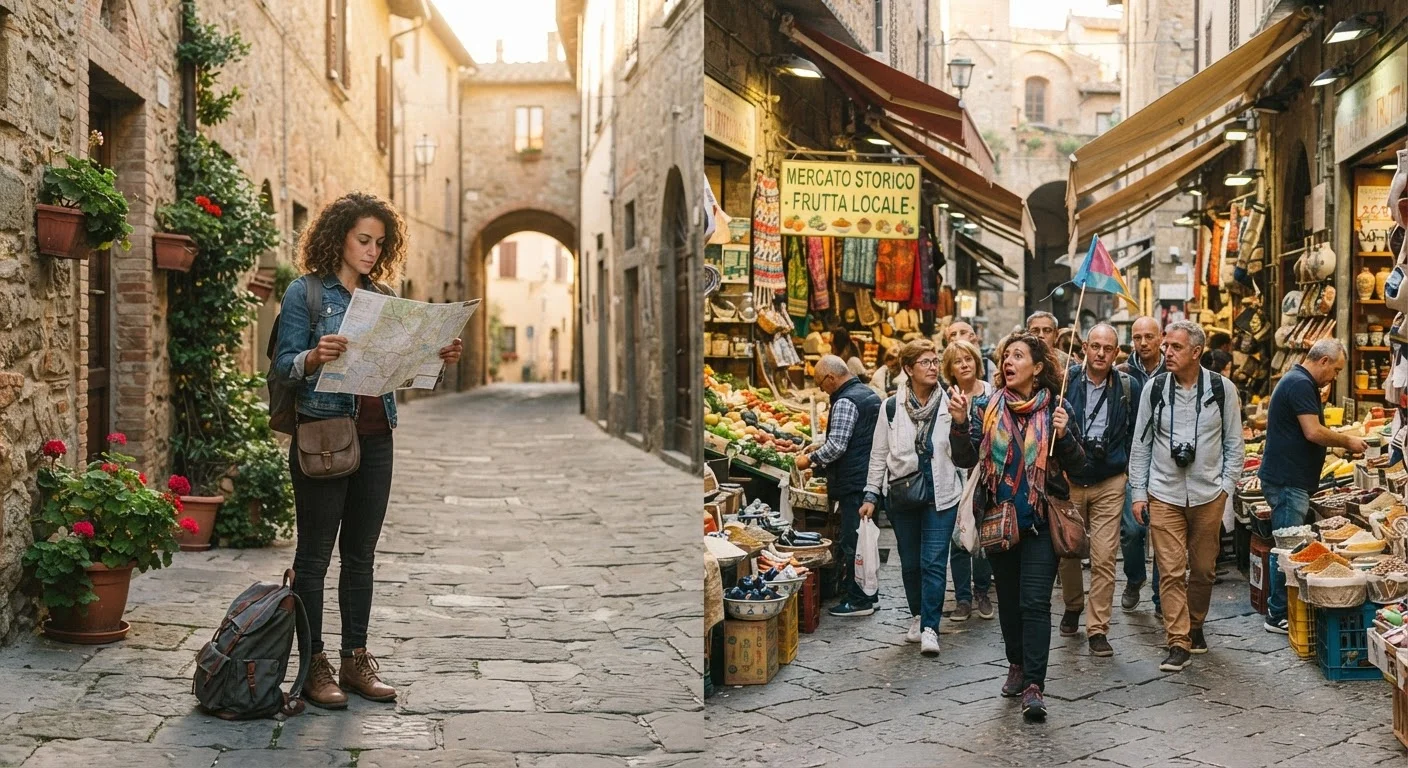
Independent travel means researching, booking, and navigating a trip on your own terms. You set the itinerary, choose when to linger or move on, and make decisions in real time. It can mean booking everything in advance or leaving large windows deliberately open. The defining feature is autonomy — you're the architect of every day.
Guided tours, by contrast, hand much of that architecture to someone else. A local expert or tour company builds the framework: the sites, the schedule, the transport, often the meals. What you receive in return is access — to knowledge, contacts, and experiences that can be genuinely difficult to arrange independently. A guide who grew up in Oaxaca or spent twenty years studying Angkor Wat brings a different kind of insight than a well-researched traveler ever could.
Neither approach is a monolith. Independent travel ranges from meticulous planners to loose wanderers. Guided tours span everything from large bus groups to intimate small-group expeditions to private day tours bolted onto an otherwise solo trip. For a fuller picture of how to structure any trip around what matters most to you, see our framework for experience-first travel planning.
Flexibility, Pace, and the Control Question
The clearest practical difference between independent travel and guided tours is control over pace. Independent travelers can spend three hours in a single room of a museum, take an unplanned detour to a village they spotted from the train window, or skip a famous landmark entirely because it doesn't resonate. That freedom has real value — some of the most memorable travel moments come from unscripted decisions.
Guided tours move on a schedule. That's not always a limitation — in fact, for travelers prone to analysis paralysis or those visiting a destination with a short window, a well-designed itinerary removes friction and guarantees meaningful coverage. The trade-off is that you're sharing the experience with others, and the group's needs shape the experience collectively.
Consider a Hybrid Approach
You don't have to choose one style for an entire trip. Joining a guided experience for a specific activity — a cooking class, a historical walking tour, a national park excursion — while keeping the rest of your trip independent captures the best of both. This is especially effective in destinations where logistical complexity is high in one area but manageable elsewhere.
It's worth noting that flexibility and guided touring aren't mutually exclusive. Many travelers build hybrid trips — a structured multi-day tour through a complex region, followed by independent days in a city. The logistics of solo vs. group travel planning can help you think through how to blend both effectively.
Access, Expertise, and Hidden Layers
One underrated advantage of guided tours is access. Reputable operators often have relationships — with local families, artisans, conservation sites, or community organizations — that simply aren't available to walk-in visitors. A guided food tour in a neighborhood market can surface stories, ingredients, and recipes that no amount of solo wandering would reliably uncover.
Independent travel has its own access advantages: you can go where larger groups cannot, engage with locals more naturally when you're not moving in a pack, and follow curiosity wherever it leads. For travelers who enjoy urban exploration or deep nature immersion, independent movement often makes those experiences more immersive.
| Independent Travel | Guided Tours | |
|---|---|---|
| Flexibility | High — fully self-directed pace | Lower — follows group schedule |
| Planning effort | High — all logistics on you | Low — operator handles most details |
| Local expertise | Self-sourced, variable depth | Built-in guide knowledge and access |
| Social dynamic | Solo or self-chosen companions | Shared with group members |
| Cost predictability | Variable, dependent on decisions | Largely fixed upfront |
| Ideal destination fit | Familiar or well-signposted destinations | Complex, remote, or language-challenging places |
Language barriers and destination complexity are worth factoring in honestly. Traveling independently in a country with a script you can't read and limited English signage is a genuinely different proposition than navigating a well-trodden European capital. Neither is impossible, but one demands considerably more preparation and tolerance for ambiguity.
Practical Considerations: Planning, Cost, and Safety
Independent travel typically requires more upfront planning effort. Researching transport options, accommodation, entry requirements, and local customs falls entirely to you. For detail-oriented travelers, this is part of the pleasure. For others, it's a source of stress that a tour operator can eliminate. Our trip planning tips hub covers the core logistics that apply to either approach.
Cost comparisons are genuinely complicated. Guided tours carry a premium for expertise and convenience, but independent travelers pay for every mistake — a missed connection, a suboptimal accommodation, a paid attraction that didn't deliver. For some destinations and itineraries, a well-priced group tour can be more economical than doing it yourself, particularly when you factor in the time cost of planning.
Safety considerations vary by destination, traveler profile, and trip type. Independent travelers carry full responsibility for their own judgment in unfamiliar environments. Guided tours provide a built-in safety net, which many solo travelers — especially first-timers — find genuinely reassuring. See our honest account of solo travel for the first time for a grounded picture of what independent travel actually feels like in practice.
Always verify visa requirements, travel advisories, vaccination recommendations, and local regulations through official government and provider sources before traveling. Conditions can change; this article provides general information only.