

Key Takeaways
Why Experience-First Travel Hits Differently
There's a particular kind of trip where you return home with more questions than when you left — a curiosity about a craft technique, a recipe someone's grandmother never wrote down, a language you started to love the sound of. That's what happens when you trade passive sightseeing for genuine participation. The experiences below aren't gimmicks or tourist productions. They're real entry points into how people actually live, work, and create in places far from your own zip code.
Not sure where to start? Our guide on finding locally meaningful experiences in any destination offers practical strategies for identifying the right opportunities before you book. And if you're working with limited time, getting the most from a short trip can help you go deep without burning out.
Homestays with Local Families
Staying in a family home — whether in rural Vietnam, coastal Portugal, or the Andean highlands — changes the texture of travel entirely. Meals happen at a shared table. Morning routines reveal daily rhythms no guidebook captures. Many homestay networks are organized through community cooperatives or cultural exchange programs, giving hosts direct economic benefit rather than a cut going to an intermediary. Look for programs that are community-endorsed and transparent about how host families are compensated.
A shared meal at a family table reveals more about a place than a week of museums.
Traditional Craft and Artisan Workshops
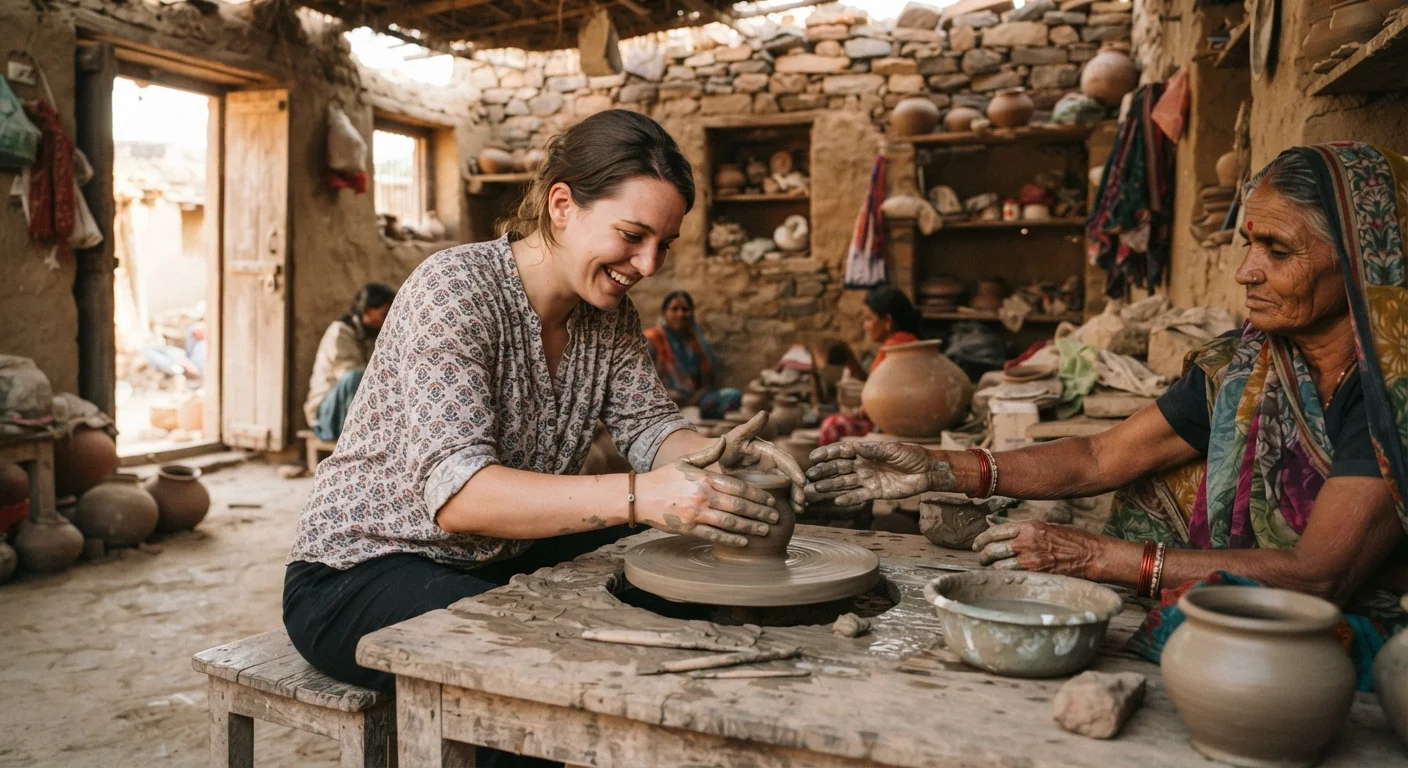
Weaving in Oaxaca. Block-printing in Jaipur. Woodblock carving in Kyoto. Hands-on craft workshops connect travelers with centuries-old techniques that are increasingly at risk of disappearing. Most sessions are led by working artisans who earn their livelihood from their craft, not from tourism alone — your participation directly supports that continuity. Even a two-hour introduction to a craft you've never tried produces something far more lasting than a souvenir purchased at a market stall.
Learning a craft from a working artisan supports cultural continuity in a tangible way.
Foraging and Farm Immersion
Agritourism — spending time on a working farm, joining a harvest, or foraging local ingredients with a guide — offers an earthy, grounding alternative to urban itineraries. Parts of Tuscany, the Basque Country, and New Zealand's South Island have well-developed farm experience programs where visitors help with seasonal tasks and share in the results. Even a half-day picking olives or gathering wild herbs reframes your relationship to food and landscape in ways that linger long after you're home. Food tourism myths are worth unpacking before building any trip around culinary experiences.
A morning foraging with a local guide reframes your entire relationship with food and place.
Language Immersion Programs
Enrolling in even a short-term language program — a week of Spanish in Guatemala, French in Senegal, or Arabic in Morocco — embeds you in a community rather than floating above it. Many programs pair structured classroom learning with homestays, conversation partners, or cultural outings. You don't need to reach fluency for the experience to be worthwhile. The act of stumbling through someone else's language, and being met with patience and warmth, teaches you something about humility and hospitality that changes how you travel afterward.
Stumbling through a language and being met with patience teaches more than any phrase book.
Indigenous-Led Cultural Experiences
Across North America, Australia, New Zealand, and beyond, Indigenous-led tourism programs offer guided access to land, story, and ceremony that outside operators simply cannot replicate. These experiences range from guided walks through ancestral landscapes to storytelling evenings and traditional ecological knowledge sessions. The key distinction — and it matters — is that these programs are designed, operated, and owned by the communities sharing them. Seek out those that make ownership and control explicit, and approach each experience as a guest, not a consumer.
Indigenous-led programs offer access to knowledge and landscape that no outside operator can replicate.
Community-Based Conservation Volunteering
Ethical conservation volunteering — coral reef monitoring in the Maldives, reforestation work in Costa Rica, wildlife corridor surveys in southern Africa — places travelers inside real conservation work rather than at its edges. These aren't photo-opportunity programs; participants typically commit to at least a week, follow researcher-led protocols, and contribute data that actually feeds into ongoing projects. The travel vertically deepens the experience: you leave understanding the ecosystem on its own terms. Before signing up, verify that local scientists or community members lead the program and that your role is genuinely useful.
Ethical conservation volunteering turns your trip into data — and that data actually matters.
Making the Most of These Experiences
The common thread across all of these is intentionality. Immersive travel doesn't just happen — it takes a little advance research, a willingness to follow someone else's rhythm, and honest self-reflection about what you actually want from a trip. If you find yourself drawn to the slower end of the spectrum, slow travel as a philosophy is worth understanding before you go. And if you're considering any kind of volunteer component, read up on the distinction between ethical volunteering and voluntourism — it matters more than most people realize.
Research Before You Commit
Before joining any immersive program, spend time verifying who runs it and how the community benefits. Check whether host families or artisans receive fair compensation, and look for programs endorsed by local cultural or conservation bodies rather than purely commercial operators. A little due diligence upfront protects both you and the communities you're hoping to engage with meaningfully.
For unfamiliar terms you encounter while planning — agritourism, transformative travel, community-based tourism — our quick reference glossary of experience-based tourism terms cuts through the jargon. Whatever form your next trip takes, the experiences below prove that the world rewards those who show up ready to engage.