

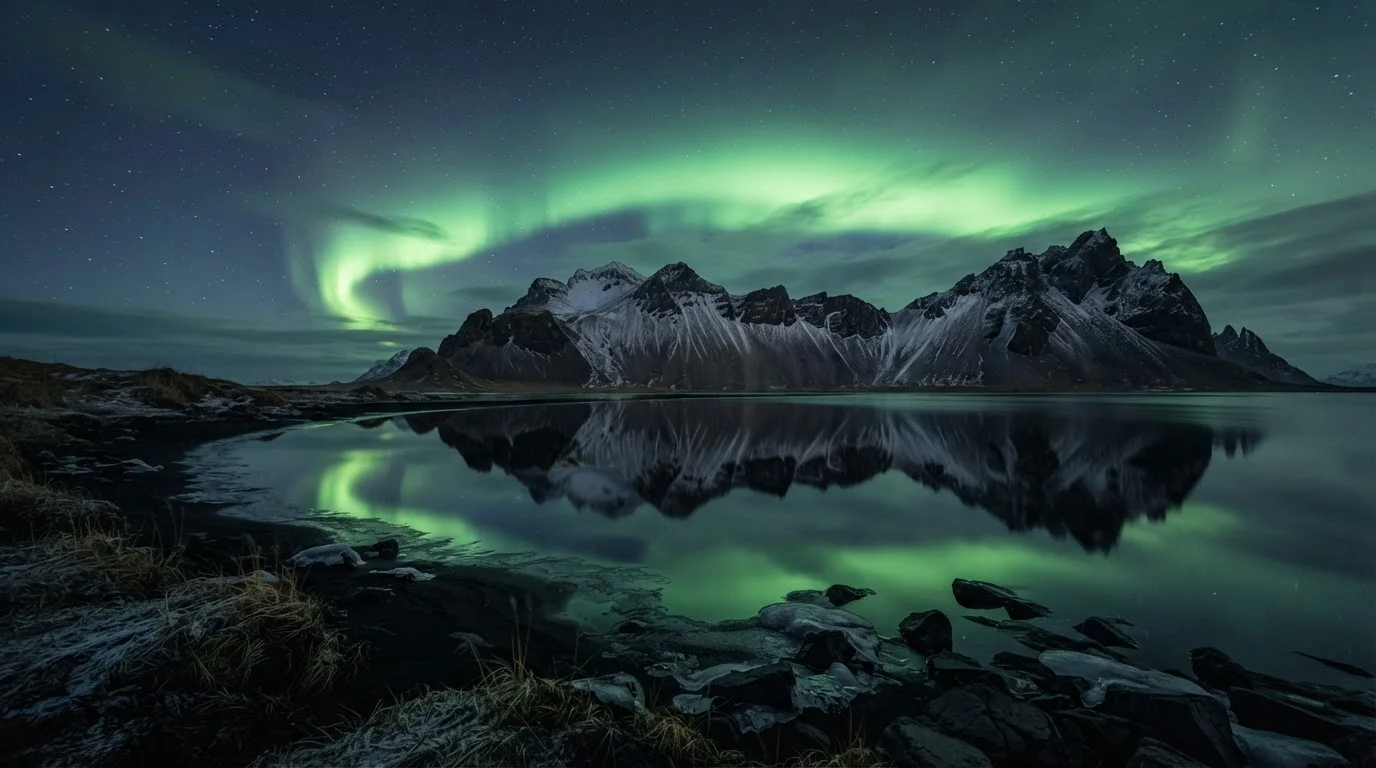
| Aurora Season | September – March (darkness required) (Icelandic Met Office) |
| Midnight Sun Peak | Around June 21 (summer solstice) |
| Highland F-Roads Open | Approximately late June – late September (Road.is (varies annually)) |
| Average Summer High (Reykjavík) | 55–61°F (13–16°C) (Icelandic Met Office climate data) |
| Average Winter Low (Reykjavík) | 27–32°F (-3–0°C) (Icelandic Met Office climate data) |
| Peak Tourist Season | June – August |
| Puffin Arrival (South Coast) | May – August |
Iceland's Four Seasons at a Glance
Iceland doesn't operate on a typical seasonal calendar. Daylight swings from nearly 24 hours in June to barely 4 in December, and weather can pivot from sunshine to sleet within the same afternoon — any month of the year. Understanding what each season actually delivers, rather than what travel brochures promise, is the difference between a trip that exceeds expectations and one that leaves you unprepared.
| Aurora Season | September – March (darkness required) (Icelandic Met Office) |
| Midnight Sun Peak | Around June 21 (summer solstice) |
| Highland F-Roads Open | Approximately late June – late September (Road.is (varies annually)) |
| Average Summer High (Reykjavík) | 55–61°F (13–16°C) (Icelandic Met Office climate data) |
| Average Winter Low (Reykjavík) | 27–32°F (-3–0°C) (Icelandic Met Office climate data) |
| Peak Tourist Season | June – August |
| Puffin Arrival (South Coast) | May – August |
For travelers thinking about timing through the lens of crowds and value, it helps to understand what shoulder season actually means for a destination like Iceland — where the calculus is far less predictable than, say, a Mediterranean beach town.
Season-by-Season Breakdown
Winter (November – February)
This is aurora season. Long polar nights — sometimes fewer than five hours of true daylight — create a wide window for northern lights viewing, but cloud cover is the wild card. Storms roll in frequently from the North Atlantic, so clear skies are never guaranteed. Roads in the highlands close entirely; even the Ring Road can be temporarily shut after blizzards. That said, winter offers a raw, uncrowded version of Iceland that many experienced visitors prefer.
Spring (March – May)
Daylight climbs fast — from around 12 hours in March to nearly 18 in May. Aurora sightings remain possible through mid-April. Snow begins retreating from lower elevations, waterfalls surge with meltwater, and puffins start arriving on coastal cliffs in May. Highland roads (the F-roads) are still closed through spring; expect mud, patchy ice, and road closures in the interior. This is genuinely one of the stronger off-season cases — decent conditions at reduced visitor numbers.
Summer (June – August)
The midnight sun peaks around the June solstice, when the sun barely dips below the horizon. Highland F-roads open (usually by late June), making interior destinations like Landmannalaugar and the Kjölur route accessible. This is peak season: flights fill, accommodation prices climb, and popular sites like Geysir and the Blue Lagoon area can feel uncomfortably crowded mid-day. Temperatures are mild rather than warm — expect 50–60°F (10–15°C) on average, with wind and rain still common.
Autumn (September – October)
Many Icelandic travelers consider this the sweet spot. Auroras return as nights lengthen, highland roads remain open through September, fall foliage colors the moorlands in amber and rust, and visitor numbers drop noticeably after school holidays end. Weather is increasingly unpredictable, particularly in October, but that's true of Iceland year-round. Factoring climate and crowds into your planning pays off enormously here.
Aurora Borealis
Natural light display caused by charged solar particles interacting with Earth's atmosphere, visible in high-latitude regions. In Iceland, it typically appears as green, white, or occasionally red ribbons of light in a dark, clear sky.
Midnight Sun
A phenomenon in high-latitude regions where the sun remains visible at midnight during summer months. In Iceland, this occurs around the June solstice, producing near-continuous daylight for several weeks.
F-Roads
Iceland's highland interior roads, designated with an 'F' prefix, which are unpaved, often involve river crossings, and are legally restricted to 4WD vehicles. They are closed during winter and spring due to snow and impassable terrain.
Polar Night
A period in winter when the sun does not rise above the horizon, leaving a location in twilight or darkness for most or all of the day. Iceland experiences long polar nights in December and January but stops short of complete polar night in Reykjavík.
Practical Considerations Before You Go
A few realities shape any Iceland trip regardless of season. Road conditions can change within hours — always check the Icelandic Road and Coastal Administration (road.is) before driving. Weather forecasts from the Icelandic Met Office (en.vedur.is) are updated frequently and should be treated as essential reading, not optional.
Packing strategy matters more here than almost anywhere else. Layering is non-negotiable in every season; waterproof outer layers are essential year-round. If you're bridging seasons in your wardrobe planning, the practical layering strategies for seasonal transitions that work at home translate reasonably well to Iceland's unpredictable mix.
If you plan to rent a car — which most visitors do — note that a 4WD vehicle is required by law for F-roads, and winter tires are mandatory from November through mid-April. Verify local driving requirements and your insurance coverage before departure.
Entry requirements, road regulations, and safety advisories can change. Always verify current conditions with official Icelandic authorities and your country's government travel portal before your trip.