

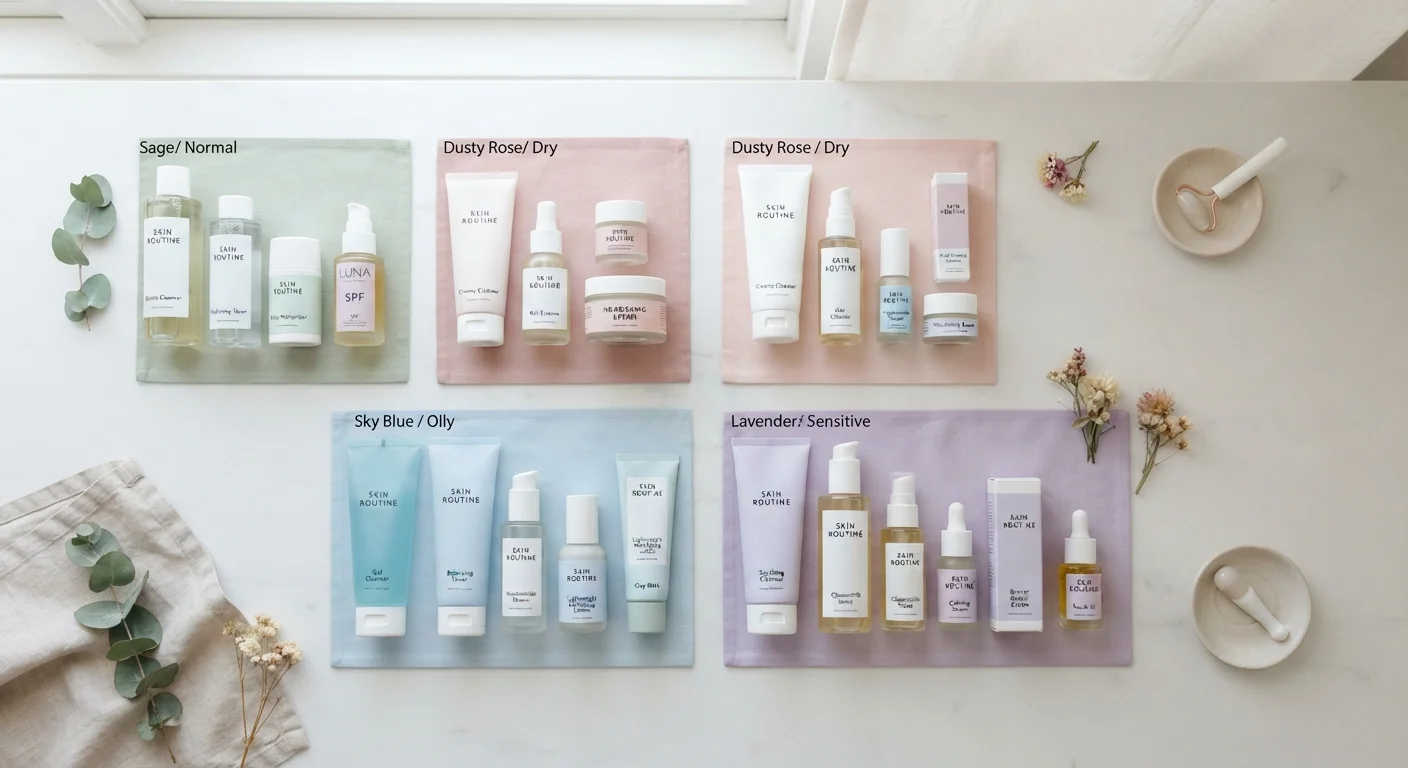
Key Takeaways
Why Skin Type Matters for Routine Building
Skin type is determined by how much sebum your sebaceous glands produce, how efficiently your skin barrier retains water, and how reactive your immune response is to environmental triggers. These biological factors directly affect which textures absorb well, which actives benefit you, and which formulas may cause breakouts or irritation. A routine built for oily skin applied to a dry complexion will accelerate dehydration; a heavy emollient intended for dry skin can clog pores prone to congestion.
Understanding your skin type isn't about locking yourself into a rigid category — many people's skin shifts with the seasons or with age. Still, identifying your current dominant pattern is the most reliable starting point for making ingredient and texture choices that work. See our plain-language ingredient reference to decode the labels once you know what to look for.
~50%
Adults reporting oily or combination skin
Surveys in dermatology literature consistently find oily and combination skin types account for roughly half of the adult population studied.
60–70%
People who self-report some degree of skin sensitivity
Research published in dermatology journals estimates that a majority of adults consider their skin sensitive at least some of the time, though clinical sensitivity is lower.
Oily Skin: Regulating Sebum Without Stripping
Oily skin produces excess sebum, which can lead to enlarged pores, shine, and acne-prone congestion. The most common mistake is reaching for harsh, alcohol-heavy cleansers to eliminate oil. These temporarily reduce shine but trigger a rebound effect — the skin senses over-drying and ramps up sebum production to compensate.
Instead, prioritize a gentle, foaming or gel cleanser that removes excess oil without disrupting the acid mantle. Follow with a lightweight, oil-free moisturizer containing humectants (ingredients that draw water into the skin) like hyaluronic acid or glycerin. For active exfoliation, BHAs (beta-hydroxy acids) — particularly salicylic acid — are lipid-soluble, meaning they penetrate the pore lining to clear congestion where AHAs cannot reach.
When addressing oily skin, look for the label 'non-comedogenic' on moisturizers — this indicates the formula has been tested to avoid blocking pores, though individual responses still vary.
Pore-clogging ingredients (comedogenic ingredients) are a common source of breakouts for oily and acne-prone skin types, and avoiding them is a recognized strategy in evidence-based skincare guidance.
For dry skin, apply moisturizer within 60 seconds of cleansing while skin is still slightly damp — this helps humectants attract more water before the surface fully dries.
Humectants are most effective when there is surface moisture available to bind; applying to damp skin is a commonly recommended practice in dermatological guidance to maximize hydration efficiency.
Avoid layering multiple mattifying products simultaneously, as this compounds dryness and potential irritation. If you're uncertain whether two products in your routine overlap in function, our guide on skincare ingredient overlaps is a useful checkpoint.
Avoid Over-Exfoliating Oily Skin
Using BHAs more than two to three times per week — or combining them with other exfoliating acids simultaneously — can compromise the skin barrier even on oily skin. Over-exfoliation presents as increased sensitivity, redness, or paradoxically worsening breakouts. If you notice these signs, scale back frequency before increasing again.
Dry Skin: Reinforcing the Barrier and Locking In Moisture
Dry skin lacks sufficient lipid content in the skin barrier, allowing water to escape through a process called transepidermal water loss (TEWL). Symptoms include tightness, flakiness, dullness, and increased sensitivity. A hydration-first approach must address both attracting water to the skin and sealing it in.
Build your routine in three functional layers: a humectant to draw in moisture (such as hyaluronic acid or aloe vera), an emollient to smooth and fill gaps in the skin barrier (such as ceramides, squalane, or fatty acids), and an occlusive to prevent evaporation (such as shea butter or petrolatum in heavier creams). Cream or balm cleansers are preferable over foaming formulas, which can further strip lipids.
Note that environmental conditions significantly affect dry skin — your moisturizer may underperform in winter as cold air and indoor heating accelerate TEWL. Adjusting texture or adding a facial oil layer seasonally is a well-founded response.
Combination Skin: Zone-Based Adjustments
Combination skin presents oiliness in the T-zone (forehead, nose, and chin) alongside normal-to-dry cheeks. Using a single product uniformly across the face often means over-treating one zone while neglecting another.
A practical approach: use a gentle, balanced cleanser across the whole face, then apply targeted treatments by zone. A lightweight, non-comedogenic moisturizer can cover the full face, with a dedicated mattifying product or BHA applied only to the T-zone if congestion is a concern. Similarly, richer emollients can be focused on cheek areas if they tend toward dryness.
Layering products thoughtfully is especially important for combination skin. Our editorial on layering skincare without canceling effects explains how to sequence products so actives remain effective.
Try a Multi-Masking Approach
For combination skin, applying different masks to different zones simultaneously — a clay or kaolin mask to the T-zone and a hydrating mask to the cheeks — lets you address both excess oil and dryness in one routine step. This 'multi-masking' technique is a practical solution supported by the different ingredient needs of each zone.
Sensitive Skin: Minimizing Triggers, Maximizing Calm
Sensitive skin is defined not by sebum production but by reactivity — a lower threshold for redness, stinging, itching, or flushing in response to topical ingredients, temperature changes, or environmental factors. It can co-occur with any of the other skin types.
The most evidence-supported approach for sensitive skin is a simplified, short-ingredient-list routine. Fragrance — both synthetic and natural — is among the most common topical irritants; formulas labeled fragrance-free (not just unscented) are more appropriate. When introducing any new active, patch-test on the inner arm for several days before applying it to the face, and introduce one product at a time to isolate any adverse response.
Barrier-supportive ingredients like ceramides, niacinamide, and panthenol are generally well-tolerated and help reduce reactivity over time by strengthening the skin's protective function. Review our guide on AM vs. PM routine differences to understand when to apply soothing versus active ingredients for best results.
Sensitive Skin and Rosacea Are Not the Same
Self-reported sensitive skin encompasses a wide spectrum of conditions. Rosacea, eczema (atopic dermatitis), and contact dermatitis each have distinct clinical presentations and management approaches. If your skin reactivity is persistent, patterned, or significantly affects quality of life, a dermatologist evaluation is appropriate rather than self-guided routine adjustments alone.
This article is for general informational and educational purposes only and does not constitute medical advice. If you experience persistent skin conditions, redness, or allergic reactions, please consult a qualified dermatologist or healthcare provider.
Ingredients That Span All Skin Types
Regardless of skin type, a handful of ingredients and practices are broadly appropriate and consistently evidence-backed:
- Broad-spectrum SPF 30+: UV exposure is the leading environmental cause of barrier damage, hyperpigmentation, and accelerated skin aging across all skin types. Daily application is supported by widespread dermatological consensus.
- Niacinamide (vitamin B3): Regulates sebum production, reduces the appearance of pores, supports ceramide synthesis, and is generally well tolerated even by sensitive skin at concentrations of 2–5%.
- Hyaluronic acid: A humectant that draws water to the skin surface. Effective across oily, dry, and combination types when applied to damp skin and sealed with a moisturizer.
- Ceramides: Lipid molecules that mimic the skin's natural barrier structure. Useful for dry, sensitive, and compromised skin but non-problematic for other types.
Building any routine — regardless of skin type — on these fundamentals before adding targeted actives reduces both risk of irritation and the likelihood of ingredient overlap.