

Key Takeaways
Why visual references work better than verbal descriptions
Most people, when asked to describe their style, reach for broad, overlapping adjectives: 'classic,' 'relaxed,' 'effortless.' These words are real, but they're too imprecise to drive decisions. 'Classic' covers everything from Parisian minimalism to American preppy — they share a label but produce entirely different wardrobes.
Visual references bypass this ambiguity. When you collect images instinctively, you're recording aesthetic preferences without the interference of language. The patterns that emerge — in color temperature, proportion, texture, and mood — are more specific and more honest than self-description tends to be.
This is why moodboarding is a useful step before any framework or archetype exercise. If you're curious about style archetypes as a complementary tool, the style archetypes framework offers a structured vocabulary for what your board might be telling you. But the board itself comes first — it gives you raw data; frameworks help you interpret it.
The approach also extends beyond clothing. The same moodboarding logic applies when decorating a room from scratch — visual references surface spatial and tonal preferences that are difficult to name in advance.
Quickly collect and organize large volumes of visual reference images into boards by theme or mood.
Canva or a similar design tool
Arrange saved images into a single-view collage that makes patterns easier to spot at a glance.
Printed magazines or catalogs
Provide tactile, analog image sources for a physical moodboard — useful if digital screens affect your judgment.
A dedicated notebook or journal
Record observations, recurring descriptors, and style words that emerge when you analyze your collected images.
How to build your moodboard — step by step
What you will need
Choose your format and open a blank canvas
Decide whether you'll work digitally or physically before you begin — mixing formats mid-process can fragment your thinking. For a digital board, open a fresh Pinterest board set to secret, or create a blank canvas in a design tool. For a physical board, gather a corkboard, a large sheet of paper, or a spread in your journal alongside scissors and adhesive.
The format choice is less important than committing to one. Digital boards make it easier to collect quickly; physical boards can slow you down in a useful way, making each selection feel more deliberate.
Set a timer and collect images without filtering
Give yourself 20–40 minutes and save anything that creates a reaction — not just outfits you'd wear, but interiors, film stills, artwork, travel photography, and portraits. The goal is volume and instinct, not curation. Resist the urge to second-guess saves mid-session.
Images that reflect a mood, a texture, or a color relationship are often more revealing than direct clothing references. A photograph of a fog-covered coastline might tell you more about your color palette instincts than a runway image will.
Arrange everything into a single view
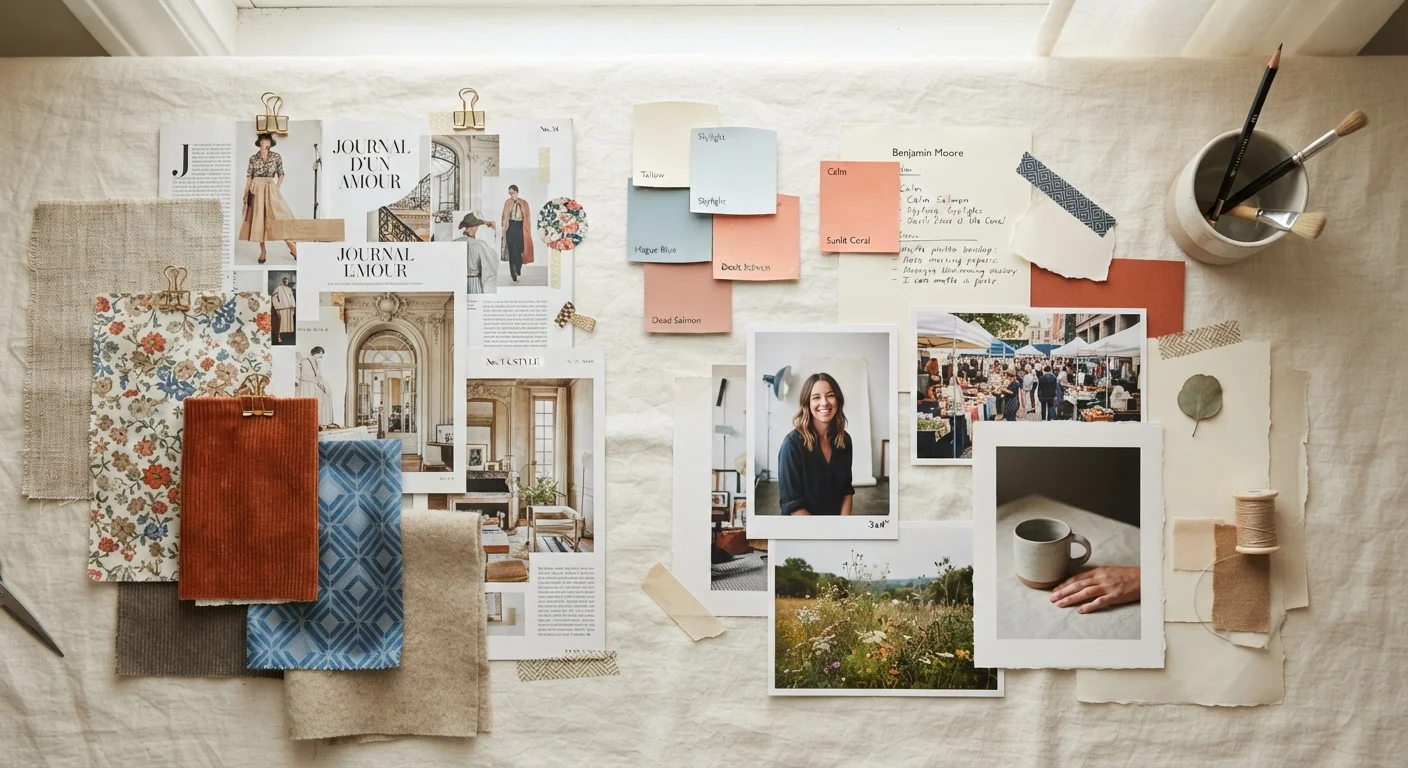
Once you've collected 30–60 images, pull them all into one visual field. On a digital tool, tile them without gaps. Physically, lay them out on a flat surface before adhering anything. The point is to see all references simultaneously, which is where pattern recognition actually kicks in.
Don't arrange by category at this stage. Randomness in the layout often makes recurring themes more visible — you'll notice color clustering and silhouette repetition that a sorted layout would obscure.
Identify the patterns — color, silhouette, texture, mood
Step back and look at your board as a whole before zooming into individual images. Note which colors appear most frequently, which silhouettes recur (structured vs. relaxed, fitted vs. oversized), and which textures dominate (matte, tactile, sheer, chunky). Write these down in your notebook as you observe them.
Then look for a tonal or emotional quality across the images. Are they predominantly quiet and monochromatic? Layered and eclectic? Sharp and minimal? These mood descriptors will be as useful as any specific item reference when you begin applying the board to real decisions.
Edit the board down to its strongest signal
Remove images that feel like outliers — pieces you saved out of momentary trend interest or social influence rather than genuine pull. Aim to reduce your collection by roughly 30%, leaving the images that feel most consistently 'you' when you look at them cold, a day after collecting.
What remains is a tighter reference set that reflects your actual aesthetic instincts rather than a broad Pinterest mood. This edited board is the working document you'll return to before shopping or decluttering.
Translate the board into actionable style language
Write 5–8 words or short phrases that summarize what you see. These might be colors ('warm neutrals, deep olive'), silhouette notes ('relaxed but structured shoulders'), texture preferences ('matte, natural fiber-looking'), or mood words ('understated, considered, slightly worn-in'). This vocabulary becomes your filter for future decisions.
From here, the moodboard pairs directly with a wardrobe audit — use it to assess which pieces you currently own align with your identified aesthetic and which create noise.
Your moodboard is a diagnostic tool, not a wishlist
The most common mistake is saving images of items you want to own rather than images that reflect how you want to feel or be perceived. When the board skews toward product shots, the resulting 'insights' tell you what you're drawn to buying in the moment — not what your actual aesthetic is. Prioritize editorial images, interiors, and non-clothing references to keep the board honest.
What to do with your moodboard once it's built
A completed moodboard is most valuable as a decision-making filter, not a decorative artifact. Before adding anything new to your wardrobe, hold it against your style language: does this piece fit within the color range, silhouette logic, and mood of the board? If the honest answer is no — even if the item is appealing in isolation — that's information.
The board also makes a wardrobe audit more productive. Rather than assessing pieces on condition or vague 'do I love it?' criteria, you're measuring alignment against a defined aesthetic. Pieces that don't fit the board's language are candidates for removal, regardless of cost or sentimental association.
If you find the board difficult to apply — if nothing in your existing wardrobe aligns — that's a signal to read the case for developing a style identity before shopping rather than immediately refreshing your closet. Understanding why the gap exists is more useful than filling it quickly.
Don't conflate aspiration with identity
Moodboards can drift toward idealized or performance-based imagery — how you wish you lived rather than how you actually live. A board full of minimalist linen interiors and off-duty model looks may reflect cultural aspiration more than personal style. Cross-check your board against your real daily context: your climate, your movement through the day, and what you reach for consistently.
One board is not a final answer
A moodboard is a snapshot of your instincts at a particular moment, not a permanent style prescription. Revisit and rebuild it seasonally or before any significant wardrobe decision. Aesthetic preferences shift with life context, and a board that no longer resonates is a signal worth paying attention to — not a failure of the process.