

Key Takeaways
Unit Pricing
Unit pricing is the cost of a product expressed per standard unit of measurement — such as per ounce, per sheet, per fluid ounce, or per count. Rather than comparing a $4.99 bottle to a $6.49 bottle, unit pricing lets you compare apples to apples: say, 18 cents per ounce versus 14 cents per ounce. It strips away package size as a variable and reveals the true cost of what you're buying.
In the U.S., most states require retailers to display unit prices on shelf tags for food and household products, though enforcement and formatting vary by state and retailer.
Why the Sticker Price Tells You Almost Nothing
A 32-ounce bottle of dish soap priced at $3.99 looks cheaper than a 16-ounce bottle at $2.49 — until you do the math. The larger bottle costs about 12.5 cents per ounce; the smaller one costs about 15.6 cents per ounce. The bigger package wins on unit price. But flip that scenario with a different brand and different sizes, and the outcome can reverse entirely.
This is why total price comparisons are unreliable. Retailers know shoppers anchor on the big number on the tag. Package sizes are frequently adjusted — a practice sometimes called "shrinkflation" — so that products appear price-stable while delivering less per dollar. Unit pricing is the antidote.
For a broader look at how shelf psychology can nudge your decisions, see how retailers use pricing psychology to frame perceived value.
~35%
Typical unit price gap between store and name brands
Consumer research organizations, including Consumer Reports, have consistently documented per-unit cost differences of 20–35% or more between store-brand and national-brand equivalents in common grocery categories.
19 states
States with unit pricing laws for grocery retailers
As of publicly available legislative records, roughly 19 U.S. states have statutes or regulations specifically requiring unit pricing disclosure in food retail settings, though requirements and enforcement vary.
~30%
Shoppers who regularly use unit price labels
Research on grocery shopping behavior has found that a minority of shoppers consistently consult unit price labels, despite their widespread availability, suggesting significant untapped savings potential.
How to Read and Calculate Unit Prices
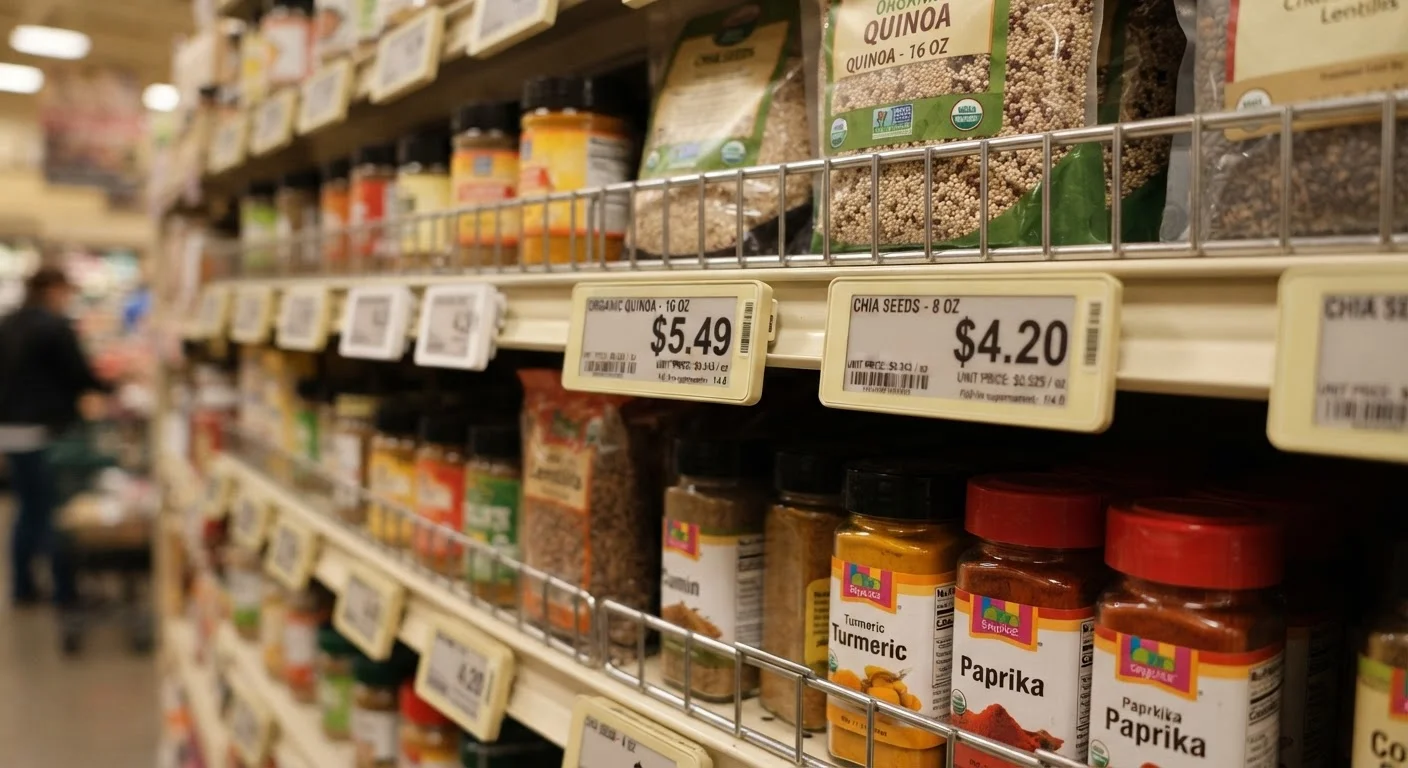
Most U.S. grocery stores display the unit price on the shelf edge tag, usually in a smaller font than the retail price. The label might read $0.18/oz or $0.04/sheet or $0.31/load — each expressing cost per the most practical measurement for that product type.
When the label is absent, unclear, or uses a different unit than a competing product, calculate it yourself:
- Identify the total price and the net quantity from the package (e.g., $5.79 for 48 oz).
- Divide total price by quantity: $5.79 ÷ 48 = $0.121 per ounce.
- Repeat for the competing product and compare the results directly.
The catch: units must match. If one pasta sauce lists cost per ounce and another lists cost per pound, convert one before comparing (multiply the per-ounce price by 16 to get per-pound cost). Mismatched units are a common source of shelf-tag confusion.
Use Your Phone When Labels Are Unclear
If shelf tags use different units or the math isn't immediately clear, the calculator on your phone takes less than 30 seconds. Divide the total price by the package quantity to get the unit price. For laundry products, always try to compare by load count rather than volume — it's the most accurate reflection of how many uses you're getting per dollar.
Where Unit Pricing Reveals the Biggest Surprises
Several product categories routinely produce counterintuitive results when examined by unit price:
- Paper products (toilet paper, paper towels): "double roll" and "mega roll" labeling makes sheet-count math essential. Two products in the same shelf section can differ by 40% or more on a per-sheet basis.
- Cereals and snacks: Family-size boxes are not always the better unit deal. Promotional sizes and multipack configurations sometimes undercut the bulk option.
- Laundry detergent: Concentration levels vary. A "2x concentrated" detergent with a higher price per fluid ounce may still be cheaper per load than a diluted competitor. Always compare by load count, not volume.
- Canned goods: Store brands in the same aisle frequently offer an equivalent product at 20–35% lower unit cost, according to general consumer research findings from organizations like Consumer Reports.
Unit pricing also interacts with sale mechanics in ways worth understanding. A "buy one, get one 50% off" promotion changes the effective unit price — but only if you actually need two units before they expire. See how bulk deals interact with unit pricing for a detailed breakdown.
Unit Pricing as One Tool Among Several
Unit pricing is powerful but not the complete picture. It measures purchase efficiency — cost per unit acquired — not total ownership value. A product with a marginally higher unit price might still be the smarter choice if it has a longer shelf life, better packaging that reduces waste, or a significantly lower rate of returns.
Similarly, unit pricing doesn't capture costs that arrive after checkout. Hidden post-purchase costs like shipping minimums, subscription lock-ins, or accessory requirements can erode an apparent unit-price advantage when buying online versus in-store.
For a full pre-purchase checklist that puts unit price in context alongside warranty terms, return policies, and size variations, see what to verify before comparing prices.
Used consistently, unit pricing is one of the most time-efficient habits a grocery shopper can build. It takes seconds at the shelf and compounds into meaningful savings over months and years of regular shopping.
“The unit price is the great equalizer at the grocery store. Once shoppers learn to use it reflexively, it becomes nearly impossible to be misled by package design or promotional framing.”
— Edgar Dworsky, Consumer advocate and founder of ConsumerWorld.org, long-time researcher of retail pricing practices
This article is for general informational purposes only. Prices, packaging, and product availability vary by retailer, location, and time. Always verify details at the point of purchase.