

Key Takeaways
Unit Pricing
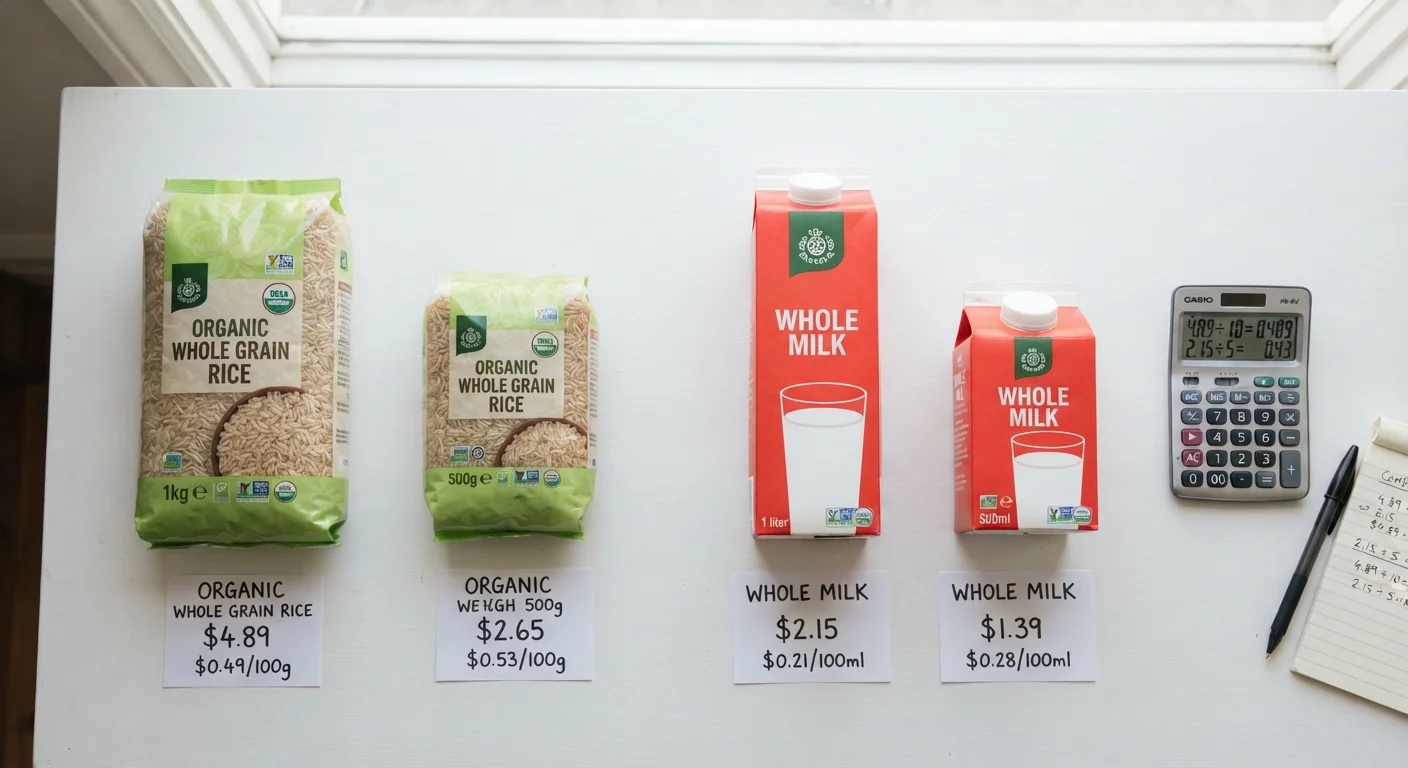
Unit pricing is the cost of a product broken down to a standard measurable quantity — such as price per ounce, per sheet, per fluid ounce, or per count. It lets you compare products of different sizes on equal footing, regardless of how they're packaged or marketed. Instead of comparing a $4.99 bottle to a $7.49 bottle, you compare $0.31 per ounce to $0.22 per ounce.
Many U.S. states require retailers to display unit prices on shelf tags, though the unit of measure used can vary — making cross-aisle comparisons require a quick manual conversion.
Why Package Price Misleads More Than It Guides
Shoppers are trained by experience to assume that a higher sticker price means a worse deal. But package price is one of the least reliable signals available. A $9 bottle of dish soap may cost half as much per ounce as a $5 competitor — or it may cost twice as much. Without calculating the unit price, there's no way to tell.
Retailers understand this. Package sizing is often designed to obscure direct comparison. A 14.5-oz can sits next to a 15-oz can. A "family size" detergent uses loads as its unit while the standard size uses ounces. These inconsistencies aren't accidental — they make it harder for shoppers to do quick mental math.
Unit pricing cuts through that noise. For a deeper look at how price comparisons can go wrong before you even pull out a calculator, see what to check before comparing prices.
30+
U.S. states with unit pricing requirements
More than 30 U.S. states have laws requiring unit price disclosure on retail shelf tags, though enforcement and consistency vary widely by retailer and product category.
~20%
Average savings identified through unit price awareness
Consumer research has generally found that shoppers who actively compare unit prices identify meaningful savings opportunities — estimates typically range from 10–25% depending on category and shopping context.
The Unit Price Calculation — And When to Convert
The formula is straightforward: divide the total price by the total quantity. A 32-oz bottle for $4.80 works out to $0.15 per ounce. A 20-oz bottle for $3.40 is $0.17 per ounce. The larger package wins — but only if you do the division.
The complication arises when products use different units on their shelf tags. One laundry detergent lists price per load; another lists price per ounce. To compare them honestly, you need to convert one. If a detergent recommends 2 oz per load, then price per load equals price per ounce multiplied by 2. That single step changes the comparison entirely in some cases.
For products measured in counts — paper towels, trash bags, vitamins — the math is even simpler: total price divided by number of units. A 120-count bottle of vitamins at $14.40 equals $0.12 per tablet. A 90-count at $11.70 equals $0.13 per tablet. The larger bottle wins by a penny per tablet, which adds up over time.
Use Your Phone's Calculator at the Shelf
Don't trust mental estimates when comparing package sizes — small differences in quantity can flip which item is actually cheaper. Open your phone's calculator, divide total price by total quantity for each option, and compare the results directly. It takes less than 30 seconds and eliminates guesswork entirely.
When Bulk Deals Don't Deliver the Math They Promise
The assumption that bulk always means cheaper is one of the most persistent misconceptions in consumer shopping. Warehouse clubs and multipack retailers have built entire business models around this assumption — and while they often do offer genuine per-unit savings, not every category or item follows that pattern.
Three specific situations where bulk purchases underperform:
- Perishables with short shelf life. A bulk container of salad greens or fresh bread at a lower unit price delivers zero savings if half of it goes in the trash before you use it. The real cost includes the waste.
- Membership overhead. If accessing bulk pricing requires a paid annual membership, that cost needs to be factored in proportionally. As noted in our look at costs that quietly erase a good deal, fees that seem separate from the product price still affect your real per-unit cost.
- Products you'll switch or abandon. Cleaning products, supplements, and personal care items are often reformulated or replaced in a shopper's routine. Buying 200 units of something you stop using after 40 is a net loss regardless of the per-unit price.
The underlying principle: a bulk deal only saves money when you actually use what you bought. Usage rate is part of the math.
Reading Shelf Tags — And What to Watch Out For
Many U.S. grocery retailers are required to display unit pricing on shelf tags, but the implementation is inconsistent. Common issues include:
- Unit prices displayed in different measurements for similar products (one in per-ounce, another in per-100g)
- Tags that haven't been updated after a price change
- Unit pricing missing entirely for some items or formats
When the shelf tag is unreliable or absent, use your phone's calculator. It takes under 10 seconds and removes all guesswork. For products where quality varies significantly between package sizes — such as paper towels with different ply counts — also factor in functional yield. A two-ply sheet may do the work of 1.5 single-ply sheets, changing the effective unit price even if the nominal count is the same.
Unit pricing is also the foundation of smarter value comparisons across product categories — not just groceries. Applying this same discipline to electronics accessories, cleaning supplies, or pet food can reveal savings that a quick price scan would miss entirely.
“Unit pricing is perhaps the single most underused tool available to consumers. It removes the packaging and forces an honest comparison — but only if you use it.”
— Consumer Reports Editorial Team, Independent consumer product testing and advocacy organization