

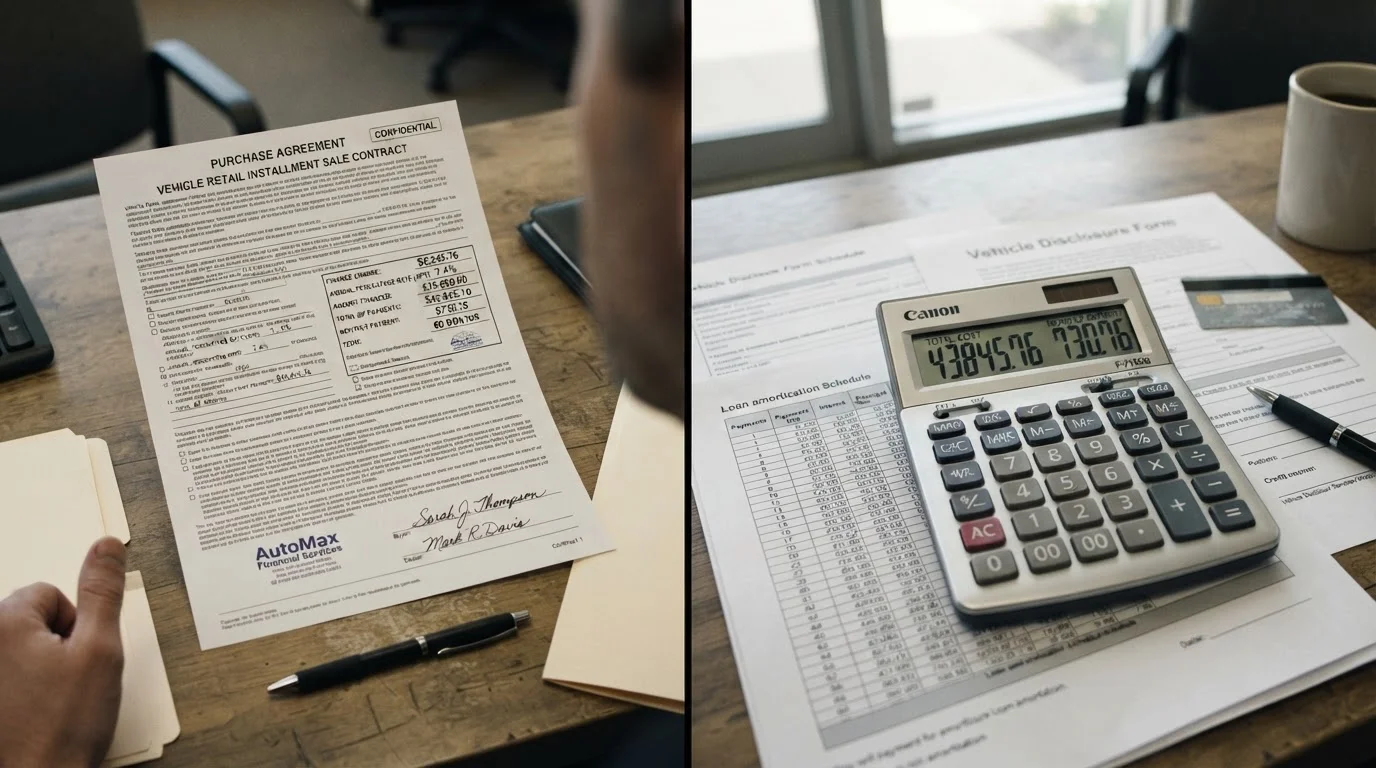
Key Takeaways
Option A
Annual Percentage Rate (APR)
The true cost of borrowing, expressed annually.
Best for: Comparing the real cost of two different loan offers on equal footing.
Option B
Monthly Payment
The short-term cash-flow figure lenders lead with.
Best for: Assessing whether a loan fits within your current monthly budget.
If you're comparing two or more loan offers side by side
Annual Percentage Rate (APR)
APR is the only standardized measure that lets you compare loans of different structures on equal footing. Monthly payment figures are too easily manipulated by adjusting the loan term.
If you need to confirm a loan fits your monthly budget
Monthly Payment
Monthly payment is a useful budget-planning figure, but only after you've already verified the APR and total repayment cost are acceptable.
If you're financing an appliance or furniture with a promotional '0% interest' offer
Annual Percentage Rate (APR)
Deferred interest promotions often carry a high APR that activates retroactively if the balance isn't paid in full by the promotional deadline.
Why Lenders Lead With Monthly Payment
Walk into any car dealership or browse an appliance retailer's financing page and you'll notice a pattern: the number they emphasize is almost always a monthly payment. "Only $249 a month!" is a far more comfortable figure than "$14,800 in total interest over six years." This framing isn't accidental.
Monthly payment is highly malleable. A lender can make almost any loan feel affordable by extending the term. A $35,000 auto loan at 8% APR runs about $711/month over 48 months — but stretch that to 84 months and the payment drops to $547. That $164 monthly savings costs approximately $3,800 in extra interest over the life of the loan. The monthly payment went down; the total cost went up significantly.
Understanding this dynamic is the first step toward evaluating any financing offer clearly. For a deeper primer on the mechanics, see our auto loan basics guide.
What APR Actually Measures
APR — Annual Percentage Rate — is a standardized expression of what you pay to borrow money, calculated on a yearly basis. Under the federal Truth in Lending Act, lenders are required to disclose APR, because it includes not just the interest rate but also certain fees folded into the cost of the loan. This makes it a far more complete measure than the stated interest rate alone.
When comparing two loan offers, the one with the lower APR will generally cost less over time — assuming identical loan terms. That last caveat matters. A loan with a slightly lower APR but a longer term can still cost more in total dollars. This is why both figures need to be evaluated together.
| Criterion | Annual Percentage Rate (APR) | Monthly Payment |
|---|---|---|
| What it measures | Total annual borrowing cost, standardized | Cash outflow per month |
| Usefulness for comparison | High — consistent across lenders | Low — varies with loan term |
| Affected by loan term | Not directly | Significantly — longer term = lower payment |
| Includes fees | Yes, under federal disclosure rules | No — only principal + interest |
| Reveals total interest paid | Yes, when combined with loan term | No |
| Risk of misleading shoppers | Lower — standardized metric | Higher — easily reduced by extending term |
Appliance and furniture financing introduces another wrinkle: promotional "0% APR" offers. These can be legitimate interest-free deals, but many carry deferred interest clauses — meaning if any balance remains when the promotional period ends, interest accrues retroactively at a rate that often exceeds 25%. The monthly payment during the promotional window looks attractive; the real cost if you miss the payoff deadline is anything but.
The Loan Term Variable Nobody Talks About
Loan term is the hidden lever in every financing conversation. Lenders know that most shoppers anchor to the monthly payment, so extending the term is the easiest way to close a deal without lowering the price or the APR.
72+ months
Common new-vehicle loan term in the U.S.
According to Experian's State of the Automotive Finance Market reports, loans of 73–84 months have represented a growing share of new vehicle financing in recent years.
~$3,800
Extra interest from extending a $35K loan by 36 months
Illustrative calculation: a $35,000 loan at 8% APR over 84 months versus 48 months, holding rate constant.
25%+
Typical deferred-interest APR on retail financing
Store-branded financing cards often carry APRs in this range, which activate retroactively if a promotional balance isn't paid in full by the deadline.
Auto loan terms have grown steadily longer over the past decade. Terms of 72 and 84 months — once uncommon — are now a significant share of new vehicle financing. The financial risk compounds: longer-term loans also increase the period during which you may owe more than the vehicle is worth (called being "underwater" or having negative equity), which creates problems if you need to sell or trade in early.
For appliances, the dynamic is similar in structure if smaller in scale. A refrigerator financed at 18% APR over 24 months versus 12 months may look cheaper month-to-month in the longer option — but results in meaningfully more interest paid. Always calculate total repayment: multiply the monthly payment by the number of months, then compare that figure against the cash price.
These hidden compounding costs connect directly to the broader picture of what a purchase truly costs. Our piece on hidden costs that don't appear on the price tag covers related ground worth reviewing before any large purchase.
How to Evaluate Any Financing Offer
A practical framework for assessing auto or appliance financing involves three numbers, not one:
- APR — the annual cost of borrowing, standardized for comparison.
- Loan term — how many months you'll be paying, and how that affects total interest.
- Total repayment amount — APR times term produces the actual dollar cost. Always ask for this figure explicitly.
If a lender or retailer is reluctant to provide the total repayment figure or keeps redirecting to the monthly payment, treat that as a signal to slow down. Legitimate financing offers can withstand scrutiny across all three numbers.
For auto purchases specifically, financing costs are just one component of what you'll spend. Registration, insurance, fuel, and maintenance all factor into real-world affordability — our total cost of ownership breakdown puts the full picture in one place. And if you're weighing whether to finance at all versus lease, the leasing vs. financing comparison addresses that question directly.
The core principle applies across categories: monthly payment is a budget tool; APR is a cost tool. Use both, but never let the payment figure substitute for understanding the loan's actual price.