

Key Takeaways
Deal Fatigue
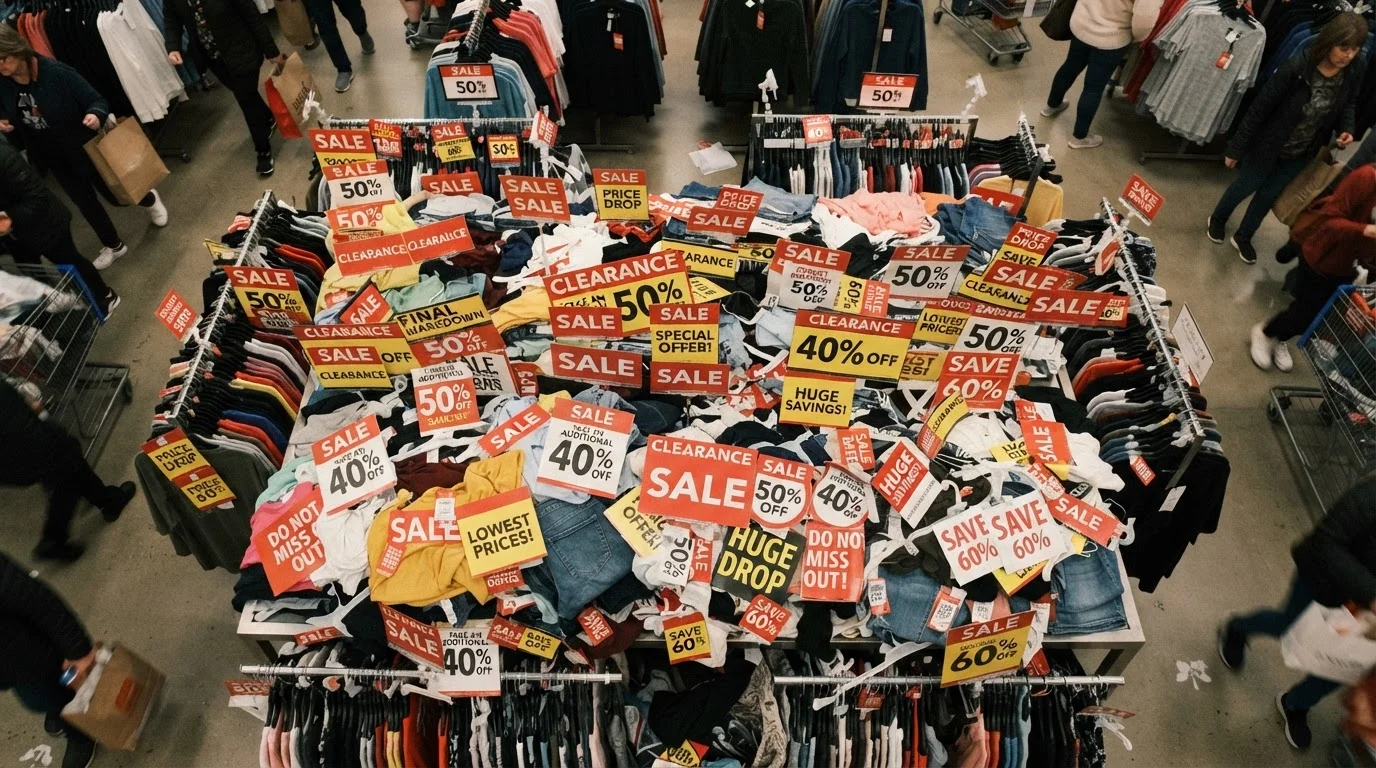
Deal fatigue describes the state consumers reach when they've been exposed to so many promotions, markdowns, and limited-time offers that they can no longer reliably judge whether a price is actually good. The original or 'regular' price loses credibility as a benchmark because discounts appear so frequently they seem permanent. As a result, shoppers struggle to decide when — or whether — to buy.
In behavioral economics, this relates to reference price erosion: when a product's 'sale' price is displayed often enough, it becomes the consumer's internal anchor, rendering the stated original price psychologically meaningless.
How Promotions Became the Default, Not the Exception
Retail promotions were originally designed to create urgency around specific, time-limited events — clearing seasonal inventory or celebrating a holiday. Over time, the cadence of sales has accelerated to the point where some retailers run continuous promotions with no meaningful gap between them. A mattress store perpetually advertising a 'Presidents' Day sale' in July is a familiar example, but the pattern extends across electronics, apparel, home goods, and beauty categories alike.
This promotional saturation creates a structural problem for consumers: the 'original' price — the number a discount is measured against — becomes unreliable as a reference point. If a television is listed at $999 with a $300-off tag for 40 weeks of the year, the $999 figure is not a genuine market price. It's a number that exists primarily to make $699 look like a bargain. Understanding this dynamic is foundational to smarter shopping, and it connects directly to the true meaning of value that marketing language tends to obscure.
~40%
Shoppers who say sales happen too often to trust
Consumer surveys conducted by retail research organizations have consistently found that a significant share of U.S. shoppers doubt the legitimacy of promotional pricing due to its frequency.
90 days
Price history window recommended for comparison
Consumer advocates generally suggest reviewing at least 90 days of price history before treating a 'sale' price as a genuine reduction from the norm.
Billions
Dollars spent during major promotional sales events annually
U.S. consumers spend tens of billions of dollars during marquee sales events each year, much of it driven by perceived — rather than verified — savings.
The Psychology Behind Anchor Prices and Perceived Savings
Behavioral economists use the term anchoring to describe how the first number a person sees shapes their judgment of subsequent numbers. In retail, the 'original' or 'regular' price functions as an anchor: a $200 item marked down to $120 feels like a meaningful saving, even if $120 has been the consistent street price for months. When promotions are constant, the stated anchor becomes arbitrary — and shoppers often sense this without being able to articulate why they feel uncertain.
The consequence isn't just confusion. Deal fatigue produces two distinct but opposite consumer behaviors. Some shoppers become impulsive, buying whenever a discount appears because they fear prices will 'go back up' — even when prices rarely do. Others become paralyzed, perpetually waiting for a deeper deal that may never arrive. Neither response serves the shopper's actual interests. Being aware of this pattern is the first step toward sidestepping it.
“The problem with permanent sales is that they don't inform the consumer — they confuse them. When everything is always discounted, the discount itself carries no information.”
— Consumer Behavior Research Consensus, Widely documented finding across behavioral economics and marketing literature
Practical Ways to Rebuild a Reliable Price Reference
When promotional noise obscures a fair price, the most direct fix is to consult price history data rather than relying on the retailer's stated 'before' figure. Several browser extensions and price-tracking services log historical prices for products sold on major platforms, letting you see what an item typically sells for over the past 30, 60, or 90 days. If the current 'sale' price matches the item's consistent historical price, the discount is mostly cosmetic.
A complementary strategy is cross-retailer comparison. A product sold by multiple sellers will often reveal its true market price range more honestly than any single retailer's promotional framing. This is particularly useful for electronics and appliances. Keep in mind that headline price is rarely the whole story — hidden costs like shipping and restocking fees can quietly reverse an apparent saving.
Set Your Own Price Threshold First
Before researching any item, decide the maximum you'd be willing to pay if no sale were advertised. Write it down. This self-anchored number acts as a filter: if the current price — sale or otherwise — falls at or below your threshold, it's a reasonable time to buy. If it doesn't, no amount of promotional framing changes the math.
For a broader framework on evaluating genuine savings versus promotional theater, our breakdown of major sales events identifies which categories tend to offer real discounts and which are largely driven by hype.
Anchoring to Utility, Not the Discount
Perhaps the most durable antidote to deal fatigue is reframing the question you ask before buying. Instead of 'how much am I saving?', ask 'what is this item worth to me at this price, independent of what it was supposedly priced before?' This shifts your anchor from the retailer's number to your own assessment of value.
Total cost of ownership is a useful lens here. An item that costs less upfront but requires frequent replacement or accessory purchases may cost more over time than a higher-priced alternative — a dynamic explored in depth in why the cheapest option often costs more long-term. Similarly, unit pricing and bulk-deal math offers another concrete tool for cutting through promotional framing and evaluating what you're actually paying per use or per unit.
Deal fatigue is a structural feature of modern retail, not a temporary condition. Shoppers who recognize it for what it is — a systematic distortion of reference prices — are better positioned to make decisions grounded in actual value rather than promotional theater.