

Key Takeaways
Option A
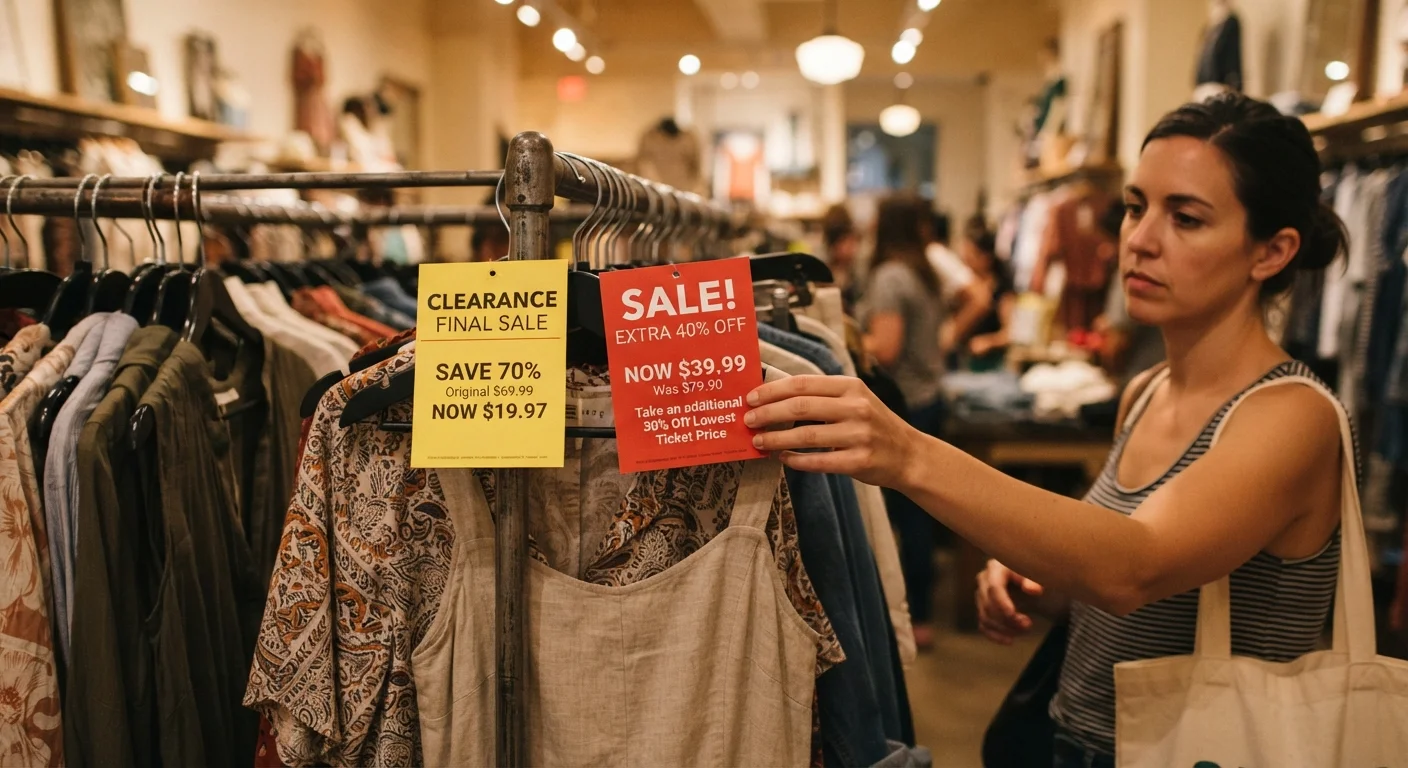
Clearance
Permanent markdowns to move inventory out for good.
Best for: Shoppers who don't need return flexibility and are buying items that won't be restocked.
Option B
Sale
Temporary price reductions on current, in-stock merchandise.
Best for: Shoppers who want discounts on mainstream items while retaining standard return and exchange options.
If you want flexibility to return or exchange after purchase
Sale
Sale items typically remain subject to standard store return policies, giving you recourse if the item doesn't work out.
If you're stocking up on basics or off-season goods you're certain about
Clearance
Clearance discounts are usually deeper and permanent, making them worthwhile when you know exactly what you need.
If you want current styles or the latest model of a product
Sale
Sale merchandise is still part of the active assortment; clearance items are often being phased out in favor of newer versions.
If you're buying home goods, linens, or apparel where fit doesn't matter
Clearance
For items where sizing and fit aren't a concern, the deeper clearance discount represents straightforward savings with little risk.
What Each Label Actually Means
Walk through any department store and you'll spot both "Sale" and "Clearance" signs, often in the same section. They both mean lower prices — but that's roughly where the similarity ends.
A sale is a temporary price reduction. The retailer is incentivizing purchases during a defined promotional window: a holiday weekend, a seasonal event, or a manufacturer promotion. Once that window closes, the price reverts. The item stays in the regular assortment.
Clearance is different in intent and consequence. A clearance tag signals that the retailer is permanently reducing the price to clear inventory — usually because a product is being discontinued, a season is ending, or a new model is replacing it. The item won't be restocked. The markdown is typically final.
Understanding this distinction matters because it changes what you're actually buying into. For a deeper look at how promotional pricing can distort your sense of value, see how constant discounts affect perceived value.
| Criterion | Clearance | Sale |
|---|---|---|
| Price reduction type | Permanent markdown | Temporary reduction |
| Inventory status | Discontinuing; won't restock | Active assortment; can restock |
| Return policy | Often final sale or exchange-only | Typically standard return policy |
| Discount depth | Usually deeper (40–80% common) | Varies; often shallower |
| Product age/style | Older model or season ending | Current; still in active rotation |
| Availability after purchase | Cannot replace; finite stock | May be reorderable during promotion |
Return Policies, Restocking, and Hidden Trade-Offs
The most practical difference between clearance and sale — and the one shoppers most often overlook — is what happens after you get home.
Sale items generally fall under a store's standard return policy. If the jacket doesn't fit or the appliance arrives damaged, you have the same recourse you'd expect from any regular purchase.
Clearance items frequently come with modified or final-sale terms. Many retailers mark clearance merchandise as non-returnable or exchange-only, because they're not restocking the item and don't want it back on the floor. Always check the receipt or ask before purchasing — this detail is sometimes buried in signage or at the register.
Availability is another factor. Sale items can run low, but a retailer can theoretically reorder them. Clearance items, by definition, exist in a finite quantity. Once they're gone, they're gone — which creates mild urgency but also means you can't easily replace a defective unit.
~60%
Shoppers unaware of clearance return restrictions
Consumer surveys have consistently found that a majority of shoppers do not check return policies before purchasing discounted merchandise, according to retail industry research.
30–80%
Typical clearance discount range off original price
Clearance discounts span a wide range depending on category and how long items have been on the floor, per general retail industry observations.
For a related breakdown of other non-standard merchandise conditions, floor models, open-box, and refurbished items carry similar considerations around returns and warranty coverage.
Does Clearance Mean Lower Quality?
A common misconception is that clearance items are defective or inferior. In most cases, that's not true. Retailers move products to clearance for logistical and financial reasons — overstocked inventory, the arrival of a new product line, end-of-season transitions — not because something is wrong with the item.
That said, clearance merchandise has sometimes spent more time on the floor, in storage, or in transit, which can affect condition for certain categories (cosmetics, perishables, electronics with limited shelf life). It's worth inspecting packaging and checking manufacture dates where relevant.
For guidance on what to verify before comparing prices, a quick condition and policy check should be part of any clearance purchase decision.
On the other hand, major sale events can create their own set of trade-offs. Not every category delivers genuine savings during big sales events — context matters as much as the price tag.
When "Final Sale" Isn't Clearly Posted
Some retailers apply clearance restrictions inconsistently — a rack may be labeled clearance without explicit final-sale signage nearby. If you're unsure, ask a store associate before you pay. Policies can also differ between in-store and online clearance purchases at the same retailer, so it's worth checking both channels if you're ordering remotely.