

| Number of recognized styles covered | 8 major styles |
| Most searched style in U.S. home searches | Modern Farmhouse (Houzz U.S. Houzz & Home Study, 2023) |
| Japandi origin | Blend of Japanese + Scandinavian design |
| Key principle of minimalist styles | Intentional negative space |
| Maximalism core rule | Curated abundance, not random clutter |
Why Interior Design Terminology Matters
When you walk into a room that just feels right, there's usually a system behind it — a coherent set of choices about color, material, scale, and mood. Interior design style names are shorthand for those systems. Knowing what each label actually means helps you communicate clearly with contractors, shop with intention, and avoid costly decorating missteps.
This reference covers the most widely used interior design styles in American homes today, each defined in plain terms. You don't need a design background to use it — just curiosity about what you like and why. If you're starting a room from scratch, our first-time decorator's guide walks through layout, color, and scale decisions before you commit to any one aesthetic.
| Number of recognized styles covered | 8 major styles |
| Most searched style in U.S. home searches | Modern Farmhouse (Houzz U.S. Houzz & Home Study, 2023) |
| Japandi origin | Blend of Japanese + Scandinavian design |
| Key principle of minimalist styles | Intentional negative space |
| Maximalism core rule | Curated abundance, not random clutter |
The Major Interior Design Styles, Defined
Most popular design styles fall into a handful of broad families. Here's what distinguishes each one.
Scandinavian / Scandi
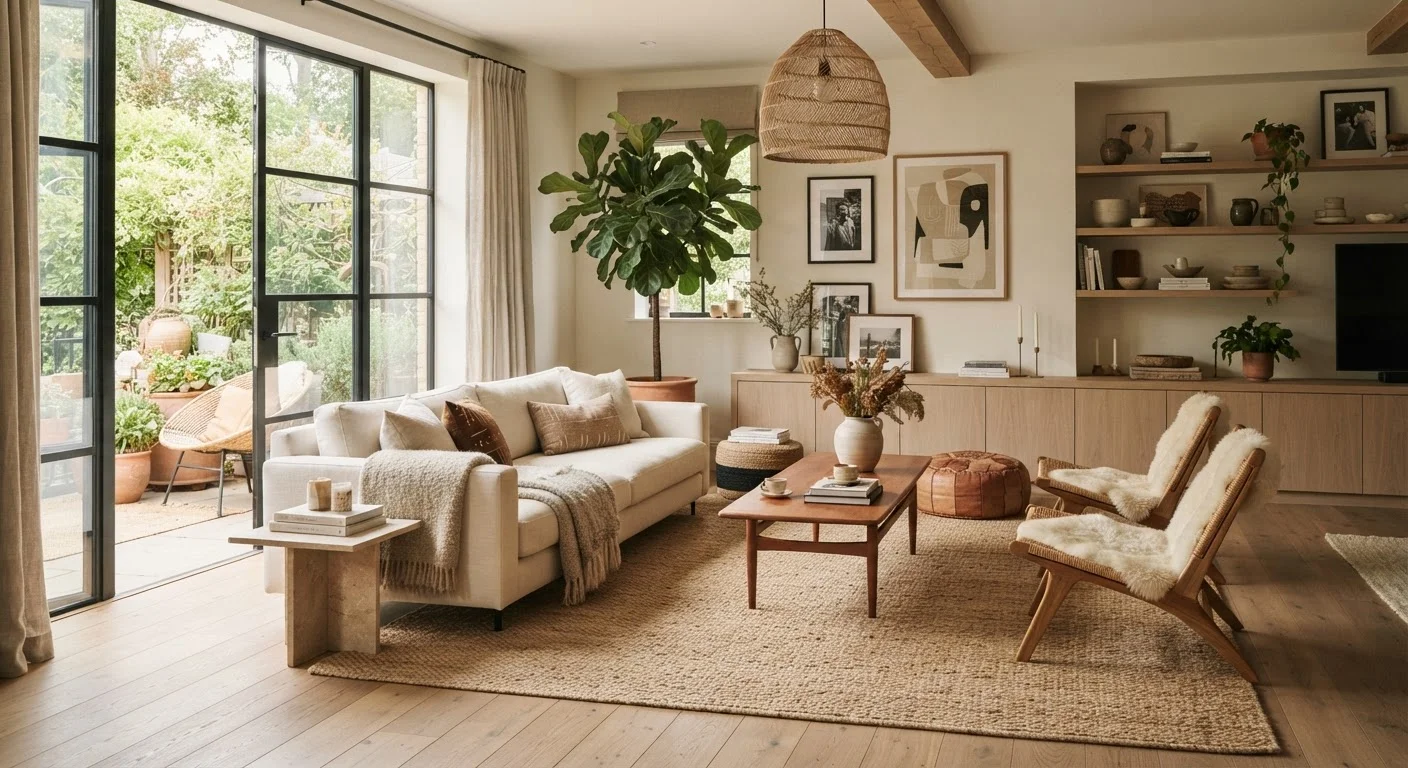
Rooted in Nordic design traditions, this style prioritizes function, simplicity, and comfort. Expect light wood tones, white or pale gray walls, minimal ornamentation, and soft textiles like wool throws and linen cushions. The goal is a calm, uncluttered environment that still feels warm.
Japandi
A hybrid of Japanese and Scandinavian design sensibilities, Japandi blends wabi-sabi (the Japanese appreciation of imperfection and transience) with Nordic minimalism. It leans darker and more asymmetric than pure Scandi, using matte ceramics, natural fibers, and low-profile furniture. Negative space is treated as a design element, not an absence.
Mid-Century Modern
Drawing from American and European design of the 1940s–1960s, this style features clean horizontal lines, organic shapes, and a mix of natural and manufactured materials — think tapered wood legs, molded plastic chairs, and bold geometric patterns. Color palettes often include mustard, olive, and burnt orange alongside neutrals.
Industrial
Inspired by urban loft spaces, industrial design embraces exposed structural elements: brick walls, concrete floors, visible ductwork, and raw steel. Furniture tends to be simple and functional. It pairs well with Edison-style lighting and reclaimed wood accents.
Bohemian (Boho)
Boho interiors layer global textiles, vintage finds, plants, and handcrafted objects to create an eclectic, lived-in feel. There are few hard rules — the style rewards personal collections and mismatched pieces that share a warm color story. Pattern mixing is encouraged.
Coastal / Nautical
Evoking breezy seaside settings, coastal design uses a blue-white-sand palette, natural textures like jute and linen, light-colored wood, and organic shapes. The atmosphere is relaxed and airy. It ranges from literal (ship rope, anchors) to subtle (pale driftwood tones and striped fabrics).
Farmhouse / Modern Farmhouse
The classic farmhouse look combines rustic wood, shiplap paneling, and vintage-inspired fixtures with practical, unpretentious furniture. Modern farmhouse softens this with cleaner lines and a more neutral palette, blending old and new without heavy ornamentation.
Maximalism
Maximalism is the deliberate embrace of abundance — rich color, layered pattern, collected objects, and full walls. Done well, it is highly curated rather than chaotic, with each element chosen for personal meaning or visual harmony. See how maximalism compares to quiet luxury as a design philosophy.
Wabi-sabi
A Japanese aesthetic philosophy that finds beauty in imperfection, impermanence, and incompleteness. In interiors, it appears as handmade ceramics with irregular edges, aged wood, and unfinished textures.
Negative space
The empty or open areas within a room's layout. In design, negative space is intentional — it allows focal points to breathe and prevents visual clutter.
Organic shapes
Forms inspired by nature — curves, asymmetry, and irregular silhouettes — as opposed to rigid geometric shapes. Common in mid-century modern and Japandi furniture.
Palette
The curated selection of colors used throughout a space. A cohesive palette typically includes a dominant color, one or two secondary tones, and an accent.
Layering
The practice of building visual depth in a room by combining multiple textures, patterns, and objects at different heights and scales.
Shiplap
Horizontal wooden planks installed with a small gap or overlap between boards. A signature element of the farmhouse style, often used on accent walls or ceilings.
How to Use Style References Without Feeling Boxed In
Few well-designed homes fall neatly into a single category. Most draw from two or three styles — a Scandi foundation with boho textile layers, or a mid-century modern frame softened with coastal textures. Style names are useful starting points, not rigid rules.
A practical approach: identify the two or three qualities that matter most to you (calm vs. energetic, sparse vs. layered, dark vs. light) and find the styles that deliver those qualities. Prioritizing timeless decorating principles within whatever style you choose also helps future-proof your investment. You might also find it useful to explore style archetypes as a complementary vocabulary for understanding your broader aesthetic instincts.