

Key Takeaways
Why Bookshelf Styling Actually Matters
A bookshelf is one of the few pieces of furniture that reveals something personal about the people who live with it. Unlike a sofa or a dining table, a shelf filled with books, objects, and collected curiosities tells a visual story — and how you arrange that story shapes how the entire room reads.
Whether your shelves are built-in or freestanding, spanning an entire wall or occupying a single corner, the way you style them is a genuine design decision with real consequences for a room's tone and usability. The good news is that there's no single correct method. Each approach has different strengths, suits different personalities, and creates a different atmosphere. Understanding the full range of options is the best way to make a deliberate choice rather than defaulting to whatever feels easiest in the moment.
If you're working on a room from scratch and unsure where shelving fits into the bigger picture, the first-time decorator's starting point guide offers helpful grounding before you dive into shelf specifics.
Organize by colour
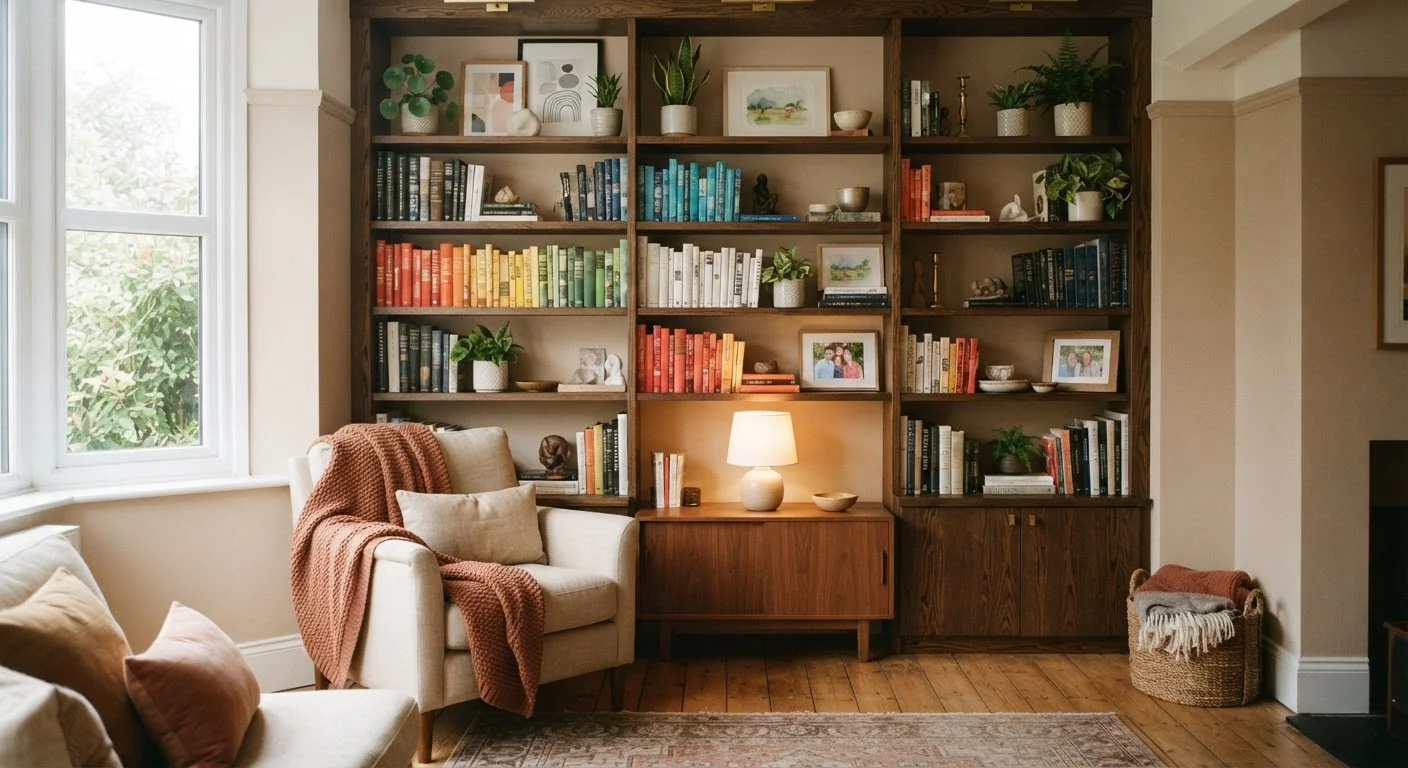
Arranging books by spine colour is the approach that tends to photograph well and generate the most immediate visual impact. Grouping warm reds and oranges on one shelf, cool blues and greens on another, and neutrals together creates a sense of deliberate order that reads as calm and curated from across the room.
The trade-off is practical: if you read frequently and look for books by title or author, this system requires you to remember what colour a spine is — which isn't always intuitive. Colour-coding works best for people who treat their shelves primarily as display surfaces rather than active libraries.
Colour-coding works best when shelves are display surfaces, not active libraries.
Organize by subject or genre
Grouping books by topic — fiction, history, cookbooks, design references — mirrors how public libraries work, and for good reason. It's the most functional approach for anyone who actually uses their books regularly. Subject-based organization makes it easy to find what you need and also signals your interests to visitors in a legible way.
Visually, this method is more varied and less controlled-looking than colour-coding. That isn't necessarily a flaw — mixed spine colours within a category can look lived-in and genuine, which suits relaxed, casual interiors well.
Subject-based organization suits readers who use their shelves as working libraries.
Mix books with objects
Rather than filling every inch of shelf space with books, this approach treats the bookshelf as a display cabinet that also happens to hold books. Framed photos, small sculptures, candles, plants, travel souvenirs, and collected objects are distributed throughout, creating visual rhythm and personal narrative.
The key to avoiding clutter is intentional grouping: arrange objects in clusters of odd numbers (typically three or five), vary their heights within each cluster, and leave breathing room between groups. This is often called the rule of three in styling circles, and while it's a guideline rather than a law, it tends to produce results that feel balanced without looking rigid.
Grouping objects in odd-numbered clusters with varied heights creates balance without rigidity.
Play with orientation — horizontal stacks and vertical rows
Most bookshelves default to vertical rows of upright spines, but alternating stacks of horizontally laid books with vertical sections creates visual variety and breaks the monotony of a uniform row. Horizontal stacks can also serve as pedestals for small objects placed on top, adding another layer of dimension.
This works especially well on taller shelves where consistent vertical rows can feel overwhelming. Varying the orientation shelf by shelf — some rows upright, some with horizontal stacks — introduces rhythm without requiring a complete overhaul of how you categorize books.
Alternating horizontal stacks with vertical rows adds visual rhythm to taller shelves.
Use negative space deliberately
One of the most counterintuitive principles of good shelf styling is that leaving portions of the shelf empty is not a mistake to be corrected — it's an active design choice. Negative space gives the eye somewhere to rest, makes individual objects stand out more clearly, and prevents a shelf from reading as chaotic or overwhelmed.
In practice, this might mean leaving the outer third of a shelf completely clear, or positioning a single meaningful object in an otherwise open space. Minimalist interiors lean heavily on this approach, but even maximalist shelves benefit from strategic pockets of openness.
Empty shelf space is an active design element, not a gap waiting to be filled.
Arrange by height for visual flow
Organizing books and objects so that heights graduate — shorter items on the outside edges, taller items building toward the center, or creating a gentle slope from one side to the other — produces a natural visual flow that feels dynamic rather than static. This is sometimes called the mountain method or pyramid approach.
Height variation prevents the shelf from reading as a flat, uniform band of color and texture. It also works well in combination with other organizational methods: you can arrange books by subject while still attending to the height transitions between them.
Graduating heights from edge to center creates dynamic flow without sacrificing organization.
Go full maximalist — and commit to it
A maximalist shelf is deliberately dense, layered, and rich with collected objects, stacked books, plants trailing over edges, framed prints leaning against spines, and textures competing for attention. This approach suits eclectic, bohemian, or collected-over-time interiors and resists the impulse to edit down.
The distinction between successful maximalism and visual clutter lies in internal logic. Even a densely packed shelf benefits from some organizing principle — grouped by colour, by theme, by material — that gives the eye a thread to follow through the density. Without any logic at all, the effect tends to read as disorganized rather than exuberantly full.
Even maximalist shelves benefit from an internal organizing logic that guides the eye.
Putting It All Together
The most important thing to recognize is that these approaches aren't mutually exclusive. Many well-styled shelves combine two or three methods — perhaps organizing books by colour within subject categories, then placing curated objects at the ends of each shelf to frame the arrangement. Experimentation is genuinely the best teacher here.
Start with what's already on your shelves
Before buying anything new, take everything off and lay it on the floor so you can see what you're actually working with. Grouping items by type, colour, and size before putting them back often reveals combinations you wouldn't have noticed with objects already in place. Most effective shelf styling uses what you already own — rearranged with more intention.
If you're still developing a sense of what appeals to you visually, building a style moodboard before rearranging your shelves can save a lot of trial and error. And if you're curious about the broader aesthetic framework driving your preferences, exploring style archetypes may help you articulate what you're actually going for. A bookshelf, arranged with intention, can be one of the most expressive surfaces in a home.