

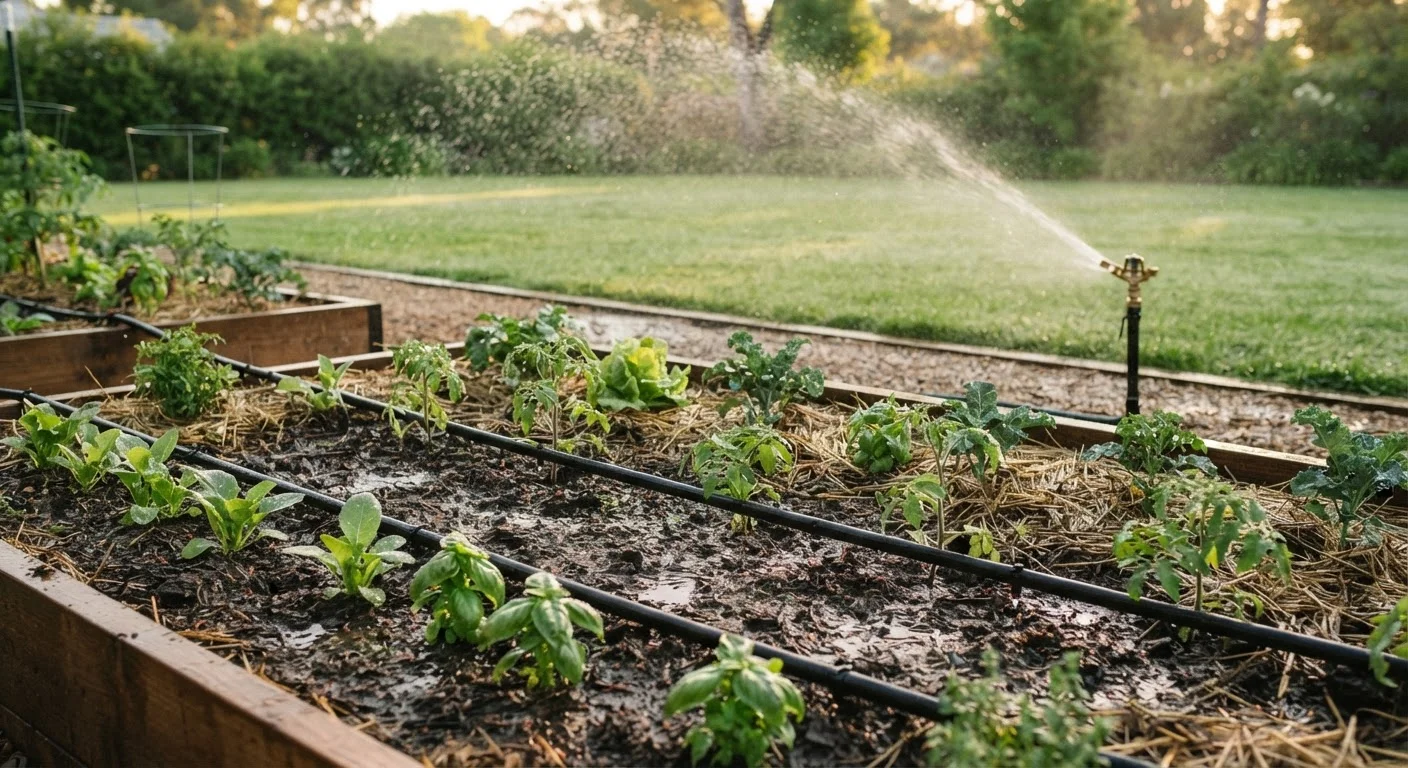
Key Takeaways
Option A
Drip Irrigation
The precise, water-efficient choice for targeted plant feeding.
Best for: Best for vegetable gardens, raised beds, shrubs, and any garden where water conservation or root-level delivery is a priority.
Option B
Sprinkler Systems
The broad-coverage solution for lawns and large planted areas.
Best for: Best for lawns, ground covers, and large planting zones where uniform overhead coverage is more practical than targeted delivery.
If you grow vegetables, herbs, or fruit in rows or raised beds
Drip Irrigation
Root-zone delivery keeps foliage dry, reducing fungal risk and directing moisture precisely where edible plants need it most.
If you need to water a lawn or large expanse of ground cover
Sprinkler Systems
Sprinklers distribute water uniformly across wide areas — a practical necessity where drip tubing would be impractical to lay.
If water conservation or drought conditions are a primary concern
Drip Irrigation
Drip systems apply water slowly at the soil surface, minimizing runoff and evaporation compared to overhead spray.
If you want a simple, lower-cost setup for a mixed garden
Sprinkler Systems
Basic oscillating or stationary sprinklers require minimal installation knowledge and cover varied plantings quickly.
If you have ornamental beds with dense, established shrubs and perennials
Drip Irrigation
Soaker hoses and drip emitters thread through established plantings without disturbing roots or wasting water on paths and mulch.
How Each System Works
Understanding the mechanics of each system helps explain why they suit different garden situations so differently.
Drip irrigation delivers water at a slow, controlled rate through a network of flexible tubing, emitters, or soaker hoses placed directly at — or just above — the soil surface near plant roots. Flow rates are typically measured in gallons per hour (GPH) rather than per minute, which allows deep, gradual soil penetration with minimal runoff. Systems are powered by standard household water pressure, often reduced through a pressure regulator.
Sprinkler systems distribute water overhead through rotating heads, oscillating bars, or fixed spray nozzles. Pop-up in-ground systems are the most permanent form, while portable sprinklers connect to a garden hose for flexible placement. Coverage areas are wider, but water is applied faster — and a meaningful portion can be lost to wind drift and evaporation before reaching the soil.
Both systems are compatible with automatic timers, which is one of the most practical upgrades you can add to either. Good watering habits matter regardless of the method you choose — see common watering mistakes that harm plants for a closer look at what goes wrong when timing or quantity is off.
| Criterion | Drip Irrigation | Sprinkler Systems |
|---|---|---|
| Water delivery method | Root-zone, low-flow emitters | Overhead spray or mist |
| Water efficiency | High — minimal evaporation | Moderate — wind and evaporation losses |
| Foliar disease risk | Low — foliage stays dry | Higher — leaves regularly wetted |
| Coverage area | Targeted, individual plants | Broad, uniform zones |
| Installation complexity | Low to moderate, DIY-friendly | Moderate to high; in-ground needs trenching |
| Best plant types | Vegetables, shrubs, trees | Lawns, ground covers, large beds |
| Maintenance | Emitter cleaning, filter checks | Head alignment, seasonal blowout |
| Scalability | Highly modular, easy to expand | Zone-based, harder to modify |
Water Efficiency and Plant Health
Water efficiency is one of the sharpest points of contrast between these two systems. Drip irrigation is consistently recognized by irrigation specialists as a more efficient delivery method for individual plants, primarily because water goes to the root zone rather than the surrounding air or soil surface.
Overhead watering — the hallmark of sprinklers — wets foliage as well as soil. For many vegetables and roses, sustained leaf moisture creates conditions favorable to fungal diseases like powdery mildew and black spot. Drip systems sidestep this entirely by keeping leaves dry. This makes drip irrigation particularly well-suited to tomatoes, squash, cucumbers, and other plants with known foliar sensitivity.
30–50%
Potential water savings with drip vs. sprinklers
The U.S. Environmental Protection Agency estimates drip irrigation can use 30–50% less water than conventional sprinkler systems when properly designed and maintained.
50%
Outdoor water use lost to inefficiency
According to the EPA's WaterSense program, roughly half of outdoor residential water use is wasted due to evaporation, wind, and overwatering.
1–4 GPH
Typical drip emitter flow rate
Standard drip emitters deliver 1–4 gallons per hour, compared to sprinkler heads that commonly apply 1–3 gallons per minute.
For lawns, however, overhead delivery is essentially the only practical option — drip tubing cannot realistically be threaded through turf. Sprinklers also work reasonably well for densely planted annual beds where individual emitter placement would be time-consuming. The truth about lawn watering timing is also worth reviewing — watering in the morning rather than evening reduces disease risk regardless of system type.
Installation, Maintenance, and Cost
Installation demands differ considerably. A basic drip system for a vegetable bed can be assembled from a kit in an afternoon using simple hand tools — no trenching required. Components include a backflow preventer, pressure regulator, filter, main supply tubing, and individual emitters. The modular nature means you can expand or reconfigure as your garden evolves.
In-ground sprinkler systems are more complex. They typically involve trenching to bury supply lines, installing zone valves, and connecting to the home's water supply — work that often requires a licensed plumber or irrigation contractor depending on your local codes. Always verify local permit and licensing requirements before beginning any underground irrigation work.
Drip systems are also more prone to clogging at emitters, particularly if water quality is poor or filters aren't cleaned regularly. Sprinkler heads can become misaligned or blocked by soil and lawn thatch over time. Both systems benefit from an annual inspection before the growing season begins. If your garden includes raised beds or in-ground plots, the bed type can also influence which irrigation approach is easier to implement. Costs vary widely by region and installation scope, so gathering local quotes is the most reliable way to budget accurately.
For a broader seasonal maintenance schedule that includes irrigation checkups, the month-by-month garden maintenance guide is a useful reference throughout the year.
Winterizing Your Irrigation System
In climates with freezing winters, both drip and sprinkler systems require seasonal winterization to prevent pipe and emitter damage. For drip systems, this typically means draining lines and storing flexible tubing indoors. In-ground sprinkler systems generally need to be blown out with compressed air — a task best handled by a qualified irrigation technician to avoid damage to valves and heads. Check with your local extension office or a licensed contractor for region-specific guidance.