

Key Takeaways
Why Plant Placement Matters More Than You Think
Companion planting is the practice of growing different plants near one another to create mutual benefit — or, just as importantly, to avoid mutual harm. While some of the tradition dates back centuries to Indigenous and folk agricultural practices, researchers have increasingly studied specific pairings to understand what's actually happening at the root level, in the soil microbiome, and above ground with pollinators and pests.
If you're planning a vegetable garden from scratch, understanding companion planting early can save you from costly layout mistakes later. And if you're already gardening, rethinking a few neighbors in your beds could make a meaningful difference by season's end.
Below are seven well-documented pairings — some that help and some that genuinely hurt — along with what drives each outcome.
Tomatoes and Basil — A Pairing Worth Keeping
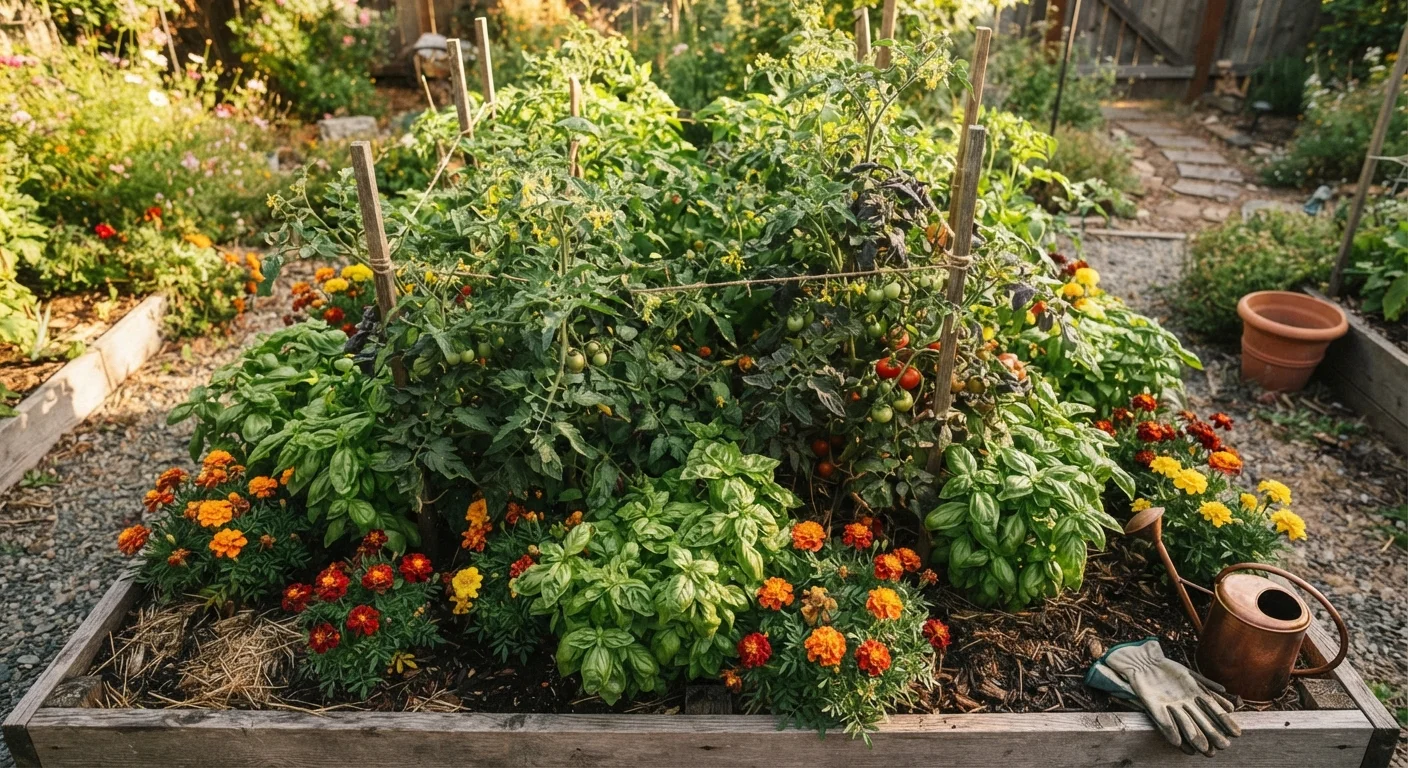
Gardeners have paired tomatoes and basil for generations, and there is reasonable evidence to support the habit. Basil is thought to repel thrips and aphids through volatile compounds it releases, and some studies suggest it may improve the flavor of nearby tomatoes — though the flavor claim remains more anecdotal than proven. What's better established is that basil attracts pollinators when allowed to flower, which benefits the entire bed. Keep basil trimmed to prevent it from bolting too quickly and shading lower tomato branches.
Basil's volatile compounds may deter aphids and thrips while attracting pollinators to nearby tomatoes.
The Three Sisters — Corn, Beans, and Squash
One of the most well-documented examples of companion planting comes from Indigenous agricultural traditions of North America. Corn provides a vertical structure for pole beans to climb. Beans fix atmospheric nitrogen into the soil, feeding the heavy-feeding corn. Squash spreads low and wide, shading the ground to retain moisture and suppress weeds. Each plant fills a different niche — vertical, nutritive, and horizontal — making the system more productive per square foot than monoculture rows. This is a foundational example when mixing plant types for a layered garden.
The Three Sisters system uses vertical, nutritive, and ground-cover roles to maximize space and soil health.
Marigolds Near Vegetables — Pest Suppression With Evidence
French marigolds (Tagetes patula) produce a root exudate that is toxic to root-knot nematodes — microscopic soil pests that damage tomatoes, peppers, and other crops. Research published in horticultural literature supports this effect, particularly when marigolds are grown as a dense border or interplanted for a full season rather than scattered sparsely. Marigolds also attract hoverflies, whose larvae prey on aphids. Plant them around the perimeter of vegetable beds or between rows for the most consistent impact.
French marigold root exudates are scientifically documented to suppress root-knot nematodes in vegetable beds.
Fennel and Almost Everything Else — Keep It Isolated
Fennel is one of the most allelopathic plants commonly found in home gardens. Allelopathy refers to a plant's ability to release chemicals that inhibit the germination or growth of other plants nearby. Fennel has been shown to suppress tomatoes, peppers, beans, and many herbs when planted in close proximity. It's not that fennel is a bad garden plant — it attracts beneficial insects and pollinators — but it should be grown in its own container or in an isolated bed well away from your vegetable patch. Most companion planting guides agree: fennel is a loner by nature.
Fennel releases allelopathic chemicals that inhibit the growth of tomatoes, peppers, and most garden herbs.
Carrots and Onions — A Classic Mutual Deterrent
The logic here is straightforward: carrot fly is deterred by the scent of onions, while onion fly dislikes the smell of carrots. Interplanting the two creates an olfactory confusion that may reduce pest pressure on both crops. The evidence is observational rather than robust in controlled trials, but the pairing is low-risk and widely practiced. It also makes efficient use of space since onions grow upright while carrots occupy the soil below. Avoid planting onions near beans or peas, as alliums are known to stunt legume growth.
Interplanting carrots and onions may confuse the specific pests that target each crop individually.
Brassicas and Strawberries — Avoid This Combination
Strawberries and brassicas (cabbage, broccoli, kale, Brussels sprouts) are frequently cited as incompatible neighbors. Strawberries can harbor verticillium wilt, a soil-borne fungal disease that also affects many brassicas, effectively acting as a disease bridge in your garden. Additionally, brassicas may inhibit strawberry growth through root competition and light blocking when plants mature. If you're growing both, give them separate, clearly defined sections of the garden — ideally with a season of rotation between them to reduce soil pathogen buildup.
Strawberries can harbor verticillium wilt, making them a disease risk when planted near brassicas.
Nasturtiums as a Trap Crop — Strategic Sacrifice
Nasturtiums are a useful companion not because they protect neighbors directly, but because they attract aphids away from more valuable plants. This strategy is called trap cropping: you deliberately plant something that pests prefer, drawing them away from crops you want to protect. Aphids cluster heavily on nasturtiums, where they can then be manually removed or targeted with a water spray. Plant nasturtiums on the upwind side of your garden or at the edge of susceptible crops. Just monitor them regularly — an unchecked aphid colony on your nasturtiums can eventually spread if left alone.
Nasturtiums lure aphids away from valuable crops — a deliberate trap that protects the rest of the garden.
Putting Companion Planting to Work in Your Garden
Companion planting works best when it's part of a broader, thoughtful garden plan rather than a last-minute arrangement. Think about spacing, sunlight competition, and water needs alongside the biological interactions described above. A pairing that works in one region's climate and soil type may not perform identically in yours.
Start Small and Observe Before Scaling
When trying a new companion pairing, test it in one section of your garden for a full season before applying it everywhere. Keep notes on pest levels, plant vigor, and yield so you can compare results year over year. Soil type, regional climate, and local pest populations all influence how well documented pairings perform in your specific yard.
For gardeners choosing between raised beds and in-ground planting, it's worth noting that raised beds give you more control over soil composition — which can amplify the benefits of nitrogen-fixing companions like beans. Also consider integrating native plants into border areas; they attract region-specific beneficial insects that support the entire garden ecosystem.
Treat companion planting as one layer of a healthy garden strategy, alongside good watering habits and thoughtful plant selection. No single pairing is a silver bullet, but collectively, smart plant relationships can reduce your reliance on interventions and support a more resilient growing space.