

| RAM role | Temporary working memory for active apps |
| Storage role | Permanent space for files, photos, and apps |
| Lower f-number means | Wider aperture, better low-light camera performance |
| Smaller nm (process node) means | More efficient chip, not necessarily higher clock speed |
| mAh measures | Battery capacity — not directly battery life |
| Optical zoom vs. digital zoom | Optical uses lens movement; digital crops and degrades image quality |
Why Spec Sheets Feel Confusing (And Why They Don't Have to Be)
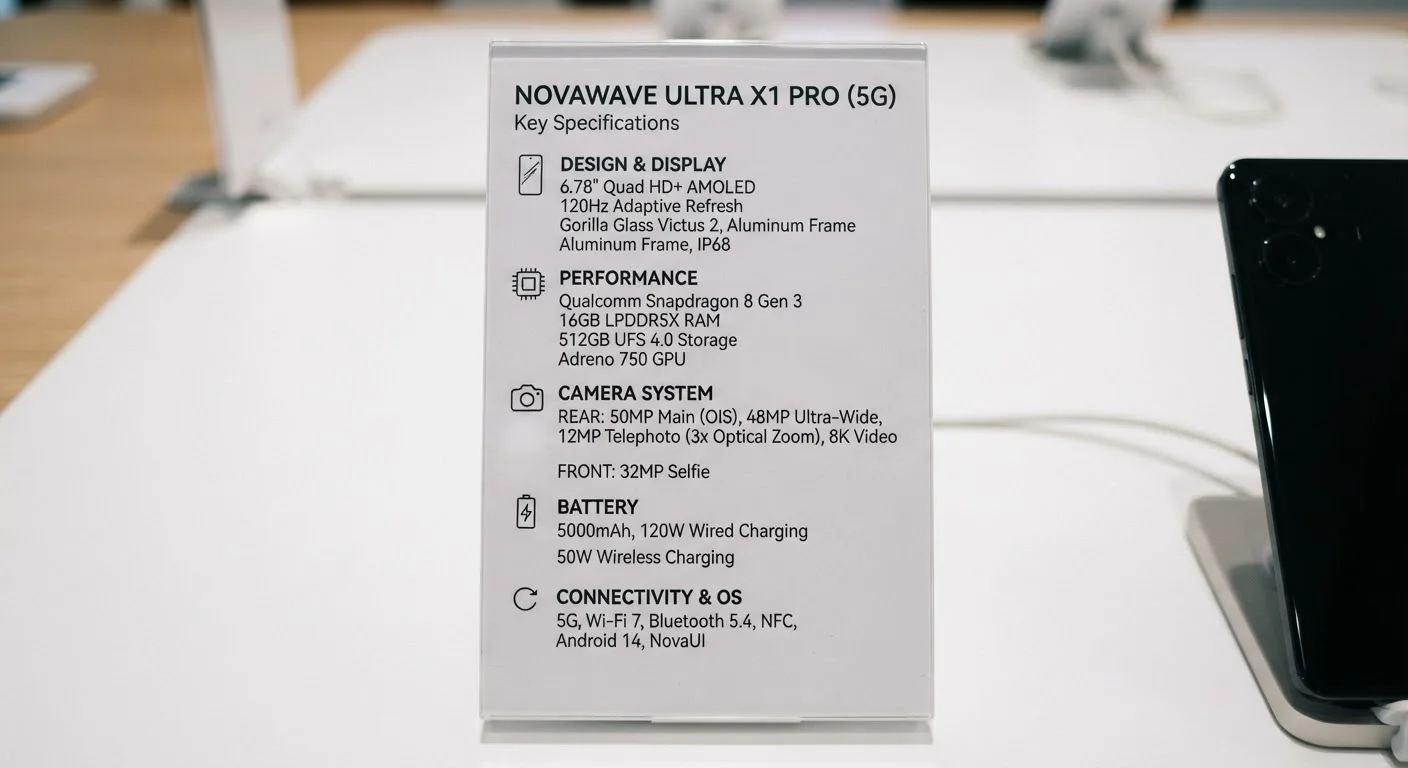
Walk into any electronics section and the spec card on a phone display reads like an engineering exam: 6.7-inch AMOLED, 12 GB RAM, 108 MP, 5000 mAh, 4 nm processor. These numbers aren't arbitrary — each one describes a specific aspect of the phone's hardware. Once you know what each spec measures, you can compare devices on substance rather than marketing language.
This reference covers the core categories you'll encounter on almost every smartphone listing. For a broader look at how this skill applies to other devices, see how to read a spec sheet without an engineering degree.
| RAM role | Temporary working memory for active apps |
| Storage role | Permanent space for files, photos, and apps |
| Lower f-number means | Wider aperture, better low-light camera performance |
| Smaller nm (process node) means | More efficient chip, not necessarily higher clock speed |
| mAh measures | Battery capacity — not directly battery life |
| Optical zoom vs. digital zoom | Optical uses lens movement; digital crops and degrades image quality |
Processor: GHz, Cores, and the Nanometer Figure
The processor — also called the chipset or SoC (System on a Chip) — is the brain of the phone. Three numbers appear most often:
- Clock speed (GHz): How many instruction cycles the chip can complete per second. Higher GHz can mean faster single tasks, but it's not the only factor.
- Core count: Modern smartphone chips use multiple cores (often 8) grouped into efficiency and performance clusters. More cores help with multitasking and sustained workloads.
- Process node (nm): The size of the transistors on the chip. A smaller nanometer number (e.g., 4 nm vs. 7 nm) generally means greater power efficiency and thermal performance — not necessarily raw speed alone.
Processor generation matters more than raw GHz in practice. A newer chip at a lower clock speed often outperforms an older chip at a higher one. For a parallel look at how this plays out on laptops, see laptop processor tiers decoded.
RAM, Storage, and the Spec That Trips People Up Most
RAM (Random Access Memory) is temporary working memory — it holds apps and data the phone is actively using. More RAM (measured in GB) allows more apps to run simultaneously without reloading. For most everyday use, 6–8 GB is a reasonable baseline; heavy multitaskers or power users may benefit from more.
Storage (also listed in GB or TB) is where your photos, apps, and files live permanently. It is a completely separate resource from RAM. This distinction confuses a lot of shoppers — for a deeper explanation, RAM vs. storage explained covers it in full.
Storage type matters too. UFS (Universal Flash Storage) is the common standard on modern smartphones, with higher UFS versions offering faster read/write speeds for tasks like loading large apps or recording video.
SoC (System on a Chip)
A single chip that integrates the processor, graphics unit, modem, and other components. Most smartphone chipsets are SoCs, which is why phones don't have separate CPU and GPU cards like desktop computers.
RAM (Random Access Memory)
Temporary, fast-access memory the phone uses while running apps. When you close an app, that RAM is freed. It is not the same as storage where your files are saved permanently.
Aperture
The opening in a camera lens that controls how much light reaches the sensor. Expressed as an f-number — a lower value means a wider opening and better performance in dim conditions.
mAh (Milliamp Hour)
A unit measuring battery capacity — how much electrical charge the battery can store. Higher mAh can support longer use, but real-world battery life depends on many other factors.
Process Node (nm)
The size of transistors on a chip, measured in nanometers. Smaller nodes typically allow more transistors in the same space, improving efficiency and performance-per-watt.
UFS (Universal Flash Storage)
The storage standard used in most modern smartphones. Higher UFS versions (e.g., UFS 3.1 vs. UFS 2.2) offer faster data read and write speeds, which affects app loading and file transfer times.
Camera: Megapixels, Aperture, and Sensor Size
Camera specs are among the most marketed — and most misunderstood — numbers on a phone box.
- Megapixels (MP): The resolution of photos the sensor can capture. A 108 MP camera produces very large image files, but pixel count alone does not determine photo quality. Sensor size, lens quality, and image processing software all play significant roles.
- Aperture (f/number): Controls how much light the lens lets in. A lower f-number (e.g., f/1.8) means a wider aperture and better low-light performance. A higher number (e.g., f/2.4) means a narrower opening.
- Optical zoom: Uses physical lens movement to magnify. Digital zoom simply crops and enlarges the image, reducing quality. A spec listing "3x optical zoom" is more meaningful than "10x digital zoom."
For a related look at how display specs interact with photo viewing, the display glossary for phone shoppers is a useful companion reference. And if you've heard that more megapixels always means better photos, common smartphone myths debunked addresses that directly.
Battery and Display Numbers Worth Knowing
Battery capacity (mAh — milliamp hours) indicates how much charge the battery can hold. A higher mAh generally means longer potential battery life, but actual endurance depends on the processor's efficiency, screen brightness, and software optimization. A 5000 mAh battery in a phone with an inefficient chip may last no longer than a 4000 mAh battery in a well-optimized one.
Charging speed (watts): Wired charging speeds are listed in watts (W). Higher wattage means faster charging — though the charger included in the box (or sold separately) must match the phone's supported wattage to achieve those speeds.
For display specs — including what nits (brightness), refresh rate, and panel types like OLED and LCD mean — those deserve their own dedicated reference. The screen resolution and brightness glossary covers each term clearly. The same principles of spec literacy apply when evaluating laptops — comparing laptop specs for real-world performance is a practical next step.
Specs Reflect Capability, Not Experience
Spec sheets describe hardware potential, not guaranteed real-world performance. Software optimization, thermal management, and how the manufacturer implements hardware all shape the actual experience. Two phones with identical specs on paper can feel noticeably different in everyday use. Use specs as a starting framework for comparison, not as a definitive ranking.