

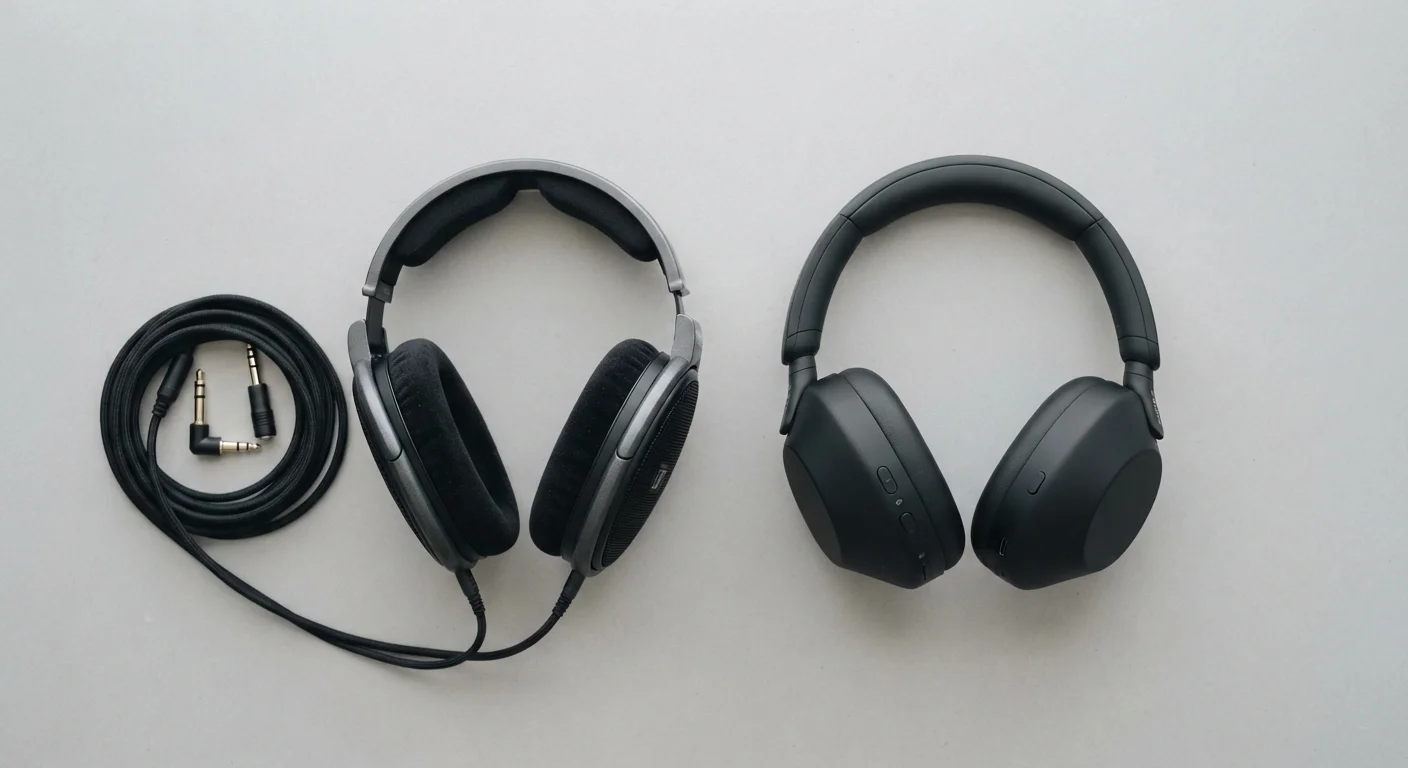
Key Takeaways
Zero added latency for gaming and video
A direct analog signal path introduces no processing delay, keeping audio perfectly synchronized with on-screen content — critical for gaming and video editing workflows.
No battery to charge or degrade
Passive wired headphones draw minimal or no power from the source and have no internal battery to age, making them reliably available whenever you need them.
Simpler, interference-free signal path
A physical cable connection is immune to Bluetooth interference, codec negotiation failures, and wireless congestion — the signal either works or it doesn't.
Compatible with high-impedance amplifier setups
Wired headphones can be paired with dedicated headphone amplifiers and DACs to unlock greater dynamic range and driving power than any wireless connection currently supports.
Freedom of movement without tethering
Wireless headphones remove the physical constraint of a cable, allowing comfortable use while commuting, exercising, or moving around a workspace.
Modern codecs narrow the audio quality gap
High-resolution Bluetooth codecs like LDAC and aptX Lossless now transmit audio at bitrates that are very difficult to distinguish from wired in controlled listening conditions.
Enables advanced onboard features
Active noise cancellation, transparency mode, and touch controls all depend on onboard processing that wireless headphones are designed to support natively.
Cable tethers movement and creates wear points
Physical cables restrict how far you can move from a source and are subject to mechanical stress at connectors and bends — common failure points over time.
Headphone jack is disappearing from devices
Many current smartphones and laptops have dropped the 3.5 mm jack, requiring dongles or USB-C adapters that add inconvenience and another potential failure point.
Battery life is a hard ceiling
Wireless headphones must be charged regularly, and heavy ANC use shortens runtime — leaving you without audio at the worst possible moments if you forget to charge.
Battery capacity degrades over years
Lithium-ion cells in wireless headphones lose effective capacity after hundreds of charge cycles, meaningfully reducing real-world runtime as the headphones age.
Bluetooth interference in crowded environments
The 2.4 GHz band shared by Bluetooth and Wi-Fi can become congested in offices, airports, or urban settings, causing audio dropouts or degraded quality.
Codec compatibility limits audio quality ceiling
Audio quality depends on the codec both the source device and headphones mutually support — mismatches force a fallback to lower-quality compression, often without warning.
Our Verdict
Neither wired nor wireless headphones are universally superior — they optimize for different priorities. Wired connections remain the more technically straightforward choice for low-latency, high-fidelity applications, while wireless delivers genuine convenience for everyday mobile listening. Understanding where each type falls short is more useful than chasing a single winner.
Wireless suits commuters and casual listeners who prioritize convenience; wired suits audio enthusiasts, gamers, and professionals who need reliability and precision.
What You're Actually Comparing
The wired vs. wireless debate is often framed as old vs. new, but the more useful frame is what each connection type is engineered to do well. Wired headphones transmit an analog or digital audio signal directly from a source — a phone, DAC (digital-to-analog converter), or amplifier — through a physical cable. Wireless headphones (almost universally Bluetooth in the consumer market) compress, transmit, and decode audio over a radio link.
That difference in signal path creates knock-on effects across latency, fidelity, battery life, and reliability — and none of them are absolute. The codec your wireless headphones use, the impedance of your wired pair, and the quality of your source device all shape the real-world experience. See our explainer on impedance and sensitivity for context on how specs shape sound before you even pick a connection type.
The Case for Wired
Wired headphones carry two structural advantages that no wireless technology has fully closed: zero added latency and no battery dependency. A direct analog connection introduces no processing delay — audio from your source reaches your ears in under a millisecond, which matters for video synchronization and gaming. Wireless connections, by contrast, typically add 20–200 ms of latency depending on the codec and hardware, which can cause perceptible audio-video drift.
Power is the other pillar. A wired headphone draws power from the source device — often none at all for passive designs — so there's nothing to charge, nothing to degrade over time, and no mid-session interruption. High-impedance wired headphones can unlock better amplifier pairings and, in some listening contexts, a wider dynamic range than Bluetooth compression currently allows.
Zero added latency for gaming and video
A direct analog signal path introduces no processing delay, keeping audio perfectly synchronized with on-screen content — critical for gaming and video editing workflows.
No battery to charge or degrade
Passive wired headphones draw minimal or no power from the source and have no internal battery to age, making them reliably available whenever you need them.
Simpler, interference-free signal path
A physical cable connection is immune to Bluetooth interference, codec negotiation failures, and wireless congestion — the signal either works or it doesn't.
Compatible with high-impedance amplifier setups
Wired headphones can be paired with dedicated headphone amplifiers and DACs to unlock greater dynamic range and driving power than any wireless connection currently supports.
Freedom of movement without tethering
Wireless headphones remove the physical constraint of a cable, allowing comfortable use while commuting, exercising, or moving around a workspace.
Modern codecs narrow the audio quality gap
High-resolution Bluetooth codecs like LDAC and aptX Lossless now transmit audio at bitrates that are very difficult to distinguish from wired in controlled listening conditions.
Enables advanced onboard features
Active noise cancellation, transparency mode, and touch controls all depend on onboard processing that wireless headphones are designed to support natively.
The practical downsides are real, though. A cable tethers you physically, creates wear points at connectors (both 3.5 mm and USB-C jacks are vulnerable to repeated stress), and increasingly requires an adapter as headphone jacks disappear from smartphones and laptops.
The Case for Wireless
Freedom of movement is the obvious win, but the less-discussed advantage is how far Bluetooth audio quality has improved. High-resolution codecs — LDAC, aptX HD, aptX Lossless — can transmit audio at bitrates and quality levels that are difficult to distinguish from wired in controlled listening tests. Our Bluetooth codecs explainer breaks down exactly what SBC, AAC, aptX, and LDAC change in practice — because not all wireless audio is equal.
Cable tethers movement and creates wear points
Physical cables restrict how far you can move from a source and are subject to mechanical stress at connectors and bends — common failure points over time.
Headphone jack is disappearing from devices
Many current smartphones and laptops have dropped the 3.5 mm jack, requiring dongles or USB-C adapters that add inconvenience and another potential failure point.
Battery life is a hard ceiling
Wireless headphones must be charged regularly, and heavy ANC use shortens runtime — leaving you without audio at the worst possible moments if you forget to charge.
Battery capacity degrades over years
Lithium-ion cells in wireless headphones lose effective capacity after hundreds of charge cycles, meaningfully reducing real-world runtime as the headphones age.
Bluetooth interference in crowded environments
The 2.4 GHz band shared by Bluetooth and Wi-Fi can become congested in offices, airports, or urban settings, causing audio dropouts or degraded quality.
Codec compatibility limits audio quality ceiling
Audio quality depends on the codec both the source device and headphones mutually support — mismatches force a fallback to lower-quality compression, often without warning.
Wireless headphones also allow active noise cancellation (ANC) and transparency mode features to be integrated with onboard processing — features that require power regardless of connection type. For commuters, gym users, and remote workers, the combination of ANC and wireless freedom is a meaningful quality-of-life upgrade. Our noise-cancellation glossary explains each mode in detail if you're evaluating those features.
The Trade-Offs No One Talks About
Most comparisons stop at latency and battery life. But there are subtler considerations worth naming.
Source Device Matters as Much as Headphones
A wireless headphone's audio quality is constrained by what the source device transmits, not just what the headphone can receive. Smartphones, laptops, and DAPs (digital audio players) all have different Bluetooth chipsets supporting different codec sets. Before assuming your wireless headphones underperform, verify which codec your source device is actually transmitting — this information is often buried in developer settings or device documentation.
Battery degradation: Wireless headphone batteries lose capacity over hundreds of charge cycles. A pair that lasts 30 hours when new may deliver 18–20 hours after two or three years. Wired headphones, by contrast, degrade only through mechanical wear — cable fraying, driver damage — which is often repairable or replaceable. Battery replacement in wireless models is possible on some designs but is rarely straightforward.
Interference and reliability: Bluetooth operates on the 2.4 GHz band alongside Wi-Fi, microwaves, and other devices. In dense wireless environments — offices, airports, crowded events — dropouts and compression artifacts can occur. Wired connections are immune to this entirely.
Codec negotiation: Your wireless headphones only sound as good as the weakest codec both devices support. An iPhone connected to LDAC-capable headphones will fall back to AAC — a meaningful ceiling. Understanding your source device's Bluetooth stack matters more than most product listings communicate.
If you're also evaluating headphone design alongside connection type, our piece on open-back vs. closed-back headphones covers how acoustic design interacts with your listening environment — a separate but equally important decision.
20–200 ms
Typical Bluetooth audio latency range
Latency varies widely by codec and hardware; aptX Low Latency targets ~40 ms, while standard SBC can reach 200 ms or more.
990 kbps
LDAC maximum transmission bitrate
Sony's LDAC codec can transmit at up to 990 kbps — roughly three times the bitrate of standard SBC — narrowing the wireless fidelity gap considerably.
300–500
Charge cycles before notable battery degradation
Lithium-ion batteries in wireless headphones typically show meaningful capacity reduction after 300–500 full charge cycles, a figure consistent with general lithium-ion battery research.