

Key Takeaways
Option A
Open-Back Headphones
The audiophile-favored design for natural, spacious sound.
Best for: Quiet, private listening environments where sound leakage isn't a concern and audio immersion is the priority.
Option B
Closed-Back Headphones
The versatile, practical choice for everyday real-world use.
Best for: Commuters, remote workers, and anyone listening in shared or noisy spaces who needs isolation in both directions.
If you listen critically at home in a quiet room
Open-Back Headphones
The natural soundstage and reduced ear fatigue from open-back designs make long, focused listening sessions more comfortable and revealing.
If you commute, work in an office, or listen in shared spaces
Closed-Back Headphones
Passive isolation keeps outside noise out and your audio in, which is essential in environments where leakage would disturb others.
If you record voiceovers, podcasts, or instruments at home
Closed-Back Headphones
Open-back audio bleeds into microphones during recording; closed-back designs prevent that bleed while still delivering accurate monitoring.
If you mix or master audio in a controlled studio environment
Open-Back Headphones
The more accurate frequency response and three-dimensional imaging of open-back designs help identify subtle mix imbalances more reliably.
If you work from home and take frequent video calls
Closed-Back Headphones
Sound isolation reduces room echo on calls and keeps call audio from leaking into open-plan spaces. See also our guide on home office audio setup.
What Actually Separates the Two Designs
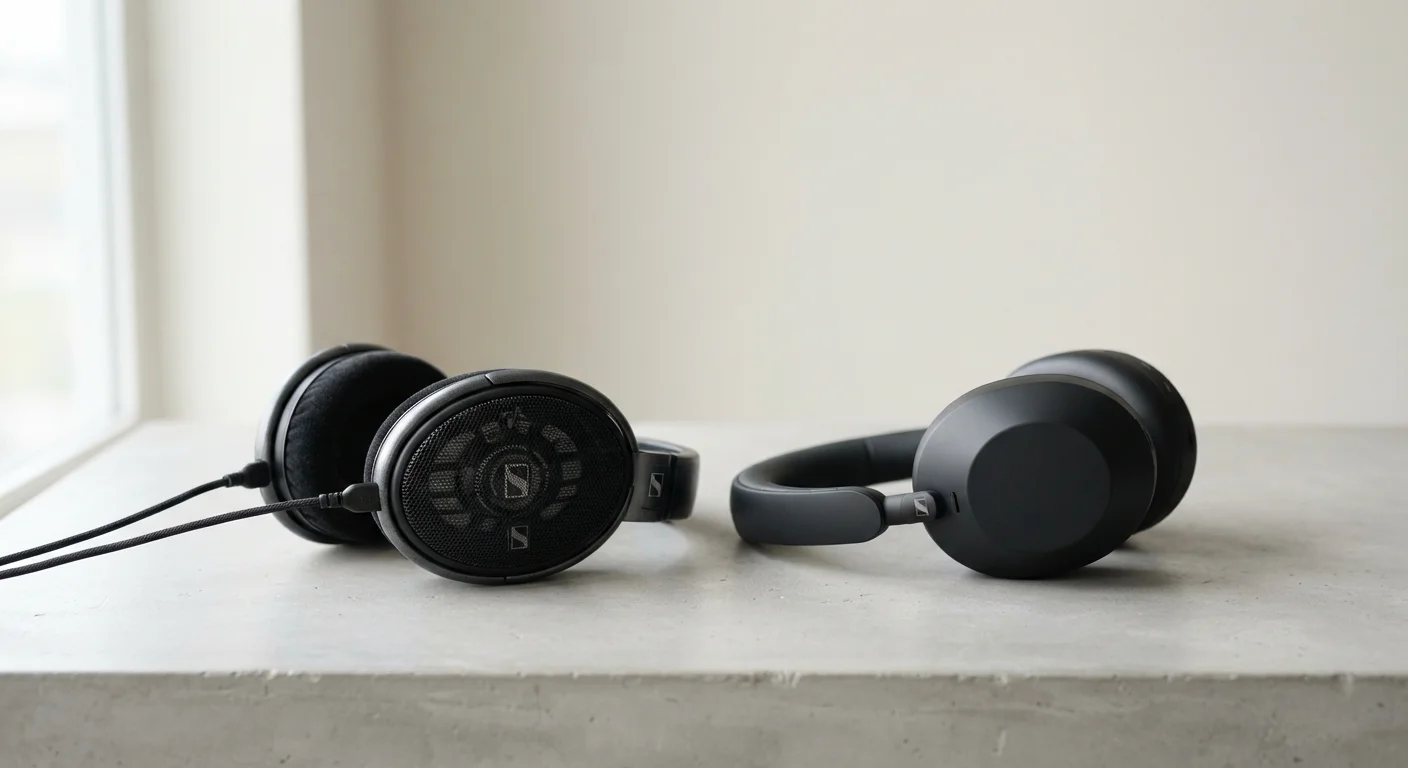
The distinction between open-back and closed-back headphones is structural, not cosmetic. In an open-back design, the outer shell of each ear cup contains perforations, a grille, or mesh panels that allow air — and sound — to move freely between the driver (the speaker element inside) and the outside environment. In a closed-back design, the outer shell is sealed, creating an acoustic chamber that traps sound inside the cup.
That single difference cascades into meaningful consequences for sound character, isolation, and appropriate use cases. Open-back headphones typically produce a soundstage — the perceived width and spatial depth of audio — that feels more like listening to speakers in a room. Closed-back headphones tend to place sound closer and more directly inside the head, which some listeners find more intimate and others find slightly claustrophobic over long sessions.
For a deeper look at how passive isolation compares to active noise cancellation, see the noise-cancellation glossary.
| Criterion | Open-Back | Closed-Back |
|---|---|---|
| Soundstage | Wide, natural, speaker-like | Narrower, more intimate |
| Sound leakage | High — audio escapes freely | Minimal — sound stays contained |
| Passive noise isolation | None to very little | Moderate to good |
| Bass response | Tighter, less boosted | Often more prominent |
| Ear fatigue over time | Generally lower | Can be higher in long sessions |
| Best environment | Quiet, private spaces | Shared, noisy, or mobile use |
| Recording/mic compatibility | Poor — bleed into microphones | Good — prevents audio bleed |
| Critical listening / mixing | Preferred by many engineers | Used but with known caveats |
Sound Character: Spaciousness vs. Isolation
Open-back headphones are frequently described as having a more natural or airy sound. Because the drivers aren't working against a sealed cavity, low-frequency buildup is minimized and the overall frequency response can feel more balanced and transparent. This is why many audio engineers and serious listeners gravitate toward open-back designs for critical listening — the sound is less colored by the enclosure itself.
Closed-back designs introduce more acoustic interaction between the driver and the sealed cup. This can emphasize bass frequencies, which many listeners enjoy for casual music listening, gaming, and content consumption. It is not inherently worse — it is simply a different tuning environment, and many manufacturers deliberately account for and optimize around it.
~6 dB
Typical passive isolation of closed-back headphones
Acoustic measurements published in headphone reviews consistently find sealed designs attenuate ambient sound by roughly 6–15 dB depending on ear pad material and clamping force.
Up to 30 dB
Leakage output from open-back at normal volumes
Audio engineering references note that open-back headphones at typical listening levels can produce audible leakage comparable to a quiet ambient conversation.
If you're pairing either type with a high-impedance model, the guide to headphone impedance and sensitivity explains why your source device matters as much as the headphone design itself.
Practical Considerations: Leakage, Isolation, and Context
Sound leakage is the most immediately practical difference for most listeners. Open-back headphones broadcast audio outward — anyone nearby in a quiet room can hear what you're listening to. At moderate volumes, leakage from open-back headphones is roughly comparable to a quiet conversation. This makes them entirely impractical on public transit, in shared offices, in libraries, or anywhere you have an obligation not to disturb others.
Closed-back headphones contain that audio. They also provide passive isolation — physical blocking of outside sound — which reduces the need to raise volume to overcome ambient noise. This has real implications for hearing health during extended sessions in noisy environments.
The inverse also matters: open-back headphones let environmental sound in, which some users prefer for safety (remaining aware of surroundings at home) or comfort (reducing the sealed, pressurized feeling that some find fatiguing). It's worth also thinking about your connection type — the wired vs. wireless trade-offs interact with both headphone designs in different ways.
Semi-Open Designs: A Middle Ground
Some headphones use a semi-open architecture — partially vented ear cups that aim to blend spatial openness with moderate isolation. These can work well for home studio monitoring but rarely match the full soundstage of true open-back designs or the isolation of fully sealed ones. If a product is marketed as semi-open, review its specific isolation and leakage measurements rather than assuming it splits the difference evenly.
Who Should Choose Which
The clearest way to decide is to map your primary listening environment to the design's strengths. If you listen mainly at a desk at home, in a treated room, or during focused private sessions, an open-back design rewards you with more natural imaging and lower ear fatigue. Audio professionals doing final mix reviews often prefer this for its accuracy.
If you listen on the go, work in a shared space, participate in video calls, or record audio simultaneously, closed-back designs solve real problems that open-back designs create. The isolation is passive — no battery required, no algorithm — which also makes it reliable and consistent.
Some listeners own both: an open-back pair for quiet evening listening sessions and a closed-back pair for work, travel, or calls. This isn't an extravagance so much as an acknowledgment that neither design fully serves every context. Understanding the trade-offs clearly is the first step to spending on what your actual habits require, not what sounds impressive on a spec sheet.