

Key Takeaways
Why Star Ratings Are a Starting Point, Not a Conclusion
Star ratings were designed to aggregate shopper experience at scale — a useful shortcut when you can't handle a product in person. But the shortcut has limits. A rating is an average of self-reported satisfaction at a single moment in time, filtered through whatever incentives and friction existed between purchase and review. It does not measure durability, safety, consistency across production batches, or how a product compares to alternatives at the same price point.
The most reliable use of a star rating is as a filter, not a verdict. A product below 3.5 stars likely has meaningful problems. Above that threshold, you need to look at the underlying data — distribution, volume, recency, and written content — before drawing any conclusion about quality. Comparing value across similar products requires going past the average number entirely.
Myth
A product with a 4.8-star average must be genuinely excellent and safe to buy without reading further.
Fact
A high average score can mask a small sample size, a narrow reviewer base, or an influx of incentivized reviews that skew the distribution upward.
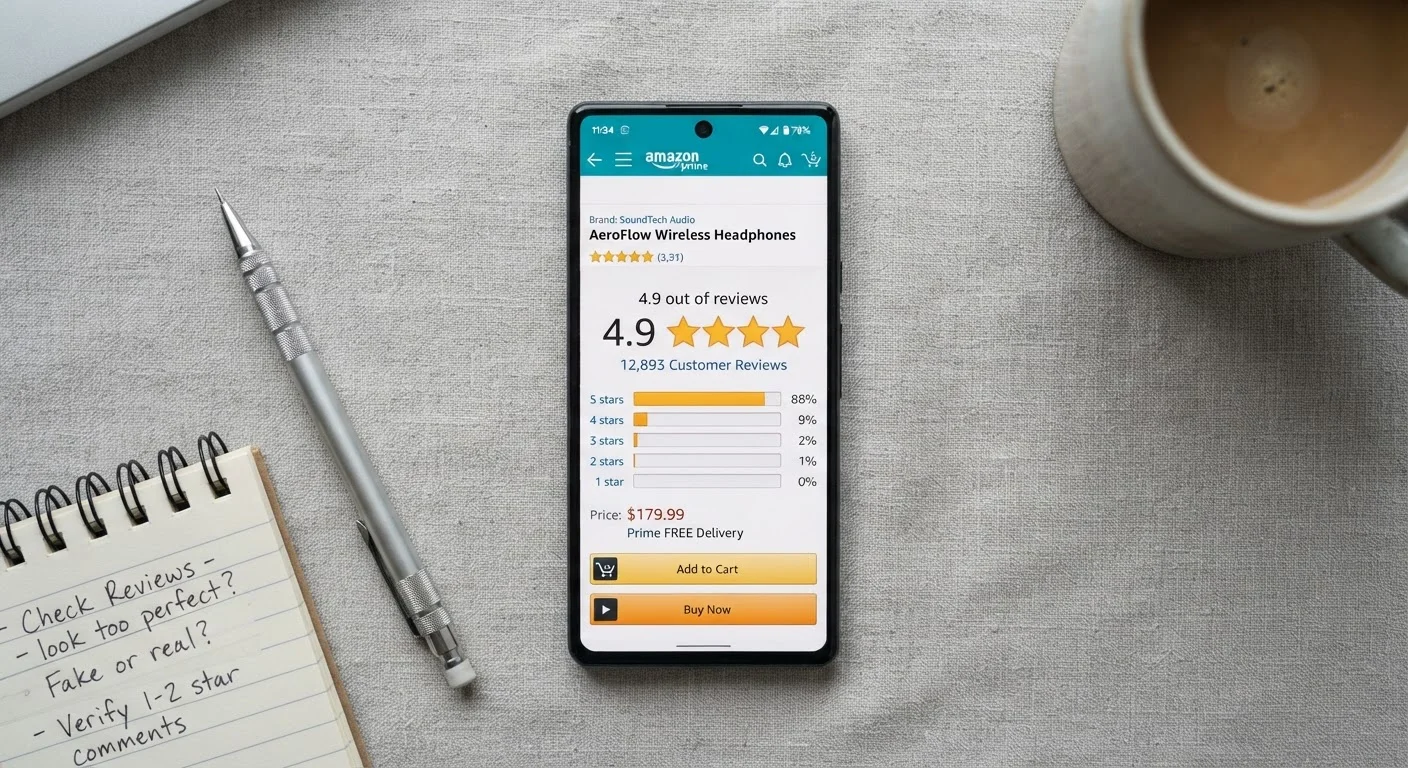
When a product has fewer than 50 reviews, a single cluster of enthusiastic early adopters — or a seller-run review campaign — can push the average to near-perfect. Platforms differ in how aggressively they filter incentivized reviews, so a 4.8 on one site may reflect a very different review ecosystem than a 4.8 on another. A more useful signal is the distribution shape: a healthy product typically shows a large peak at 4–5 stars and a small but present tail of 1–2 star ratings. An unnaturally clean distribution with almost zero negative reviews is itself a red flag.
Myth
More reviews always means a more trustworthy rating.
Fact
Volume only improves reliability when the reviews are independent, verified, and diverse — conditions that are frequently not met.
Review counts can be inflated by importing reviews from older or unrelated product listings, running off-platform giveaway campaigns, or using review-generation services. Some products accumulate thousands of reviews quickly because the seller ships at high volume and follows up aggressively — not because the product is consistently good. Before trusting a large review count, check whether the reviews span a range of dates and purchaser profiles, and whether the written content is substantive rather than generic one-liners.
Myth
Three-star reviews are the least useful — they're just wishy-washy opinions.
Fact
Mid-range reviews often contain the most specific, actionable quality information of any rating tier.
One-star reviews can be emotional and situation-specific (late delivery, damaged packaging), while five-star reviews tend to be brief and enthusiastic. Three-star reviewers, by contrast, often describe exactly what worked and what didn't — noting that the fabric pilled after three washes, or that the battery life was shorter than advertised. Sorting by three-star reviews is one of the fastest ways to surface realistic, balanced assessments of a product's actual performance. Understanding material quality signals can help you judge whether those mid-tier complaints are deal-breakers.
Myth
A product certified or tested by the seller has passed independent quality verification.
Fact
Seller-claimed certifications are not the same as independent third-party testing, and some certification logos on listings are fabricated or expired.
Genuine independent testing — from labs, standards organizations, or editorial review outlets — involves protocols the seller does not control. When a listing badge says "tested for quality" or "certified performance," look for the name of the certifying body and verify it independently. Legitimate certifications are searchable and traceable. If no third-party body is named, treat the claim as marketing language rather than verified fact — similar to how food label terms like "natural" carry no regulated definition, as explored in food label claims that often mislead.
Myth
If a product is highly rated, the price reflects its real value.
Fact
Star ratings say nothing about whether the price is fair, and high ratings are sometimes used to justify inflated pricing.
A product with strong ratings can still be overpriced relative to comparable alternatives, or it may carry hidden costs that erode its apparent value. Hidden costs like restocking fees and shipping charges can quietly close the gap between a "highly rated" premium item and a modestly rated one. Evaluating price separately from rating — and comparing specifications rather than scores — gives a more complete picture of actual value.
How to Read Reviews More Effectively
The written content of reviews carries far more signal than the numeric score. A few practical habits sharpen what you extract from them:
- Sort by most critical first. One- and two-star reviews identify recurring failure points. If the same issue — motor burning out, zipper failing, sizing wildly off — appears across multiple independent reviewers, treat it as a likely product flaw rather than bad luck.
- Check review dates. A product that earned strong ratings two years ago may have gone through a quality change since. A cluster of negative reviews in recent months, following years of positive ones, is a meaningful signal.
- Look for verified purchase labels. Platforms that distinguish verified purchases from unverified ones give you a way to weight reviews more accurately, though verification is not a guarantee of honesty.
- Be skeptical of suspiciously uniform praise. If dozens of reviews use nearly identical phrasing, that pattern can indicate coordinated or templated review activity.
For a broader framework on assessing who you're buying from, evaluating seller credibility adds another layer of protection beyond the product listing itself.
Watch for Review Hijacking on Marketplaces
Some marketplace listings accumulate thousands of positive reviews under one listing, then swap the product being sold — a practice known as review hijacking. If the review content mentions a different item than what's currently listed, treat the entire rating history as unreliable. This is especially common on open third-party marketplace platforms.
Better Quality Signals Than a Star Average
Ratings are one data point. These additional signals tend to be more directly tied to physical quality:
- Material and specification transparency. Sellers confident in their product quality typically publish detailed specs — thread counts, alloy grades, motor wattage, waterproof ratings with standard designations. Vague or absent specifications are worth noting. Material quality indicators across categories can help you know what to ask for.
- Return and warranty policy. A seller willing to stand behind a product with a meaningful return window or warranty is signaling confidence in durability — skin in the game that a star rating doesn't create.
- Independent editorial reviews. Testing-focused publications and consumer organizations evaluate products against defined criteria rather than aggregating sentiment. Their methodology is transparent and not tied to the sale.
- Price consistency over time. Products whose prices fluctuate wildly to manufacture artificial urgency or perceived value are worth approaching carefully — promotional saturation distorts perceived value in ways that can obscure whether a product is genuinely worth what it costs.
Ratings Reflect Satisfaction, Not Quality
Customer ratings measure how happy buyers were at the moment of review — not whether a product will hold up after six months of use. A buyer delighted by fast shipping and pretty packaging may leave five stars even if the item fails within weeks. Always look past the average to understand what reviewers are actually responding to.
Used together, these signals build a more complete picture than any single number on a five-point scale.