

Key Takeaways
Our Verdict
No single mattress type is universally superior. The right choice depends on your sleep position, temperature regulation needs, budget, and how long you plan to keep the mattress. Understanding the structural differences — not the brand language — is the most reliable way to make a sound decision.
| Best for | Recommended |
|---|---|
| Budget-conscious shoppers or those who prefer a bouncy, cooler sleep surface | Innerspring |
| Side sleepers or those with pressure-point pain who sleep cool | Memory Foam |
| Shoppers who want balanced support, bounce, and comfort without committing to all-foam | Hybrid |
| Long-term investors prioritizing durability, natural materials, and responsiveness | Latex |
Why Mattress Marketing Is Especially Noisy
The mattress industry spends heavily on marketing, and terms like "orthopedic," "therapeutic," and "clinical-grade" are largely unregulated — any manufacturer can use them. That means a shopper comparing two mattresses on a showroom floor is often comparing taglines, not meaningful structural differences.
The more useful framework is to focus on construction: what materials form the support core, what sits in the comfort layers, and how those materials behave over time. For a broader look at how to assess build quality across product categories, see this material quality primer.
Before comparing prices, it also helps to understand what variables make two seemingly similar mattresses very different purchases — warranty terms, trial periods, and return policies can significantly change the value equation.
The Four Core Mattress Types, Compared
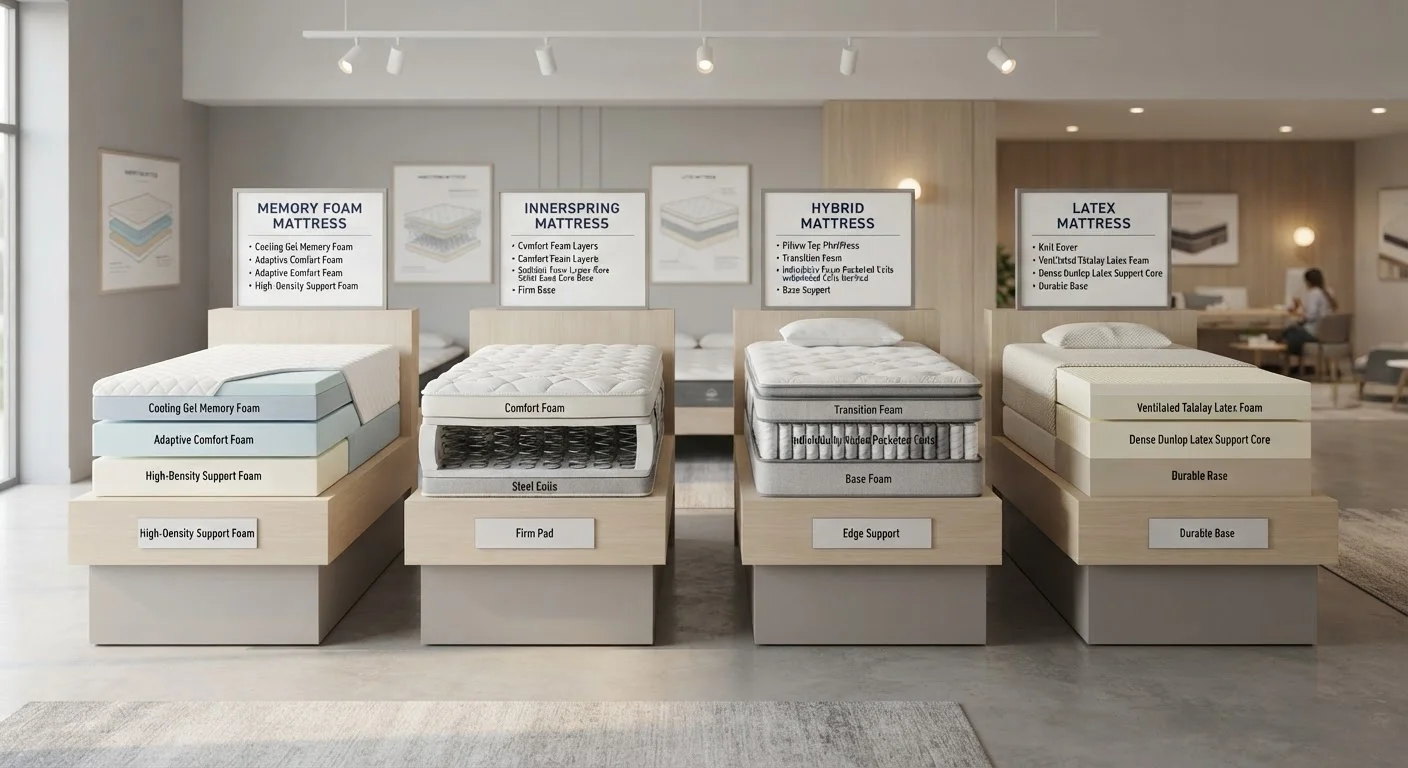
Each mattress type has a distinct construction logic that produces predictable trade-offs in feel, temperature, longevity, and cost. Here's how they stack up across the criteria that most affect everyday sleep quality.
| Innerspring | Memory Foam | Hybrid | Latex | |
|---|---|---|---|---|
| Support feel | Firm, bouncy | Contouring, slow-response | Balanced bounce + cushion | Responsive, buoyant |
| Motion isolation | Poor to fair | Excellent | Good (with pocketed coils) | Good |
| Temperature regulation | Excellent airflow | Can retain heat | Better than all-foam | Naturally breathable |
| Typical lifespan | 5–8 years | 7–10 years | 8–10 years | 10–15+ years |
| Edge support | Good to excellent | Fair | Good | Good |
| Relative price range | Lower | Low to mid | Mid to high | High |
| Best sleep position match | Stomach, back | Side, combo | Most positions | Back, stomach, combo |
A few clarifications on the table: "motion isolation" refers to how well the mattress absorbs movement on one side without disturbing the other — relevant for couples. "Edge support" describes how well the perimeter holds up under weight, which affects usable surface area and ease of getting in and out of bed.
Memory Foam and Latex: Depth Matters
Both memory foam and latex are sold in a wide range of densities and thicknesses, and those specs matter more than the material label alone. Memory foam is typically measured by density (pounds per cubic foot) and ILD (Indentation Load Deflection, a firmness measure). Higher-density memory foam generally lasts longer and provides more consistent support, though it also retains more heat.
Latex comes in two main forms: natural latex (derived from rubber tree sap) and synthetic latex (petroleum-based). Natural latex is more durable and resilient; synthetic latex is less expensive but degrades faster. A third category, blended latex, mixes the two. Look for the Dunlop or Talalay processing method on the label — Talalay tends to be softer and more consistent, Dunlop denser and firmer.
Check the Comfort Layer Thickness
On memory foam and latex mattresses, comfort layer depth is as important as the material itself. A 1-inch foam topper over a cheap base is a very different product from 3–4 inches of high-density foam over a quality support core. Ask manufacturers or retailers for layer-by-layer specs, not just total mattress height.
Pair your mattress research with what actually makes sheets feel comfortable — the mattress surface material and cover fabric together shape how the bed actually feels at skin level.
Innerspring and Hybrid: Coil Construction Is the Variable
Not all innerspring mattresses are equivalent. The coil type determines much of the feel and longevity:
- Bonnell coils — hourglass-shaped, interconnected; the oldest design, lower cost, less contouring.
- Offset coils — similar to Bonnell but with a hinged design for better contouring.
- Continuous coils — made from a single wire; durable but can transfer motion readily.
- Pocketed (individually wrapped) coils — each coil is encased in fabric; best for motion isolation and body contouring among coil types.
Hybrid mattresses use pocketed coils as their support core and add foam or latex comfort layers on top — typically 2–4 inches. The coil gauge (thickness) and coil count affect durability and support, though coil count alone isn't a reliable quality indicator; coil gauge and construction method matter equally.
Coil Count Claims Can Mislead
Manufacturers sometimes market high coil counts as a premium feature, but a mattress with 2,000 thin, low-gauge coils can perform worse than one with 800 sturdy, individually pocketed coils. Focus on coil type, gauge, and whether they are independently wrapped rather than the raw count figure alone.