

Key Takeaways
Following Distance
Following distance is the space you maintain between your vehicle and the one directly in front of you while driving. It serves as a buffer that gives you time to perceive a hazard, react, and bring your vehicle to a stop before a collision. The widely taught two-second rule is a useful baseline, but physics, speed, and road conditions can make it dangerously insufficient.
Total stopping distance equals perception-reaction distance plus braking distance. At highway speeds, both components scale significantly — braking distance alone increases with the square of velocity, not linearly.
The Math Behind Stopping a Moving Vehicle
Every driver learns the two-second rule at some point, but few are taught the physics that determines whether it's actually sufficient. Stopping a vehicle involves two distinct phases: the perception-reaction phase and the braking phase. Both consume distance, and both are affected by factors most drivers rarely consider.
Perception-reaction time — the interval between seeing a hazard and physically pressing the brake pedal — averages around 1.5 seconds for an alert, unimpaired driver. At 60 mph, that's approximately 132 feet of travel before the brakes engage at all. The braking phase then adds further distance depending on vehicle weight, tire condition, and road surface. Combined, total stopping distance at 60 mph on dry pavement typically falls in the range of 240 to 300 feet for a standard passenger car.
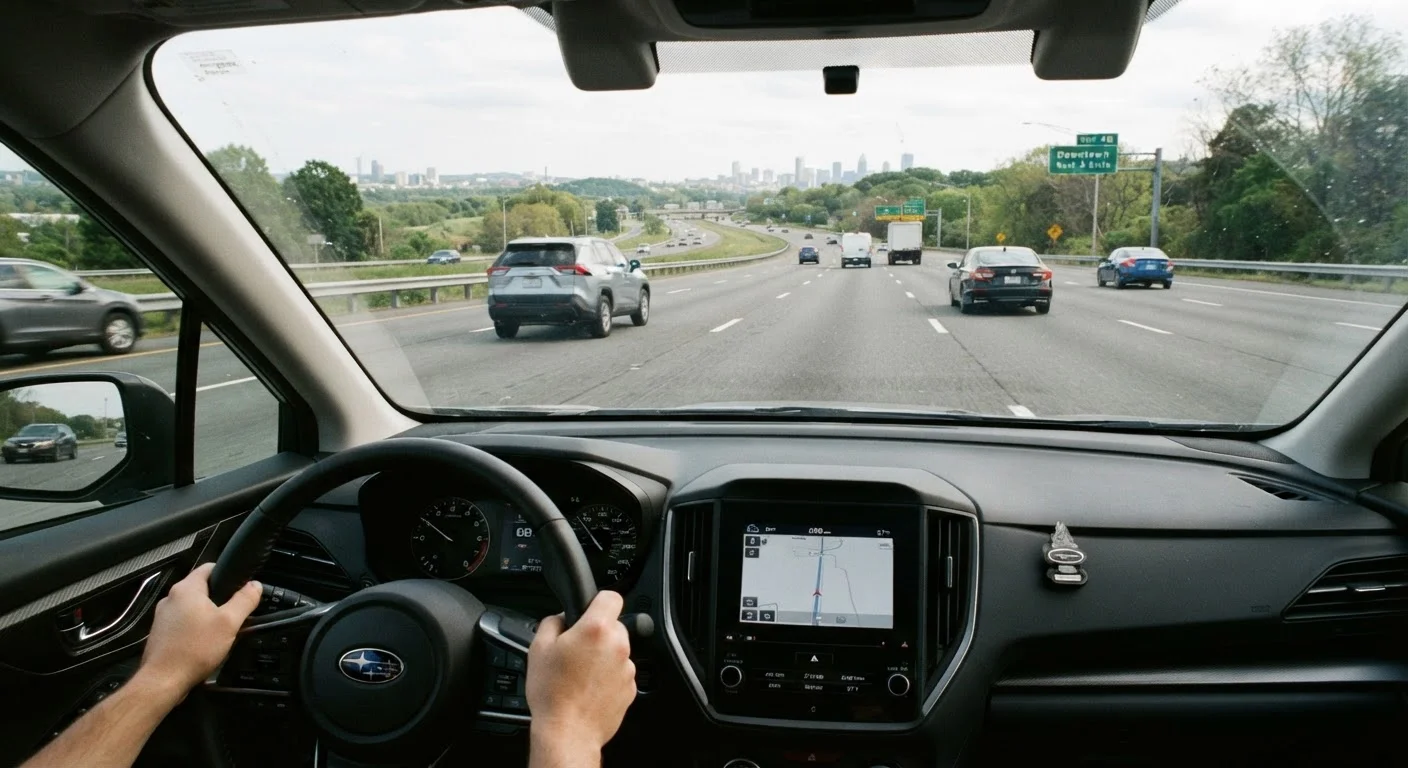
The two-second rule at 60 mph gives you roughly 176 feet of buffer. That gap can disappear in a single hard stop.
~300 ft
Typical stopping distance at 60 mph on dry pavement
This figure combines perception-reaction distance and braking distance for an average passenger car under normal conditions.
1.5 sec
Average driver perception-reaction time
Research on driver response time consistently places the average alert driver's reaction at approximately 1.5 seconds before brakes are applied.
50%+
Increase in stopping distance on wet roads
Wet pavement reduces tire grip substantially; stopping distances commonly increase by half or more compared to dry conditions.
How Speed Changes Everything
The relationship between speed and stopping distance is not linear — it's exponential. Braking distance increases with the square of your speed. This means that going from 30 mph to 60 mph doesn't double your stopping distance; it can quadruple it. Most drivers significantly underestimate this effect, which is why highway rear-end collisions often involve vehicles traveling at speeds where the gap simply wasn't large enough to matter.
This is also why speed management and following distance are inseparable. Driving at 75 mph on a crowded interstate with a two-second gap leaves almost no room for error if the driver three vehicles ahead brakes hard. The cascade effect — each driver reacting in sequence — compounds the problem further down the line. Reading traffic well ahead and modulating speed gradually is one of the most effective tools for managing this risk.
When Conditions Demand More Space
The two-second baseline assumes ideal conditions: dry pavement, alert driver, well-maintained vehicle. In the real world, those conditions are frequently absent. Wet roads reduce tire-to-pavement friction significantly, and stopping distances can increase by 50% or more. Ice can reduce braking effectiveness so dramatically that the math bears almost no resemblance to dry-road figures.
A Simple Way to Recalibrate Your Gap
Instead of counting two seconds, try counting three on highways and four in rain or low visibility. Pick a fixed point — a sign, an overpass, a lane marker — and count after the vehicle ahead passes it. If you reach the same point before finishing your count, ease off the accelerator to open the gap. This takes less than five seconds of deliberate attention and costs nothing.
Vehicle type also matters considerably. A loaded pickup truck or SUV carries more momentum than a compact car at the same speed. Momentum scales with mass, so heavier vehicles need longer stopping distances even with identical braking systems. Drivers of larger vehicles should apply an additional margin beyond the standard guidance.
Tire condition is another frequently overlooked variable. Worn tread channels water less effectively and grips the road less reliably. A car with tires at minimum tread depth on a wet road may behave much closer to an ice scenario than most drivers expect. For more on how precipitation affects vehicle physics, see how rain changes stopping distance.
Building a Better Following Distance Habit
The practical upgrade from the two-second rule is straightforward: treat it as a floor rather than a target. Under normal highway conditions, three to four seconds provides a substantially safer buffer. In rain, double it. In fog or at night — when perception distance is reduced — the gap should increase further still, since you may not see a hazard until you're much closer to it. Night driving introduces its own visibility challenges that make generous following distance especially important after dark.
One underappreciated benefit of larger following distance is that it tends to reduce unnecessary braking, which improves fuel economy and reduces brake wear. Drivers with more space ahead can ease off the accelerator gradually rather than reaching for the brake pedal at every minor slowdown. The financial and mechanical benefits are modest but real and cumulative over time.
Following distance is one of the simplest driver behaviors to adjust — it requires no equipment, no cost, and no special training. What it does require is a deliberate decision to prioritize the gap, even when other traffic pressures push you to close it.