

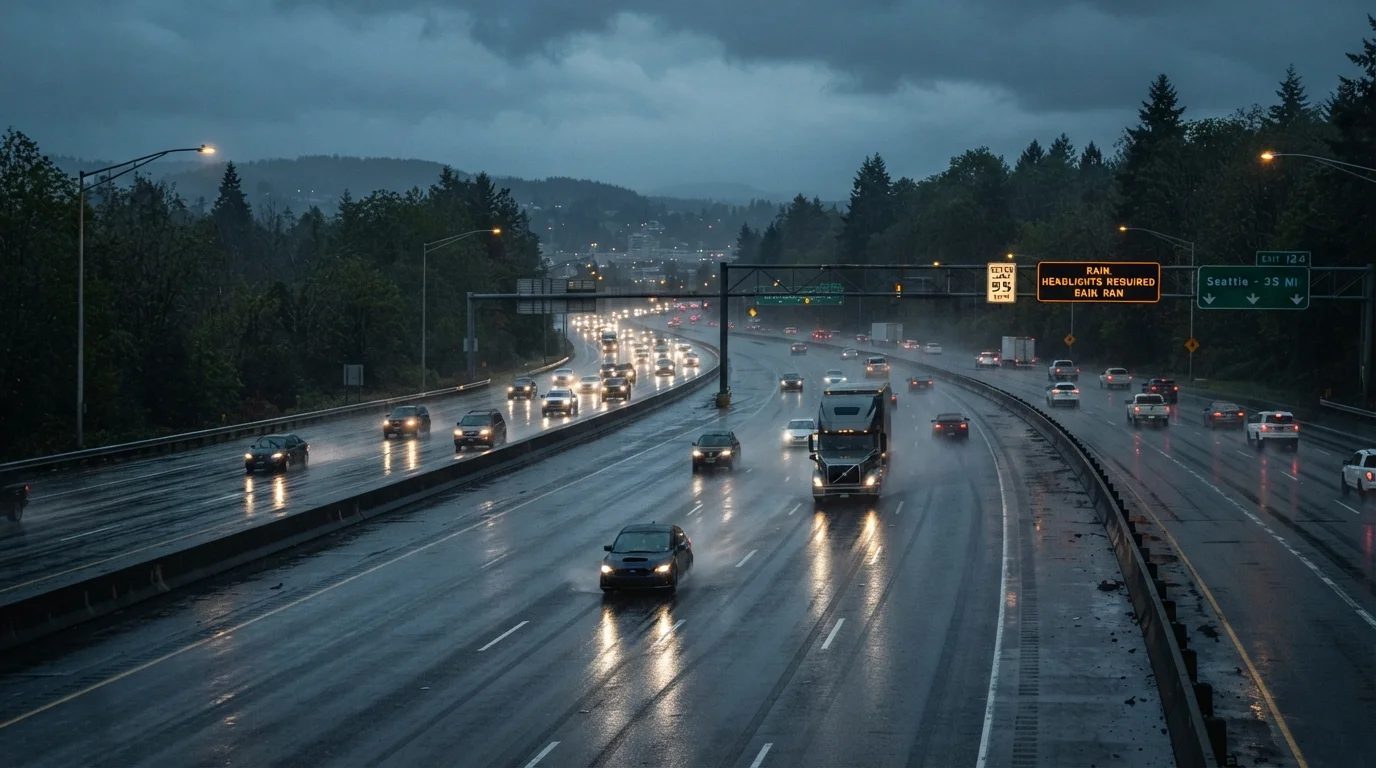
Key Takeaways
Why Rain Changes the Physics of Driving
Rain doesn't just make the road wet — it fundamentally changes the relationship between your tires and the pavement. Dry asphalt offers substantial friction; a thin film of water between tire and road reduces that friction significantly, sometimes dramatically. The result is longer stopping distances, reduced steering response, and a higher likelihood that a given input will exceed what your tires can actually deliver.
Tires work by maintaining a contact patch — the small area where rubber meets road. When water pools faster than tires can disperse it, that contact patch shrinks or disappears entirely. This is hydroplaning, and it renders steering and braking largely ineffective. Understanding this physics isn't academic: it's what drives every practical adjustment you should make in wet conditions.
Hydroplaning Can Happen Instantly
Hydroplaning — when a layer of water lifts your tires off the road surface — can occur at speeds as low as 35 mph on a tire with worn tread. When it happens, do not brake hard or steer sharply. Ease off the accelerator gently and hold the wheel straight until your tires regain contact with the road.
Rain also affects visibility in ways that compound the traction challenge. Spray from other vehicles, reduced contrast on road markings, and fogged glass all cut your effective sight lines. Adjusting for rain means managing both physics and perception simultaneously.
How to Adapt Before and During Rain
Effective wet-weather driving starts before you pull out of the driveway. Confirm your wipers are clearing cleanly, your lights work, and your tires look healthy. Once on the road, the adjustments below will address the three core risks — stopping distance, visibility, and control — in the order that matters most.
What you will need
Reduce Your Speed Meaningfully
The most important adjustment in rain is speed — not just a token reduction, but a genuine one. Wet asphalt dramatically reduces tire friction. At highway speeds, stopping distances can more than double compared to dry pavement. A useful reference point: if you'd normally follow at two seconds of distance, wet roads warrant at least three to four seconds. See why two seconds of following distance often isn't enough for the underlying physics.
Increase Your Following Distance
Braking on wet roads takes longer because tires have less grip to work with. Apply the three-to-four second rule by picking a fixed point — a sign or overpass — and counting the seconds after the car ahead passes it before you reach the same point. Smooth, early braking is far more effective than late hard stops. The habit of reading traffic ahead and coasting before braking becomes even more valuable when traction is reduced.
Maximize Visibility — Yours and Others'
Turn on your low-beam headlights any time it's raining, even in daylight. Many states legally require this. Low beams help other drivers see you; high beams reflect off rain and actually reduce your own forward vision. Run your front and rear defrosters to prevent interior fogging, which can reduce effective visibility more than the rain itself. Compare this to the challenges covered in night driving visibility habits — many of the same principles apply.
Steer and Brake Smoothly
Abrupt inputs — sharp steering, hard braking, sudden acceleration — are dangerous on dry roads and significantly more so on wet ones. Each action asks your tires to do more at once than they may be capable of. Treat the steering wheel, brake pedal, and accelerator as instruments requiring smooth, deliberate movements. This is especially true in curves, where lateral force is already loading the tires. Review habits that wear down your brakes to understand how aggressive inputs affect both safety and component life.
Know How to Respond to Hydroplaning
If you feel your steering go light and unresponsive, you're likely hydroplaning. The instinct to brake hard is the wrong response. Instead: release the accelerator slowly, keep the wheel pointed straight or very gently correct your direction, and allow the car to slow until tires regain traction. Do not jerk the wheel. Most hydroplaning episodes are brief if you don't overcorrect.
Verify Your Tires Are Rain-Ready
No driving adjustment compensates fully for inadequate tires. Before rainy seasons, check tread depth and inflation. Tread channels water away from the contact patch; when they're worn shallow, water has nowhere to go and the tire rides on top of it. Proper inflation keeps the tire's footprint correctly shaped against the road. Our driver's field guide to tire pressure and tread depth covers the exact numbers and inspection steps to follow.
Don't Use Cruise Control in Wet Conditions
Cruise control prevents you from naturally modulating throttle in response to changing traction. If a wheel starts to slip while cruise control is engaged, the system may actually increase engine output to maintain speed — the opposite of what you need. Disengage it any time roads are wet.
Check Your Tires Before Rainy Season
Tread depth is your first line of defense in wet weather. Use a quarter to check: insert it into a tread groove with Washington's head facing down — if you can see the top of his head, your tread is likely insufficient for safe wet-road performance. See our tire tread and pressure field guide for the full inspection routine.
When conditions are severe — heavy downpour, flooding, or near-zero visibility — the right call may simply be to pull safely off the road and wait. No destination is worth a preventable crash. Drivers who understand following distance and reaction time physics consistently make better real-time judgments about when conditions exceed safe thresholds.