

Key Takeaways
Option A
Casual
The comfort-first, no-rules default.
Best for: Relaxed social settings, weekends, errands, and any context where comfort clearly outweighs formality.
Option B
Smart Casual
The polished middle ground for modern dress codes.
Best for: Workplace environments, dinners out, networking events, or any occasion that calls for looking intentional without being formal.
If you're heading to a weekend brunch with close friends
Casual
A relaxed setting with no dress code expectation frees you to prioritize comfort and personal style without overthinking it.
If you're attending a work dinner or client-facing event
Smart Casual
Smart casual signals that you've put thought into your appearance, which matters when first impressions carry professional weight.
If the invitation says 'smart casual' and you're unsure
Smart Casual
When in doubt, err toward the polished end — it's easier to dress down subtly in the moment than to feel underdressed.
If you're building a functional everyday wardrobe
Smart Casual
Smart casual pieces tend to be more versatile, bridging the gap between casual comfort and occasions that require a little more intention.
What 'Casual' Actually Means
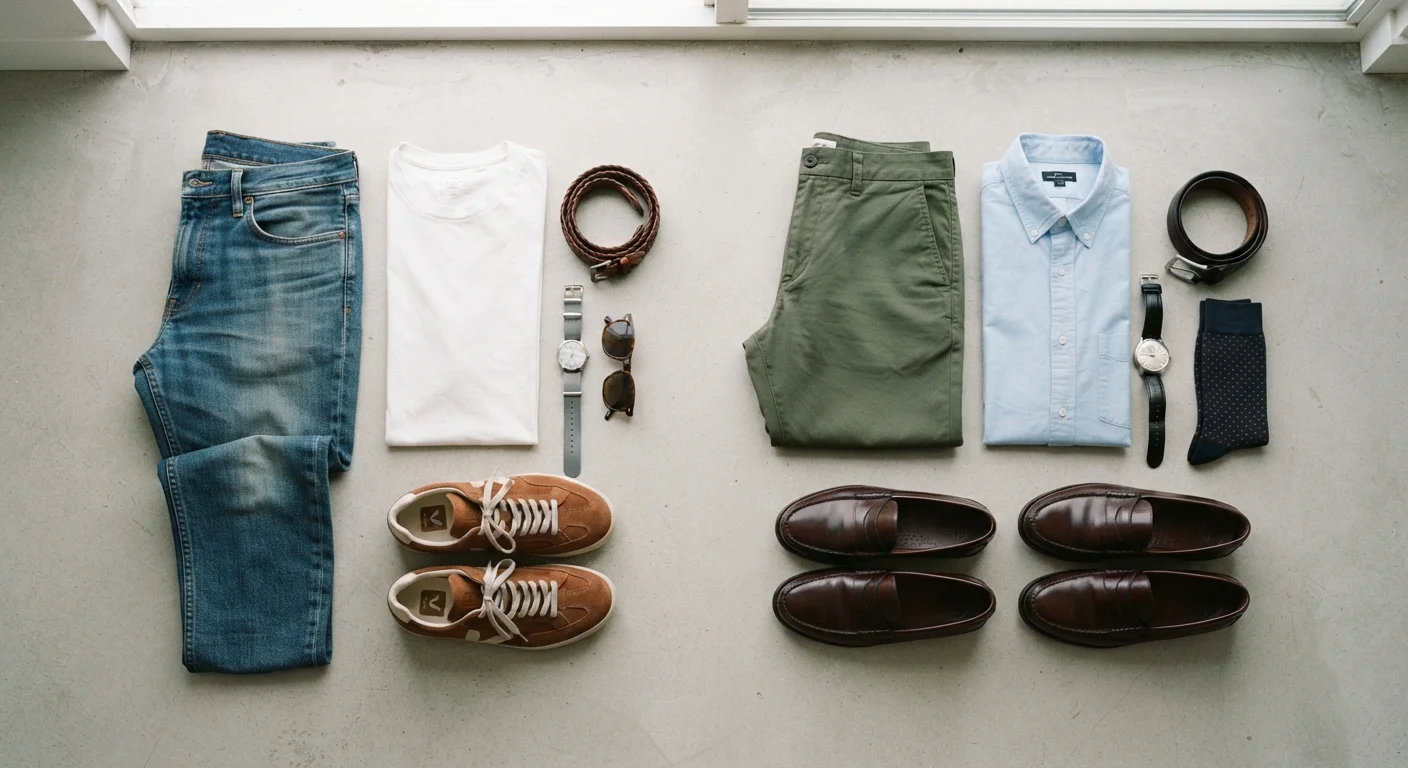
Casual dressing is often misread as simply wearing whatever you want — but it's better understood as dressing without a formality requirement. The priority is comfort, personal expression, and ease. Think lived-in denim, relaxed-fit T-shirts, hoodies, sneakers, and weekend-ready layers.
What casual is not is inherently sloppy. A well-fitted plain tee and clean white sneakers reads as intentionally casual. Stained sweats and a fraying collar, by contrast, cross from casual into unkempt — a distinction worth keeping in mind even in the most relaxed settings.
Casual attire is appropriate where there's no performance expectation around your appearance: grocery runs, lounging at a friend's place, casual outdoor activities, or a low-key neighborhood coffee shop. The absence of a dress code is almost always a green light for casual. That said, your daily context shapes your defaults — what reads as casual in one city or setting may not translate the same way elsewhere.
What 'Smart Casual' Actually Means
Smart casual is where most dress code confusion lives. The term signals that you should look put-together without being formally dressed — which leaves an enormous middle ground open to interpretation. The through-line is intentionality: every element of the outfit should feel considered.
In practice, smart casual typically involves well-fitted trousers or chinos rather than distressed denim, a collared shirt, structured knit, or a neat blouse, and footwear that leans polished — leather loafers, clean low-profile sneakers, ankle boots. Logos should be minimal; fabric quality becomes more noticeable at this tier.
What smart casual is not is a suit. The whole point of the category is to occupy the space between business formal and weekend-off comfort. A blazer over a clean T-shirt and dark trousers can work beautifully — and that layering logic is often the fastest way to elevate a look into smart casual territory.
| Criterion | Casual | Smart Casual |
|---|---|---|
| Primary goal | Comfort and ease | Polish with comfort |
| Typical bottoms | Jeans, sweats, shorts | Chinos, tailored trousers, dark jeans |
| Typical tops | T-shirts, hoodies, casual knits | Collared shirts, blouses, structured knits |
| Footwear | Sneakers, sandals, slides | Loafers, clean sneakers, ankle boots |
| Fabric expectation | Relaxed; stretch and cotton preferred | Visible quality; minimal distressing |
| Fit priority | Comfort over silhouette | Intentional, well-fitted silhouette |
| Typical settings | Weekends, errands, casual socializing | Work dinners, events, first impressions |
The Real Difference: Structure and Effort, Not Just Garments
The most useful framework isn't a checklist of allowed and banned garments — it's about the signal your outfit sends. Casual says, "I dressed for myself." Smart casual says, "I dressed with this occasion in mind."
That distinction shifts based on fit, condition, and coordination. A pair of dark slim jeans with no visible wear, tucked into clean Chelsea boots and a structured crew-neck, can read as smart casual in many settings. The same jeans with a graphic tee and beat-up sneakers? That's firmly casual. The garments overlap; the styling separates them.
Fit is arguably the single biggest variable. Well-fitted clothing reads as intentional almost regardless of formality level. This is something dressing guidance often overcomplicates — the principle is straightforward even if the execution is personal.
A Note on Dress Codes Across Cultures
Smart casual standards vary noticeably by region and cultural context. What reads as appropriately polished in a major U.S. city may differ from expectations in parts of Europe, East Asia, or the American South. When dressing for an unfamiliar environment — especially while traveling — it's worth observing local norms before defaulting to your usual interpretation of the category.
Reading the Room: Context as the Deciding Factor
Dress codes are written by the host for a reason: they communicate the tone of an experience before it begins. When an invitation says "smart casual," it's a request, not a vague suggestion. Showing up in full casual signals that you either didn't notice or didn't care — neither is a good first impression in professional or semi-formal social contexts.
Conversely, over-dressing for a clearly casual occasion creates its own friction. Wearing formal attire to a backyard cookout doesn't read as polished — it reads as disconnected from the group.
When a dress code isn't specified, look at the venue type, time of day, and who is hosting. A rooftop bar at 8pm skews smart casual. A daytime farmers market is firmly casual. A dinner at someone's home usually sits somewhere in between, leaning toward the smart casual end if you don't know the host's style well.
For a deeper look at how your actual daily life should inform your wardrobe structure — not just individual outfit moments — see how lifestyle shapes wardrobe decisions.
41%
Adults uncertain about smart casual dress codes
A survey conducted by a U.S. fashion retailer found that roughly 4 in 10 respondents said they were unsure how to interpret 'smart casual' when it appeared on an invitation.
~60%
Workplaces with casual or smart casual default dress codes
Workplace surveys from the late 2010s and early 2020s consistently found the majority of U.S. office environments had shifted away from business formal as their standard dress expectation.