

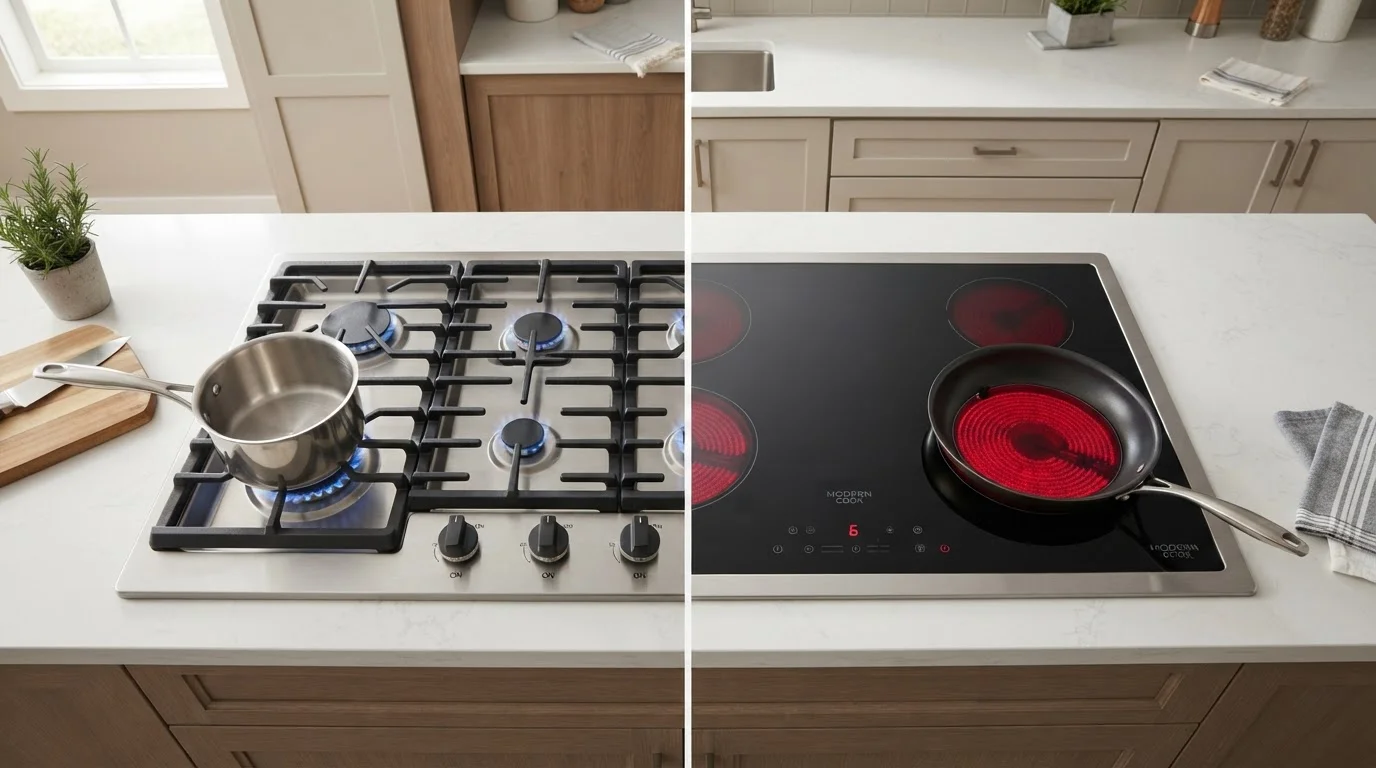
Key Takeaways
Option A
Gas Range
The chef-preferred standard with instant, visible heat control.
Best for: Cooks who prioritize responsive flame control, high-heat searing, and don't mind a slightly higher installation cost if gas lines are already in place.
Option B
Electric Range
The consistent, accessible option with lower upfront and installation costs.
Best for: Households without existing gas infrastructure, or anyone who bakes frequently and values even, steady heat distribution.
If you cook frequently on the stovetop and want precise heat control
Gas Range
Gas burners respond instantly to dial adjustments, allowing fine-tuned simmering and rapid high-heat cooking that electric coil or radiant surfaces can't match in real time.
If baking is your primary cooking activity
Electric Range
Electric ovens hold temperature more uniformly and recover heat faster after the door opens, which produces more predictable baking results across the oven cavity.
If your home lacks an existing gas line
Electric Range
Running a new gas line can cost several hundred to over a thousand dollars in labor and materials; an electric range requires only a standard 240V outlet, which many homes already have.
If energy efficiency and cooktop safety are priorities
Electric Range
Induction electric ranges transfer heat directly to the cookware rather than the surrounding air, losing far less energy in the process and keeping the surface itself cooler to the touch.
If you live in an area with frequent power outages
Gas Range
Most gas ranges can be lit manually during an outage, allowing continued cooking when the electrical grid is down — a practical advantage in outage-prone regions.
How Heat Works Differently on Each Type
The core difference between gas and electric ranges comes down to how heat is generated and transferred. A gas burner ignites a flame directly beneath the cookware, producing instant, visible heat that the cook can adjust by eye. Turn the dial down and the flame responds in under a second. This immediacy is why professional kitchens have long defaulted to gas.
Electric ranges — whether coil, radiant glass-ceramic, or induction — work differently. Coil and radiant elements heat up gradually and retain heat longer, which can cause overshooting when you reduce the setting. That lag takes adjustment for cooks used to gas. However, electric ovens tend to distribute heat more evenly across the cavity, reducing the hot spots that gas ovens commonly produce. For roasting and baking, this evenness matters.
Induction deserves a specific mention: it's technically electric, but uses electromagnetic energy to heat the cookware itself rather than the burner surface. Response time rivals gas, energy loss is minimal, and the cooktop stays relatively cool. It does require induction-compatible cookware (typically cast iron or magnetic stainless steel), which is worth factoring in if you're switching.
| Criterion | Gas Range | Electric Range |
|---|---|---|
| Heat response speed | Instant flame adjustment | Gradual; induction is near-instant |
| Oven heat consistency | Can have hot spots | More even distribution |
| Energy efficiency (cooktop) | ~40–55% transfer rate | ~65–90% (induction highest) |
| Typical installation cost | Higher without existing gas line | Lower with existing 240V outlet |
| Indoor air quality impact | Combustion byproducts present | No combustion; cleaner air |
| Usable during power outage | Yes (manual ignition) | No |
| Cooktop surface safety | Open flame; grates stay hot | Surface stays hot (not induction) |
| Cookware compatibility | Works with all cookware | Induction needs magnetic cookware |
Running Costs: What Your Utility Rates Actually Determine
Neither range type is universally cheaper to run. The answer depends almost entirely on what your local utility charges for natural gas versus electricity. In many U.S. regions, natural gas has historically been less expensive per BTU than electricity, making gas ranges cheaper to operate day-to-day. But this varies widely by state and changes as energy markets shift.
~40–55%
Energy transferred to food by gas burners
Estimates from the U.S. Department of Energy indicate gas burners lose a significant share of heat to surrounding air.
~85–90%
Energy efficiency of induction cooktops
Induction's efficiency advantage over gas and standard electric is consistently cited in appliance efficiency literature from sources such as ENERGY STAR and DOE.
Varies by state
Gas vs. electricity price differential
The U.S. Energy Information Administration tracks regional utility rates; the cost advantage of gas over electric is not uniform across all states.
Electric induction ranges narrow the gap considerably because they waste less energy heating the surrounding air. A gas burner transfers roughly 40–55% of its energy to the food; induction can reach 85–90% efficiency. So even if electricity costs more per unit, an induction range may cost similar to or less than gas to operate over time. Standard electric coil and radiant ranges fall somewhere in between, typically converting around 65–70% of energy to usable heat.
Installation costs are separate from running costs and often dominate the upfront math. If a gas line doesn't already serve your kitchen, installation can be substantial. Most homes wired for modern appliances already have a 240V outlet nearby, making electric installation comparatively straightforward. See what else to check before comparing prices — installation, ventilation requirements, and warranty terms all affect the true cost of ownership.
Safety, Maintenance, and the Infrastructure Question
Gas ranges introduce combustion byproducts — including nitrogen dioxide and carbon monoxide — into the kitchen air. Research published in environmental health journals has highlighted indoor air quality concerns with gas cooking, particularly in poorly ventilated kitchens. A quality range hood vented to the exterior significantly reduces this risk, but it's a real consideration, especially in smaller or older homes.
Electric ranges eliminate combustion risks entirely, though radiant and coil surfaces stay hot after being switched off, which is a burn hazard. Induction surfaces heat only where the pan sits, making them the safest option for households with young children.
Maintenance differences are modest. Gas burners and grates can trap grease and require more regular cleaning than a smooth glass-ceramic surface. Coil elements can be replaced individually if they fail; sealed gas burners are durable but require professional service if the igniter or gas valve malfunctions. For anyone thinking about how appliance choice intersects with broader home energy decisions, smart home energy research provides useful context on how usage patterns affect real-world savings.
Ultimately, the most practical question is what your kitchen already supports. Retrofitting for gas where only electric exists — or vice versa — adds cost that often outweighs any performance preference. Hidden variables like hookup requirements rarely show up in a spec sheet but consistently shape which choice delivers real value.