

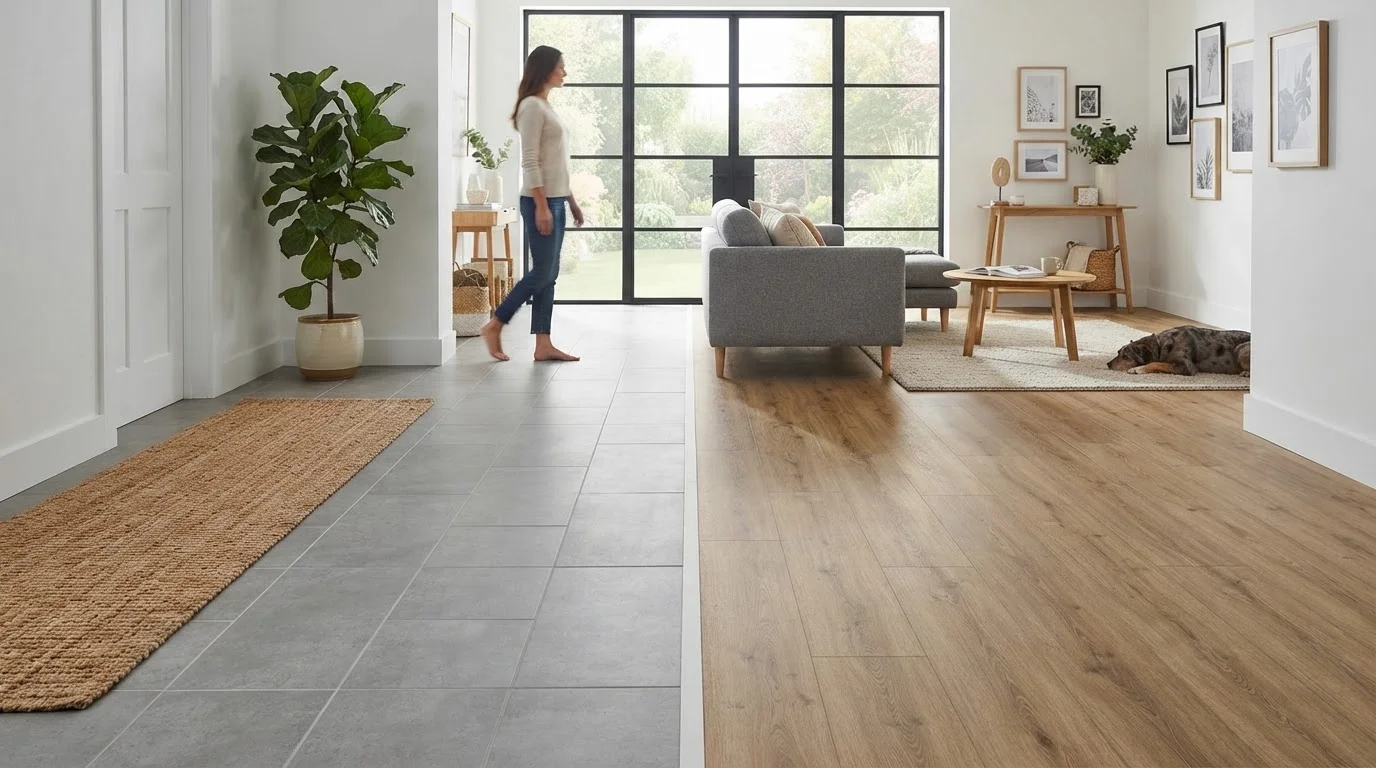
Key Takeaways
Option A
Ceramic or Porcelain Tile
The time-tested, hard-wearing classic for wet and high-traffic spaces.
Best for: Bathrooms, kitchens, entryways, and any space where moisture resistance and long-term durability are the top priority.
Option B
Luxury Vinyl Plank (LVP)
The warm, forgiving, DIY-friendly alternative to hard flooring.
Best for: Whole-home installs, basements, and households that want a wood-look floor with resilience and easier underfoot comfort.
If you're tiling a bathroom or laundry room
Ceramic or Porcelain Tile
Tile's fully waterproof surface makes it the more reliable choice where standing water, steam, and humidity are constant.
If you want to floor an entire home in a weekend
Luxury Vinyl Plank (LVP)
LVP's click-lock systems are designed for confident DIYers and don't require mortar, grout curing time, or specialized tools.
If you have a basement with temperature swings
Luxury Vinyl Plank (LVP)
LVP is more tolerant of minor subfloor flexing and temperature fluctuations than rigid tile, which can crack on unstable substrates.
If longevity over decades is the main goal
Ceramic or Porcelain Tile
Well-installed tile can outlast the home itself, whereas most LVP carries warranties in the 15–25 year range depending on wear layer thickness.
If comfort and noise reduction matter throughout living areas
Luxury Vinyl Plank (LVP)
LVP's layered construction absorbs impact and reduces sound transmission, making it noticeably softer and quieter underfoot than tile.
How These Two Floors Are Actually Built
Understanding the physical makeup of each flooring type explains most of their real-world differences before you ever look at a price tag.
Ceramic and porcelain tile are fired clay products. Porcelain is denser and less porous than standard ceramic, making it better suited to exterior or very wet applications. Both require a rigid, flat subfloor — typically a cement board underlayment — plus mortar, grout joints, and a proper cure period before foot traffic. The finished floor is essentially a stone-like surface bonded permanently to your substructure.
Luxury vinyl plank (LVP) is an engineered composite: a rigid or semi-rigid core (often stone-plastic composite, or SPC) sandwiched between a photographic design layer that mimics wood or stone, and a protective wear layer on top. Most modern LVP uses a floating click-lock system, meaning planks attach to each other — not to the subfloor — and the floor moves as a single unit. No adhesives or mortar are required for most residential installs.
| Criterion | Ceramic / Porcelain Tile | Luxury Vinyl Plank (LVP) |
|---|---|---|
| Waterproofness | Tile yes; grout needs sealing | Plank waterproof; perimeter at risk |
| DIY Difficulty | Moderate to high | Low to moderate |
| Subfloor Tolerance | Requires flat, rigid base | Tolerates minor imperfections |
| Comfort Underfoot | Hard, cold | Warmer, softer |
| Longevity | Decades to lifetime | Typically 15–25 year warranty |
| Scratch Resistance | Excellent | Good (wear-layer dependent) |
| Typical Install Time | Multiple days (cure required) | One to two days (walkable immediately) |
| Maintenance | Easy tile; grout needs attention | Easy overall, no grout joints |
Moisture, Comfort, and Temperature: Where Each Floor Shines
Both materials are marketed as water-resistant, but that claim deserves some nuance.
Tile itself is waterproof, but the grout joints between tiles are the vulnerability. Unsealed or cracked grout can allow moisture to reach the subfloor. Consistent sealing and proper installation around fixtures are essential in wet areas. When done correctly, tile is one of the most reliable choices for bathrooms and kitchens.
LVP is also waterproof at the plank level, but floating installations can allow water to seep beneath the floor if the perimeter or transitions aren't properly sealed. Most manufacturers specify that LVP should not be submerged — pooling water under the floor is a risk in flood-prone basements without proper waterproofing beneath.
Radiant Heat Compatibility Varies
If you're planning in-floor radiant heating, verify compatibility before purchasing either product. Most porcelain tile works well with radiant systems. LVP compatibility depends on the core type and maximum temperature rating specified by the manufacturer — SPC-core products are generally more tolerant than WPC (wood-plastic composite) options, but always confirm with the product's technical documentation.
On comfort: tile is hard and cold, especially in winter months. Radiant in-floor heating can offset this, but it adds significant cost and installation complexity. LVP provides natural thermal resistance and a slightly softer feel underfoot, which many homeowners find more livable in bedrooms and family rooms.
Installation and Subfloor Requirements
This is often the deciding factor for DIYers.
Tile demands a stiff, level subfloor — deflection or unevenness causes grout to crack and tiles to loosen over time. Most tile work over wood subfloors requires adding cement board, which adds weight, height, and labor. Cutting tile requires a wet saw. The project typically takes several days including mortar set and grout cure time.
LVP is considerably more forgiving. SPC-core LVP can bridge minor subfloor imperfections (manufacturers typically specify acceptable variation per linear footage — check your product's spec sheet). Click-lock planks can be cut with a utility knife or simple scoring tool for most cuts, and the floor is walkable immediately after installation. For a competent DIYer with good measuring skills and patience, a room or even a whole floor can often be completed in a single weekend.
~$5–$10/sq ft
Typical tile installation labor cost range
According to general contractor pricing guides, tile installation labor in the U.S. commonly runs higher than LVP due to mortar work, cutting complexity, and cure time requirements.
20 mil
Wear layer recommended for heavy household traffic
Flooring industry guidance generally suggests a minimum 20-mil wear layer for active households with pets or children to ensure adequate long-term durability.
That said, neither floor installation is risk-free. Tile work that isn't properly waterproofed can lead to costly subfloor damage. LVP installed without adequate expansion gaps can buckle in warm conditions. Following manufacturer guidelines precisely is non-negotiable for either product.
Long-Term Durability and Maintenance
Tile, when properly installed, is extraordinarily durable — it's one of the reasons you find original tile in century-old homes. Porcelain tile in particular resists scratching, staining, and wear in ways that vinyl simply cannot match over a 30- or 40-year horizon. However, individual tiles can chip or crack from point impacts, and grout requires periodic resealing and cleaning to stay looking good.
LVP wear durability depends heavily on the wear layer thickness, measured in mils (thousandths of an inch). Light residential use may be fine with 6–12 mil; heavy-traffic households or commercial spaces typically call for 20 mil or more. LVP can be scratched by heavy furniture or pet claws more readily than tile, and it cannot be refinished the way hardwood can — once the wear layer is gone, the plank needs replacing.
Routine maintenance favors LVP slightly: no grout lines to scrub, and a damp mop is usually all that's needed. Tile cleaning is straightforward on the tile surface itself, but grout lines require more deliberate maintenance to prevent staining and mildew in moist environments.