

Key Takeaways
Our Verdict
Neither organic nor synthetic fertilizers are universally superior — the right choice depends on your soil's current condition, what you're growing, and your longer-term garden goals. Organic fertilizers tend to build lasting soil health but require patience, while synthetics offer precision and speed that can be genuinely useful in the right context.
| Best for | Recommended |
|---|---|
| Gardeners focused on long-term soil health and sustainability | Organic fertilizers |
| Growers needing quick correction of a specific nutrient deficiency | Synthetic fertilizers |
| Vegetable and edible garden beds maintained year over year | Organic fertilizers |
| Container plants or lawns requiring consistent, measurable feeding | Synthetic fertilizers |
How Each Type Actually Feeds Plants
The most important distinction between organic and synthetic fertilizers isn't the nutrient content — it's the pathway through which nutrients reach plant roots.
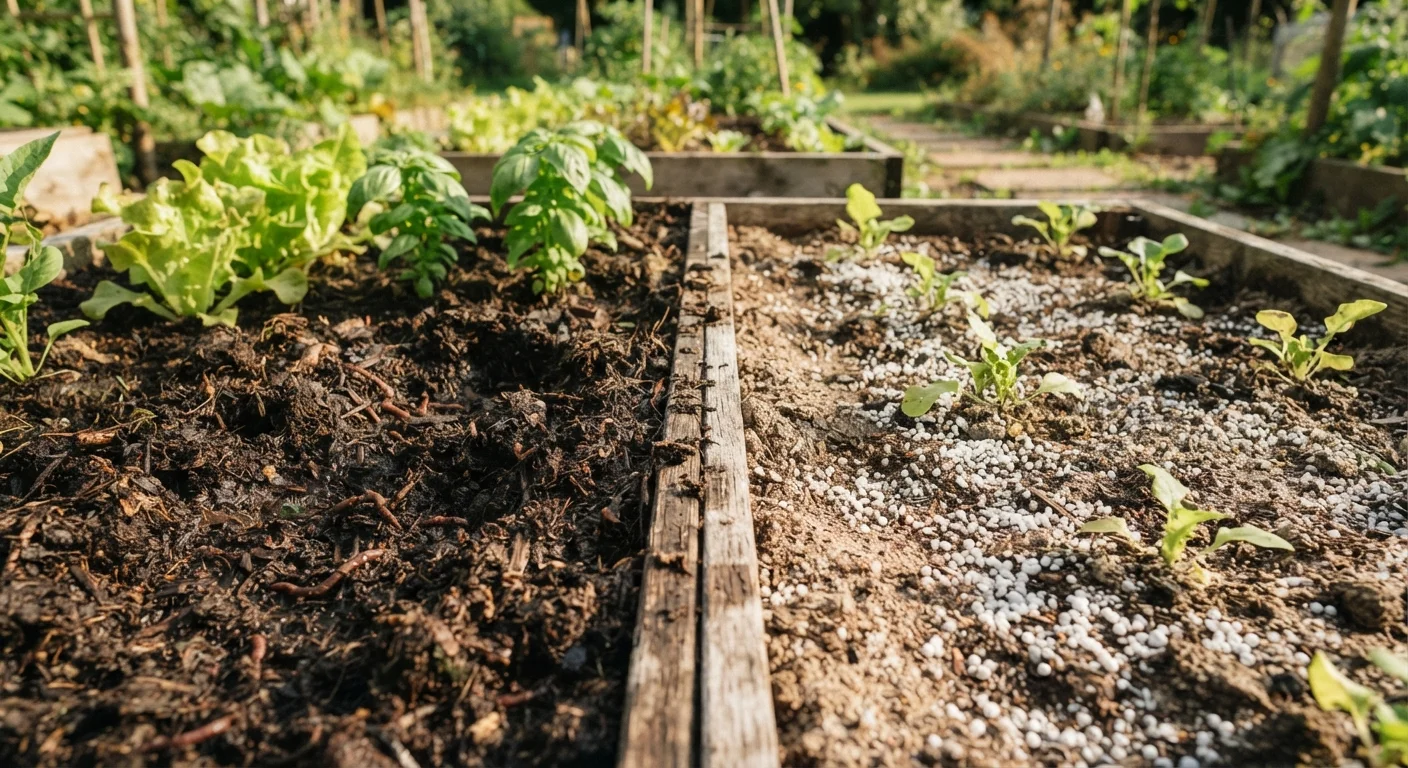
Organic fertilizers — including compost, blood meal, bone meal, kelp, and composted manure — are derived from once-living materials. Their nutrients are bound in complex organic molecules that plants cannot absorb directly. Soil bacteria and fungi must first break these materials down, releasing nutrients gradually in plant-available forms. This means organic fertilizers are slow-acting by nature, but they also feed and support the microbial communities that make healthy soil function.
Synthetic fertilizers are manufactured to deliver nutrients — primarily nitrogen (N), phosphorus (P), and potassium (K) — in mineral salt forms that dissolve quickly in water and become immediately available to roots. There's no waiting period. A nitrogen-deficient lawn or container plant can show visible improvement within days of a synthetic application.
Understanding this mechanism matters because it shapes everything downstream: how often you apply, what happens to your soil over time, and what risks come with misuse.
Effects on Soil Health Over Time
Soil is not just a medium that holds plant roots — it's a living ecosystem of bacteria, fungi, earthworms, and other organisms. Fertilizer choices influence that ecosystem in measurable ways.
Regular use of organic inputs tends to improve soil structure over time. Organic matter binds soil particles into aggregates, improving drainage in clay soils and water retention in sandy ones. The microbes doing the decomposition work also produce compounds that bind nutrients to soil particles, reducing leaching.
Synthetic fertilizers, used correctly, don't inherently destroy soil biology. However, overuse is a real risk. High concentrations of soluble salts can harm microbial communities and, in severe cases, chemically burn plant roots. Because synthetic fertilizers contribute little to no organic matter, soils that rely on them exclusively can degrade in structure and biological activity over years.
Start With a Soil Test
Before investing in any fertilizer — organic or synthetic — a basic soil test reveals your soil's pH, nutrient levels, and organic matter content. Many state university extension services offer low-cost testing kits. Knowing what your soil actually needs prevents waste, protects plants from over-feeding, and helps you choose the right product for the right reason.
For gardeners planning long-term perennial beds or kitchen gardens, understanding how different plant types use nutrients can help you decide which feeding approach supports your specific planting goals.
Nutrient Availability and Application Differences
| Organic Fertilizers | Synthetic Fertilizers | |
|---|---|---|
| Nutrient release speed | Slow (weeks to months) | Fast (hours to days) |
| Soil biology impact | Feeds and supports microbes | Neutral to negative at high rates |
| Soil structure improvement | Builds structure over time | Little to no contribution |
| Nutrient precision | Variable, harder to target | Precise, labeled N-P-K ratios |
| Runoff risk | Generally lower | Higher if over-applied |
| Cost per application | Variable; often higher upfront | Generally lower upfront |
| Best use scenario | Long-term bed building | Quick deficiency correction |
One practical consideration is how each fertilizer type behaves in different conditions. Organic fertilizers require soil temperatures above roughly 50°F for microbial activity to release nutrients — applying them to cold soil in early spring yields little immediate benefit. Synthetic fertilizers work regardless of soil biology and are effective as soon as they dissolve.
Precision also differs significantly. Synthetic fertilizers list exact N-P-K ratios on the package, letting gardeners target specific deficiencies identified through a soil test. Organic products vary more in their nutrient content and release rates, making precision harder, though this variability matters less when building overall soil fertility rather than correcting acute deficiencies.
Environmental Considerations Worth Understanding
Both fertilizer types carry environmental trade-offs that gardeners should understand before applying anything near waterways, slopes, or areas prone to runoff.
Nitrogen and phosphorus from synthetic fertilizers — particularly when over-applied or applied before rain — can run off into streams and groundwater. This is a well-documented driver of algal blooms in freshwater systems. Because synthetic nutrients are immediately soluble, they move with water quickly.
Organic fertilizers release nutrients more slowly, which generally reduces runoff risk. However, some high-nitrogen organic products like fresh manure can still contribute to nutrient runoff if applied in large quantities on wet or compacted soil.
More Fertilizer Is Not Always Better
Over-fertilizing is one of the most common gardening mistakes. Excess nitrogen, in particular, can produce lush foliage at the expense of flowers and fruit, weaken plant cell walls, and create conditions favorable to pests and disease. Always follow application rate guidelines and factor in what's already in your soil before adding more.
Regardless of which fertilizer type you use, a soil test before applying anything is the most effective way to avoid over-fertilization. Most university extension programs offer affordable soil testing that identifies exactly what your soil needs — and what it doesn't.
When to Use Each — and When to Combine Them
In practice, the organic-versus-synthetic decision is often less binary than gardening debates suggest.
Organic fertilizers make strong sense as a foundational practice for most garden beds — applied as compost or slow-release amendments in fall or early spring to build soil over seasons. Synthetics have a practical role in situations where speed genuinely matters: correcting a confirmed iron or nitrogen deficiency mid-season, supporting heavy-feeding crops during peak growth, or maintaining container plants that have limited soil volume.
Many experienced gardeners use organic inputs as their baseline and reach for synthetic options strategically rather than routinely. This hybrid approach captures the soil-building benefits of organics while retaining the precision and responsiveness of synthetics when conditions call for them.
A few practical guidelines:
- Test your soil before the season begins — amendments are far more effective when targeted.
- For vegetable gardens, prioritize building organic matter year over year; it pays compounding dividends.
- Follow label rates on synthetic fertilizers carefully; more is rarely better and often harmful.
- When in doubt, under-fertilize and observe — most fertilizer problems come from excess, not deficiency.